State Statute Law For Trespassing
Description
Get your form ready online
Our built-in tools help you complete, sign, share, and store your documents in one place.
Make edits, fill in missing information, and update formatting in US Legal Forms—just like you would in MS Word.
Download a copy, print it, send it by email, or mail it via USPS—whatever works best for your next step.
Sign and collect signatures with our SignNow integration. Send to multiple recipients, set reminders, and more. Go Premium to unlock E-Sign.
If this form requires notarization, complete it online through a secure video call—no need to meet a notary in person or wait for an appointment.
We protect your documents and personal data by following strict security and privacy standards.

Make edits, fill in missing information, and update formatting in US Legal Forms—just like you would in MS Word.

Download a copy, print it, send it by email, or mail it via USPS—whatever works best for your next step.

Sign and collect signatures with our SignNow integration. Send to multiple recipients, set reminders, and more. Go Premium to unlock E-Sign.

If this form requires notarization, complete it online through a secure video call—no need to meet a notary in person or wait for an appointment.

We protect your documents and personal data by following strict security and privacy standards.
Looking for another form?






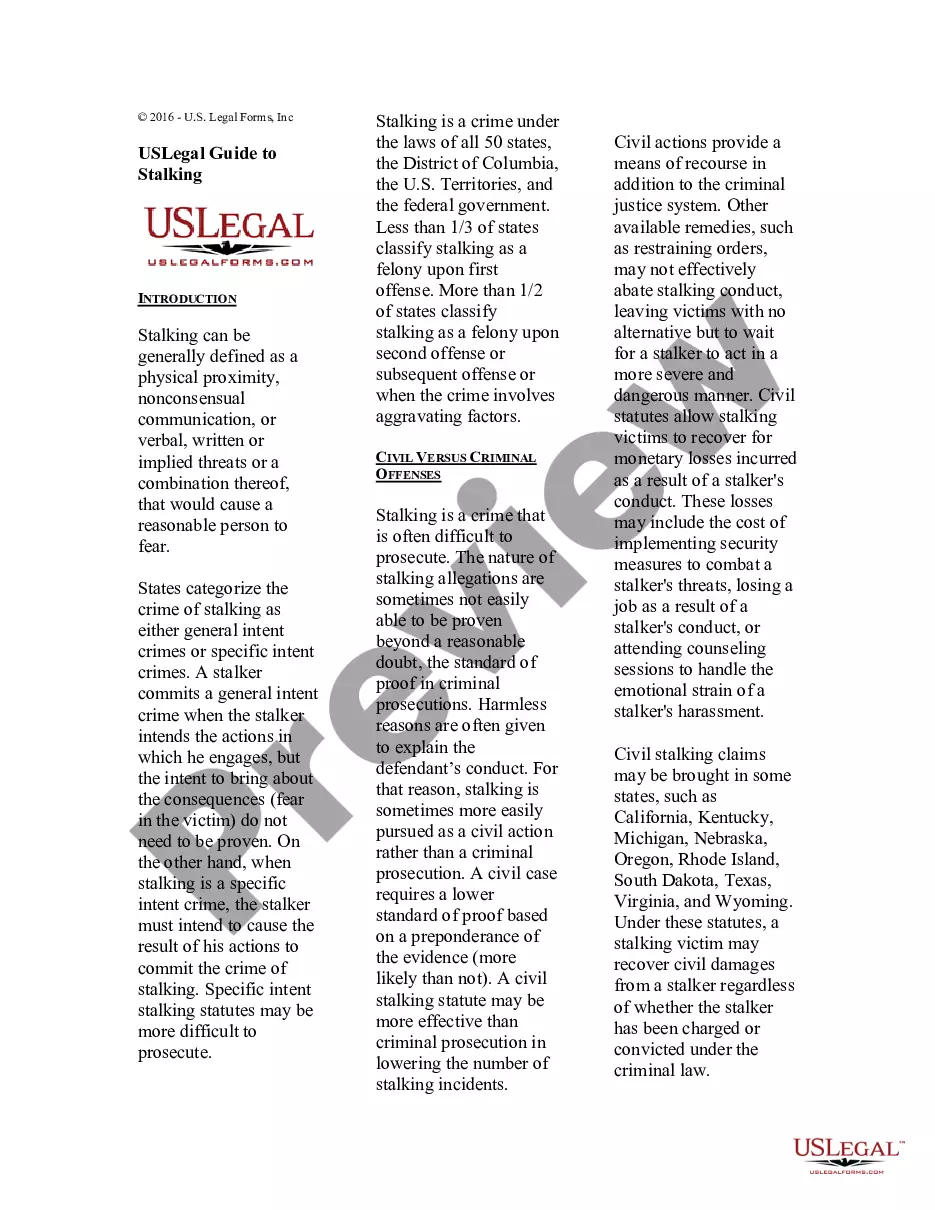
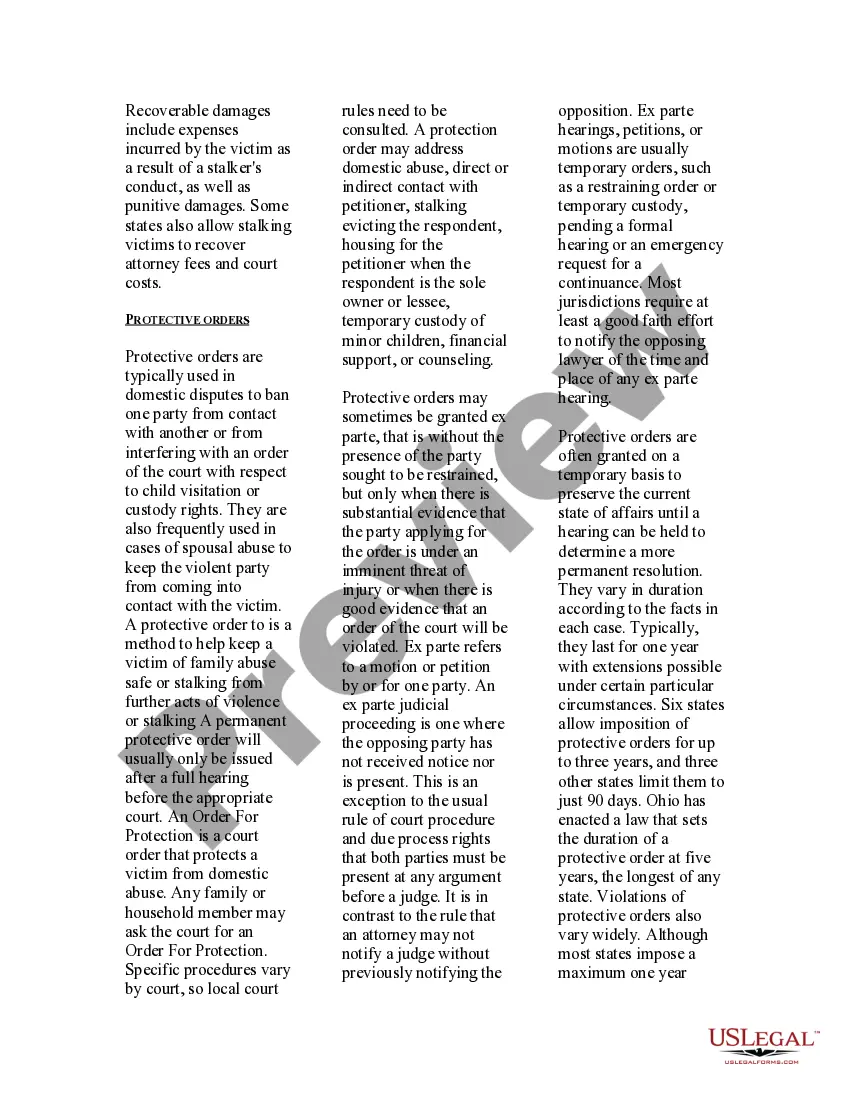
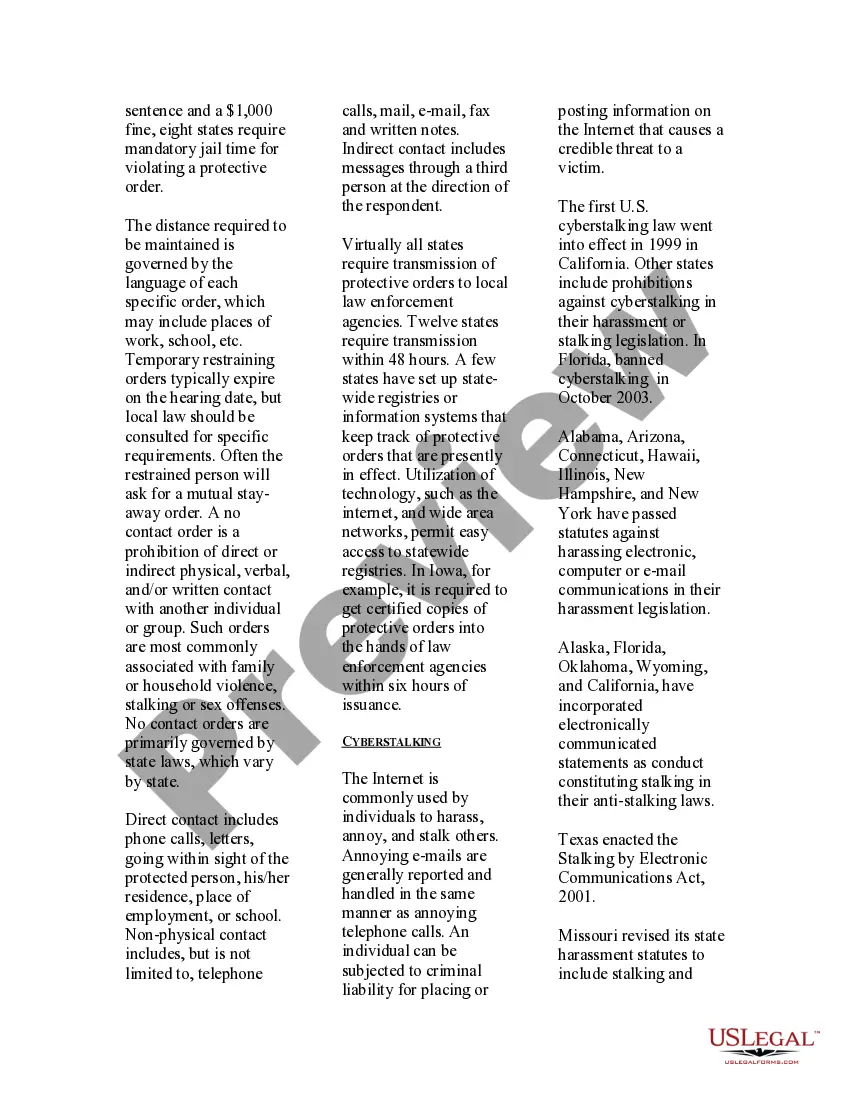
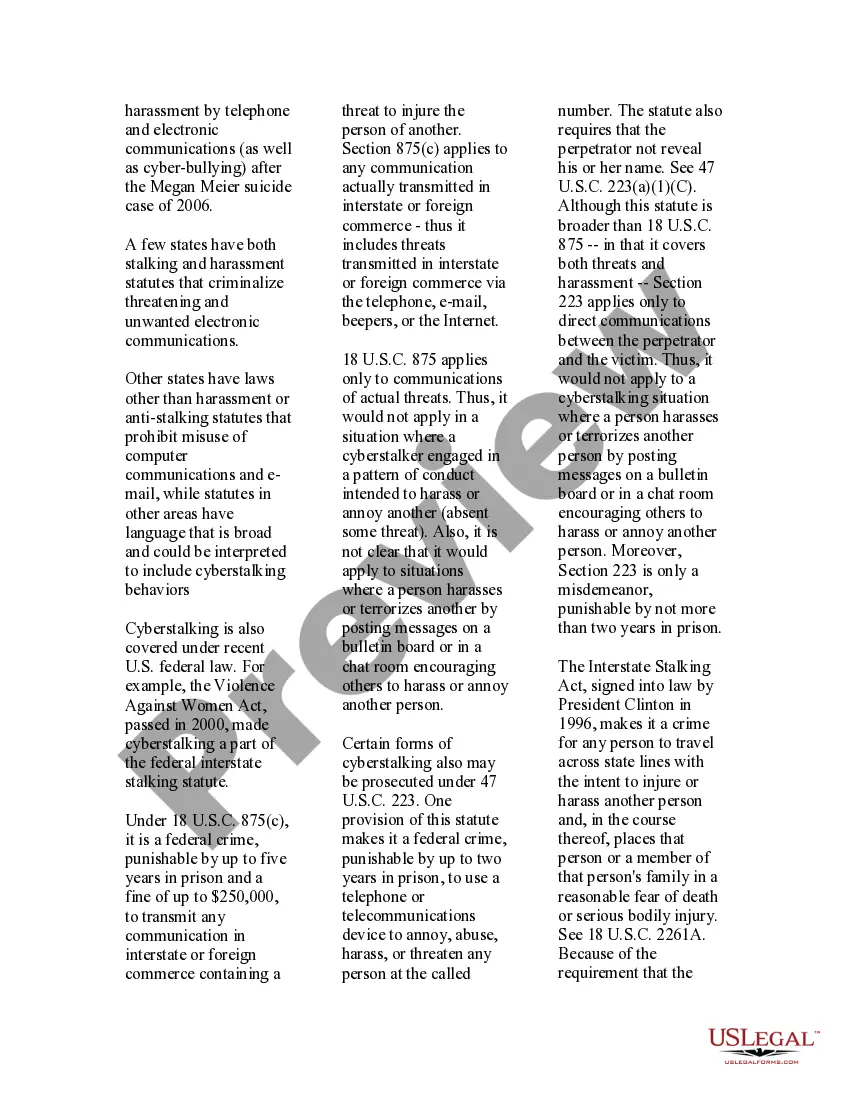
How to fill out USLegal Guide To Stalking?
Handling legal documents and procedures could be a time-consuming addition to the day. State Statute Law For Trespassing and forms like it typically require you to search for them and understand the way to complete them correctly. Consequently, if you are taking care of financial, legal, or individual matters, having a thorough and convenient web library of forms at your fingertips will greatly assist.
US Legal Forms is the number one web platform of legal templates, featuring more than 85,000 state-specific forms and numerous tools that will help you complete your documents quickly. Check out the library of appropriate documents open to you with just a single click.
US Legal Forms provides you with state- and county-specific forms available at any moment for downloading. Protect your papers management operations with a high quality support that lets you make any form in minutes without any additional or hidden cost. Simply log in to the profile, identify State Statute Law For Trespassing and download it straight away from the My Forms tab. You may also access formerly downloaded forms.
Is it your first time using US Legal Forms? Sign up and set up up an account in a few minutes and you will get access to the form library and State Statute Law For Trespassing. Then, follow the steps below to complete your form:
- Be sure you have found the right form using the Review option and looking at the form information.
- Select Buy Now once all set, and choose the subscription plan that is right for you.
- Select Download then complete, eSign, and print the form.
US Legal Forms has 25 years of expertise supporting users control their legal documents. Obtain the form you need today and enhance any process without breaking a sweat.
Form popularity
FAQ
To be found guilty of first-degree trespass, a person must have entered or remained on the property or building of another that was secured or enclosed in a manner that showed the owner's intent to keep out intruders. This is a Class 2 misdemeanor with a possible sentence of up to 60 days in jail and a $1,000 fine.
Trespassing is covered under Virginia Code Section § 18.2-119 and is entitled Trespass after having been forbidden to do so. Trespassing is a class one misdemeanor which carries the potential for 12 months in jail, a $2500 fine, and an order prohibiting you from entering onto the property again.
(1) Whoever, without being authorized, licensed, or invited, willfully enters or remains in any structure or conveyance, or, having been authorized, licensed, or invited, is warned by the owner or lessee of the premises, or by a person authorized by the owner or lessee, to depart and refuses to do so, commits the ...
Anyone who trespasses in a conveyance or structure commits a second-degree misdemeanor which is punishable up to 60 days in jail and a $500 fine. The trespass can be enhanced to a first-degree misdemeanor by the individual trespassing while another person was inside the structure or vehicle.
Anyone who trespasses in a conveyance or structure commits a second-degree misdemeanor which is punishable up to 60 days in jail and a $500 fine. The trespass can be enhanced to a first-degree misdemeanor by the individual trespassing while another person was inside the structure or vehicle.