Flsa Exemption For Law Enforcement
Description
Get your form ready online
Our built-in tools help you complete, sign, share, and store your documents in one place.
Make edits, fill in missing information, and update formatting in US Legal Forms—just like you would in MS Word.
Download a copy, print it, send it by email, or mail it via USPS—whatever works best for your next step.
Sign and collect signatures with our SignNow integration. Send to multiple recipients, set reminders, and more. Go Premium to unlock E-Sign.
If this form requires notarization, complete it online through a secure video call—no need to meet a notary in person or wait for an appointment.
We protect your documents and personal data by following strict security and privacy standards.

Make edits, fill in missing information, and update formatting in US Legal Forms—just like you would in MS Word.

Download a copy, print it, send it by email, or mail it via USPS—whatever works best for your next step.

Sign and collect signatures with our SignNow integration. Send to multiple recipients, set reminders, and more. Go Premium to unlock E-Sign.

If this form requires notarization, complete it online through a secure video call—no need to meet a notary in person or wait for an appointment.

We protect your documents and personal data by following strict security and privacy standards.
Looking for another form?


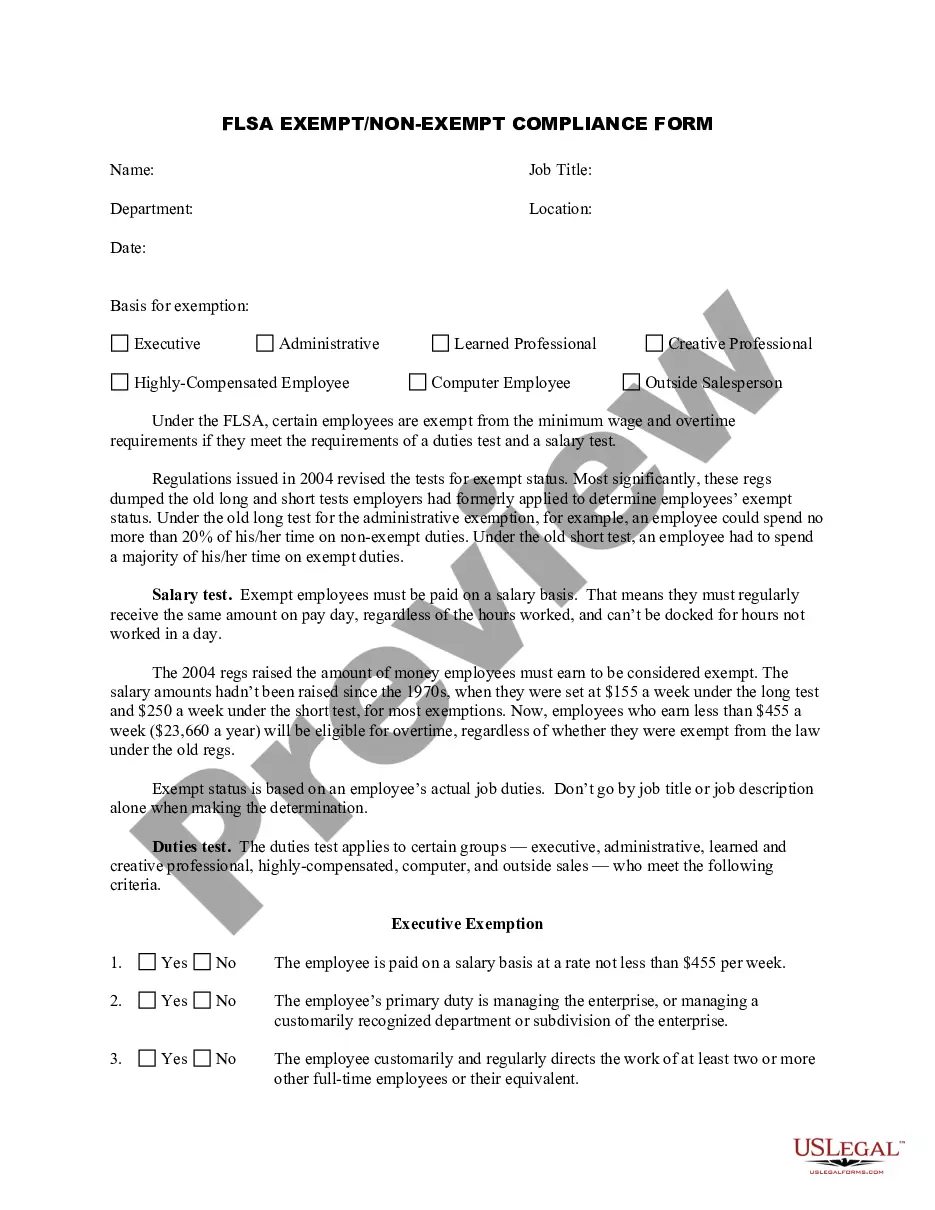
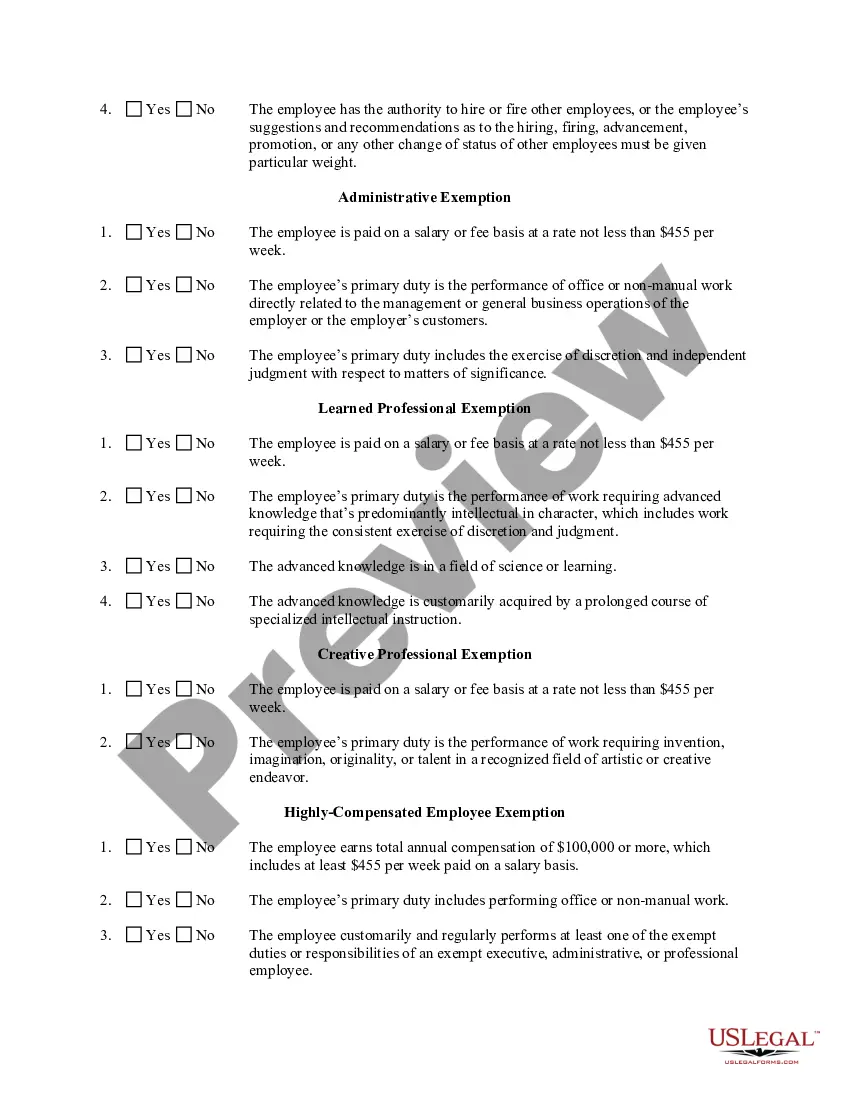
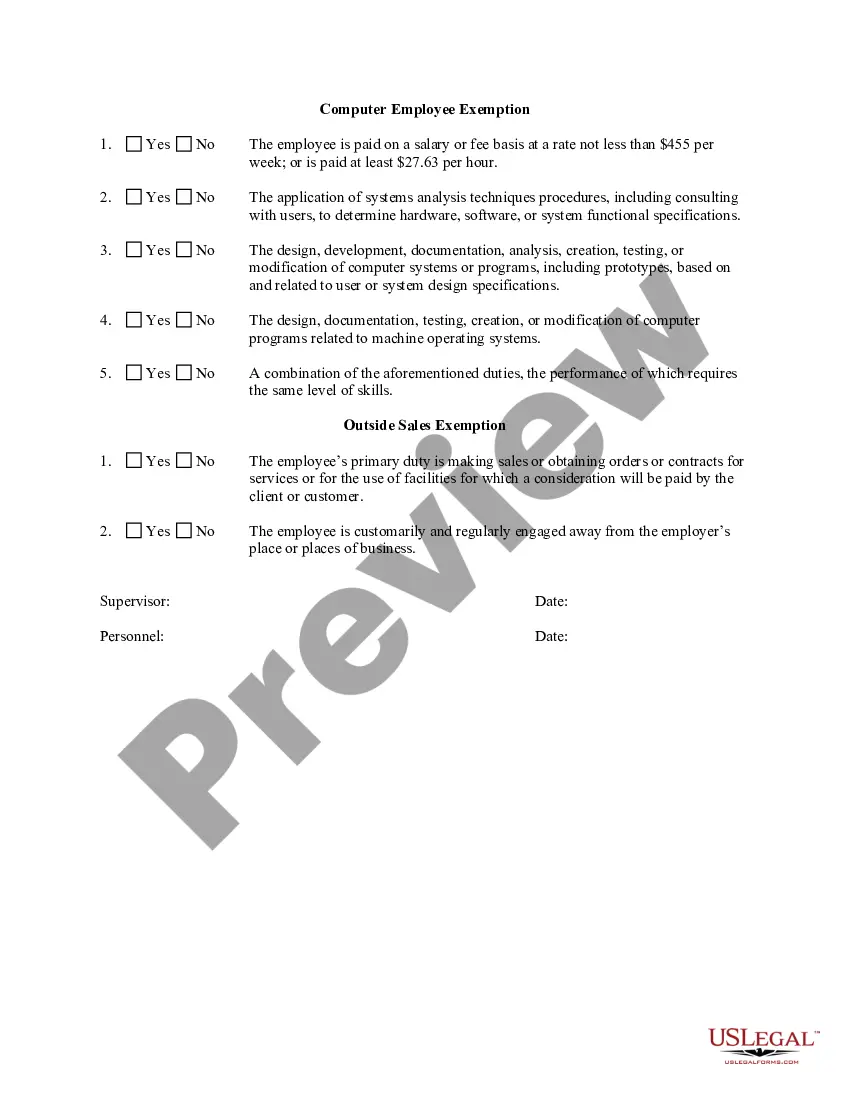
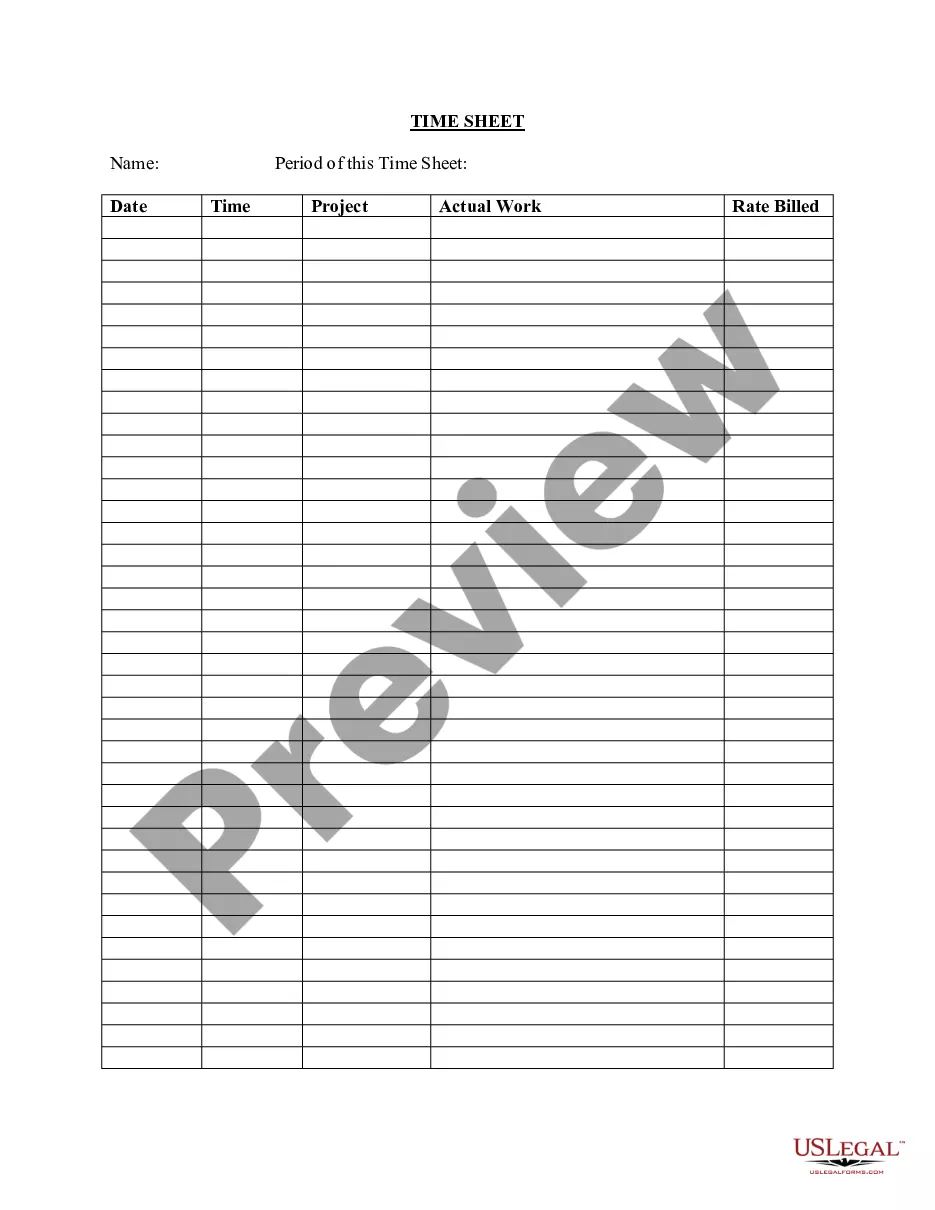
How to fill out FLSA Exempt / Nonexempt Compliance Form?
Regardless of whether for corporate objectives or personal matters, everyone must confront legal circumstances at some stage in their existence. Completing legal documents necessitates meticulous focus, starting from selecting the appropriate form template.
For instance, if you choose an incorrect version of the Flsa Exemption For Law Enforcement, it will be rejected upon submission. Therefore, it is vital to find a reliable source for legal paperwork like US Legal Forms.
With a comprehensive US Legal Forms catalog available, you don’t need to invest time searching for the appropriate template across the web. Make use of the library’s straightforward navigation to find the correct template for any situation.
- Obtain the template you require by utilizing the search bar or catalog navigation.
- Review the form’s details to ensure it aligns with your situation, state, and county.
- Click on the form’s preview to examine it.
- If it is the wrong document, return to the search feature to find the Flsa Exemption For Law Enforcement sample you need.
- Download the file if it fits your requirements.
- If you already possess a US Legal Forms profile, click Log in to access previously saved files in My documents.
- In case you have not established an account yet, you can acquire the form by clicking Buy now.
- Choose the appropriate pricing option.
- Complete the profile registration form.
- Select your payment method: use a credit card or PayPal account.
- Pick the document format you desire and download the Flsa Exemption For Law Enforcement.
- Once downloaded, you can either fill out the form using editing software or print it and complete it by hand.
Form popularity
FAQ
Determining whether an employee is exempt or nonexempt under the FLSA involves evaluating three main factors. Firstly, the type of work performed is crucial; the employee's tasks must align with exempt classifications. Secondly, the method of compensation plays a vital role; salaried employees often qualify for exemptions, while hourly workers typically do not. Lastly, responsibilities and duties must reflect the level of discretion and judgment required for the position. Understanding these factors helps law enforcement agencies classify their employees correctly.
To qualify for an FLSA exemption for law enforcement, three key tests must be satisfied. First, the employee's primary duty must involve law enforcement activities. Second, the employee must receive a predetermined salary that meets the minimum threshold. Lastly, the employee's responsibilities should predominantly require discretion and independent judgment. Meeting these criteria ensures that law enforcement professionals can effectively serve their communities while enjoying the benefits associated with their exemption status.
To become exempt from the FLSA, you must meet specific criteria set by the law. For law enforcement professionals, this may involve taking on certain job responsibilities or meeting defined salary thresholds. Understanding the nuances of the FLSA exemption for law enforcement can be complex, but you can find valuable information and documentation through uslegalforms. This platform can assist you in navigating the process, ensuring compliance while maximizing your benefits.
The Fair Labor Standards Act (FLSA) does not apply to certain employees, including those who work in specific government roles, like law enforcement. Generally, this exclusion happens when employees are covered by other specific compensatory systems or when they are engaged in law enforcement duties. For individuals, the FLSA exemption for law enforcement can provide significant monetary benefits. If you have questions about your role and eligibility, exploring resources on uslegalforms can provide clarity and guidance.
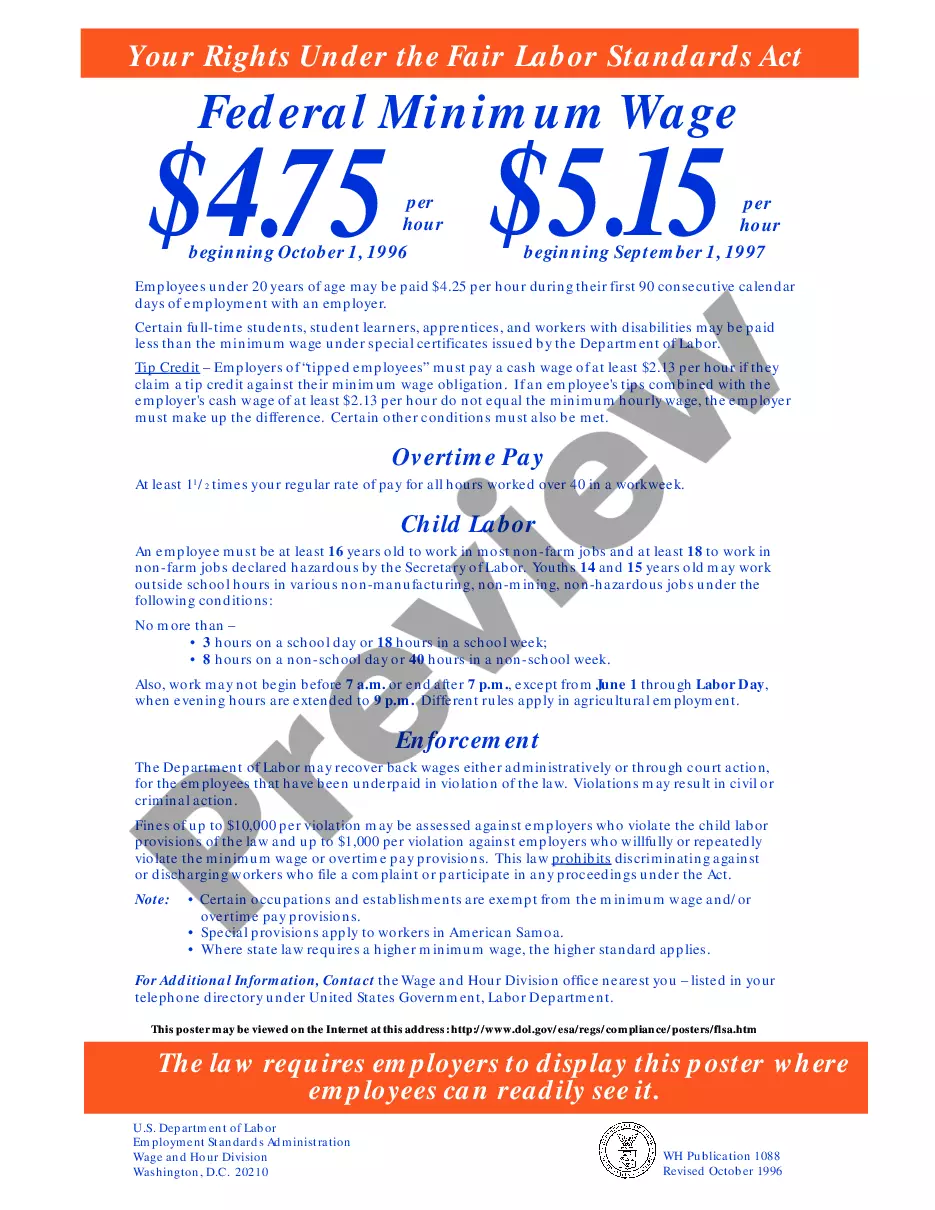
Employees who meet specific criteria related to their job duties and salary may be considered exempt under the FLSA. For law enforcement, this often includes officers who regularly exercise discretion and independent judgment. Understanding these exemptions is essential for both employees and employers to navigate the complexities of labor laws effectively.
Enforcement of the FLSA is primarily carried out by the Wage and Hour Division of the Department of Labor. They investigate complaints and ensure compliance with wage and hour laws, which includes the FLSA exemption for law enforcement. By engaging with experts or legal services, you can address compliance issues effectively and avoid potential pitfalls.
Generally, government agencies are not exempt from federal taxes, but many of their operations are funded by taxpayer dollars. However, certain activities related to law enforcement may receive specific tax exemptions or considerations. It is vital to consult a legal expert to understand how these financial matters interact with the FLSA exemption for law enforcement.
Government agencies are not entirely exempt from FLSA provisions, though some employees within these entities might be subject to special exemptions. Law enforcement agencies, for example, may encounter specific salary thresholds concerning the FLSA exemption for law enforcement. Knowing these details is crucial for both employees and employers when ensuring compliance with wage laws.
The FLSA does apply to the federal government, but with specific stipulations. Federal employees are often covered under different regulations that may provide separate guidance regarding wages and hours. Therefore, it's essential to determine how the FLSA exemption for law enforcement specifically affects federal law enforcement officers in your inquiries.
Government agencies, including law enforcement departments, are not fully exempt from the FLSA; however, certain specific exemptions may apply. Positions within these agencies may be classified differently based on job duties and responsibilities. Understanding these distinctions is important if you’re a law enforcement employee wanting to navigate the implications of the FLSA exemption for law enforcement specifically.