Exempt Vs Non Exempt On W4
Description
Get your form ready online
Our built-in tools help you complete, sign, share, and store your documents in one place.
Make edits, fill in missing information, and update formatting in US Legal Forms—just like you would in MS Word.
Download a copy, print it, send it by email, or mail it via USPS—whatever works best for your next step.
Sign and collect signatures with our SignNow integration. Send to multiple recipients, set reminders, and more. Go Premium to unlock E-Sign.
If this form requires notarization, complete it online through a secure video call—no need to meet a notary in person or wait for an appointment.
We protect your documents and personal data by following strict security and privacy standards.

Make edits, fill in missing information, and update formatting in US Legal Forms—just like you would in MS Word.

Download a copy, print it, send it by email, or mail it via USPS—whatever works best for your next step.

Sign and collect signatures with our SignNow integration. Send to multiple recipients, set reminders, and more. Go Premium to unlock E-Sign.

If this form requires notarization, complete it online through a secure video call—no need to meet a notary in person or wait for an appointment.

We protect your documents and personal data by following strict security and privacy standards.
Looking for another form?
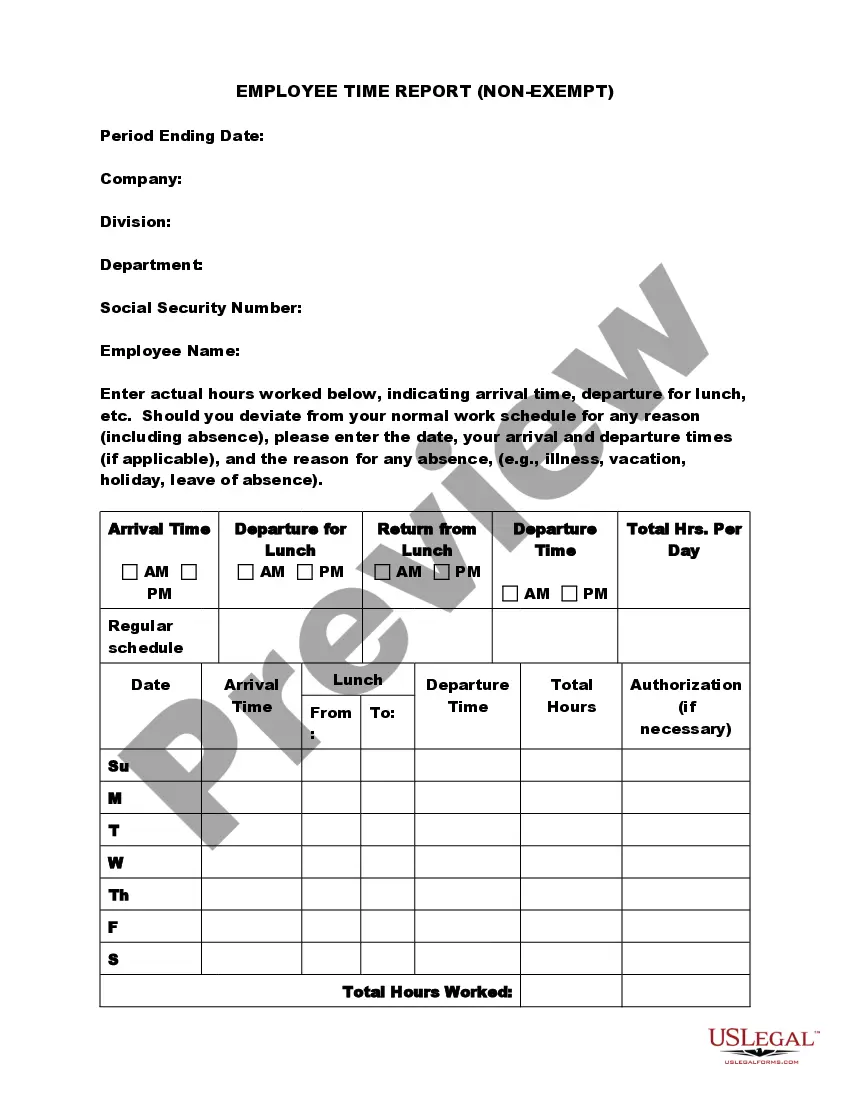
How to fill out Employee Time Report (Nonexempt)?
Regardless of whether it pertains to professional obligations or private matters, everyone inevitably encounters legal circumstances at some point in their life.
Completing legal paperwork requires meticulous care, beginning with choosing the correct form template. For example, selecting an incorrect variant of the Exempt Vs Non Exempt On W4 will result in rejection upon submission.
With an extensive catalog of US Legal Forms available, you no longer need to waste time searching for the correct sample online. Utilize the library's straightforward navigation to discover the suitable template for any given purpose.
- Obtain the required sample using the search bar or browse through the catalog.
- Review the form’s description to ensure it aligns with your situation, jurisdiction, and locality.
- Click on the preview of the form to inspect it.
- If it is not the correct document, return to the search tool to find the Exempt Vs Non Exempt On W4 template you need.
- Acquire the template if it satisfies your requirements.
- If you already possess a US Legal Forms account, simply click Log in to access previously stored templates in My documents.
- In case you do not have an account yet, you can get the form by clicking Buy now.
- Choose the suitable payment option.
- Complete the account registration form.
- Select your method of payment: either credit card or PayPal account.
- Choose the file format you prefer and download the Exempt Vs Non Exempt On W4.
- Once it is saved, you can complete the form using editing software or print it to fill it out by hand.
Form popularity
FAQ
Filling out your W4 correctly involves understanding your filing status, income level, and deductions. Start by entering your personal information, then use the worksheets provided to calculate your allowance based on your tax situation. Knowing the difference between exempt vs non exempt on W4 allows you to make informed decisions about what to enter on the form. For assistance, consider relying on user-friendly platforms like uslegalforms to guide you through the completion process.
When you claim exempt on your W4, you should clearly write 'Exempt' on the designated line, typically found in the section focused on withholding allowances. This informs your employer not to withhold federal income tax from your paychecks. Be aware that understanding exempt vs non exempt on W4 is essential to ensure you qualify to claim this status accurately. Utilizing tools from platforms like uslegalforms can simplify understanding this section.
To claim exempt on your W4 form, you need to write 'Exempt' on the appropriate line of the form and ensure you meet the criteria for exemption. This usually means you had no tax liability last year and expect none this year. Understanding the implications of exempt vs non exempt on W4 helps you navigate this process easily. For clarity on your eligibility, consider using resources like uslegalforms to assist you.
To change your exemption status on your W4, you must fill out a new W4 form and submit it to your employer. Indicate the change in your exemption status clearly so there are no misunderstandings about your withholdings. If you find the concepts of exempt vs non exempt on W4 confusing, platforms like uslegalforms can offer guidance and templates to streamline the process. Make sure to keep your employer informed whenever your financial situation evolves.
You should report your deductions on the W4 form in the appropriate section, typically in the line labeled for any adjustments you wish to make. You can list your deductions if they impact your taxable income to ensure accurate withholding. This is crucial when considering the difference between exempt vs non exempt on W4, as it could influence your tax return. Always ensure you fill out this section truthfully for optimal results.
Deciding whether to put exempt or non-exempt on your W4 should be based on your eligibility. If you qualify for exempt status according to IRS guidelines, you can mark it on your W4 to keep more of your earnings. However, if you are unsure about your tax obligations, it might be safer to choose non-exempt. Understanding the implications of exempt vs non exempt on your W4 can help you maintain financial stability.
The decision to claim exempt or not exempt hinges on your current tax situation. If you do not expect to owe taxes, claiming exempt may benefit you by increasing your disposable income. However, if you foresee tax obligations, you should consider not claiming exempt to avoid year-end surprises. Navigating the exempt vs non exempt on your W4 ensures you choose what's best for you.
Claiming 0 on your W4 typically results in higher withholdings compared to claiming exempt. If you claim 0, more taxes are withheld from each paycheck, which could lead to a larger refund at tax time. However, this varies based on individual financial situations, so consider how each option affects your finances. Comparing exempt vs non exempt on your W4 should guide your decision.
Yes, there can be penalties for incorrectly claiming exempt status on your W4. If you falsely claim exempt and owe taxes at the end of the year, you may face fines and interest charges on your unpaid taxes. Always ensure you meet the criteria before making this claim. Understanding exempt vs non exempt on your W4 is essential for maintaining compliance.
You report exempt status on your W4 by writing 'Exempt' in the designated space on the form. Make sure to also indicate your personal details correctly and confirm that you qualify for this status. It's important to keep a record of your exemption claims in case the IRS requires proof. Clarity in your reporting can streamline the comparison of exempt vs non exempt on your W4.