Working Conditions With Heat
Description
Get your form ready online
Our built-in tools help you complete, sign, share, and store your documents in one place.
Make edits, fill in missing information, and update formatting in US Legal Forms—just like you would in MS Word.
Download a copy, print it, send it by email, or mail it via USPS—whatever works best for your next step.
Sign and collect signatures with our SignNow integration. Send to multiple recipients, set reminders, and more. Go Premium to unlock E-Sign.
If this form requires notarization, complete it online through a secure video call—no need to meet a notary in person or wait for an appointment.
We protect your documents and personal data by following strict security and privacy standards.

Make edits, fill in missing information, and update formatting in US Legal Forms—just like you would in MS Word.

Download a copy, print it, send it by email, or mail it via USPS—whatever works best for your next step.

Sign and collect signatures with our SignNow integration. Send to multiple recipients, set reminders, and more. Go Premium to unlock E-Sign.

If this form requires notarization, complete it online through a secure video call—no need to meet a notary in person or wait for an appointment.

We protect your documents and personal data by following strict security and privacy standards.
Looking for another form?








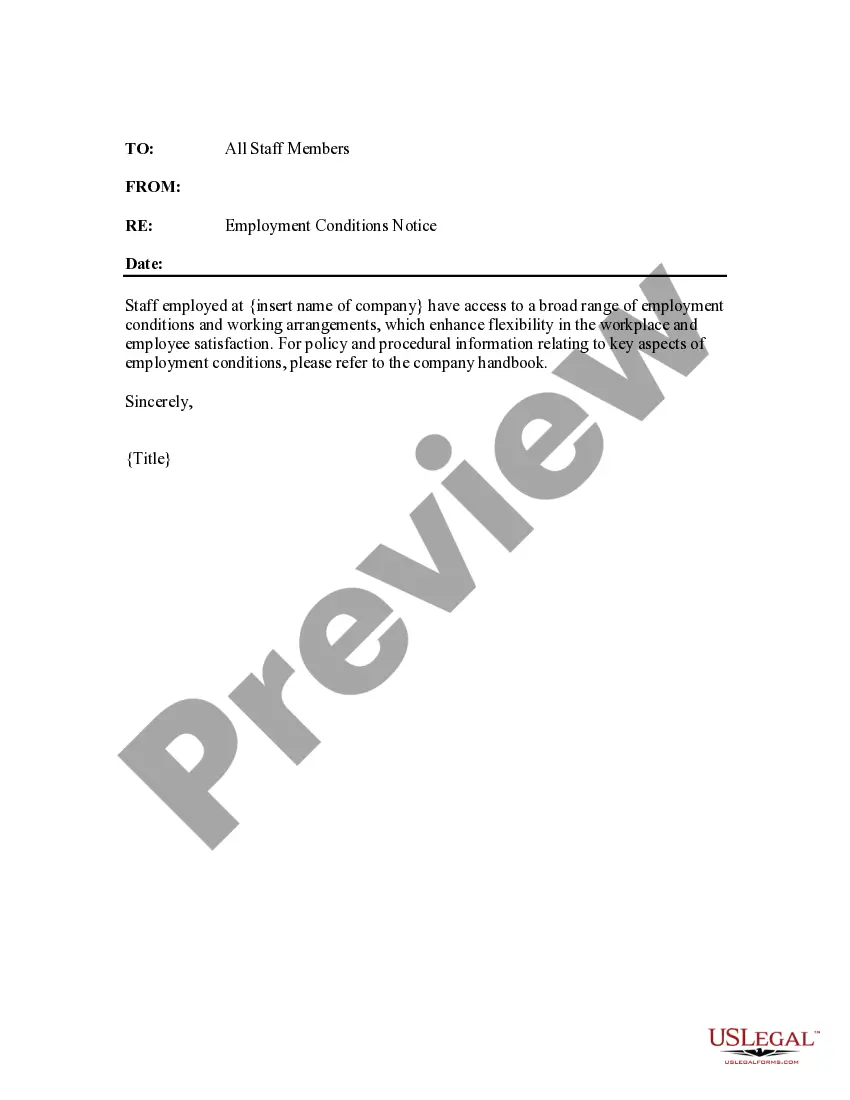
How to fill out Employment Conditions Notice - Notice To Existing Employees Of Flexibility In Working Arrangements?
Creating legal documents from the ground up can occasionally feel a bit daunting.
Some situations may require extensive research and significant financial investment.
If you’re seeking a simpler and more economical method of preparing Working Conditions With Heat or any other forms without having to navigate unnecessary obstacles, US Legal Forms is readily available.
Our online repository of over 85,000 current legal documents encompasses nearly every facet of your financial, legal, and personal issues.
Before proceeding to download Working Conditions With Heat, adhere to these guidelines: Review the document preview and details to ensure you are accessing the proper form. Verify that the template you choose meets the specifications of your state and county. Select the appropriate subscription plan to obtain the Working Conditions With Heat. Download the file, then complete, certify, and print it. US Legal Forms enjoys an impeccable reputation and has over 25 years of experience. Join us now and simplify and streamline the form execution process!
- With just a few clicks, you can promptly access state- and county-specific templates meticulously prepared by our legal specialists.
- Utilize our platform whenever you require a trustworthy and dependable service through which you can swiftly find and download the Working Conditions With Heat.
- If you’re familiar with our services and have set up an account previously, simply Log In to your account, find the form and download it or re-download it anytime in the My documents section.
- Don’t have an account? No worries. It only takes a few minutes to create one and explore the library.
Form popularity
FAQ
Legally, there isn't a specific temperature limit defined for working conditions with heat in all states, but employers must ensure safety practices are in place. If working in conditions above 90 degrees Fahrenheit, certain precautions should be implemented, such as hydration breaks and job rotations. Ultimately, employers bear the responsibility to protect employees from excessive heat. Using resources like US Legal Forms can help clarify employee rights and employer obligations surrounding heat safety.
OSHA emphasizes the importance of managing working conditions with heat to prevent heat-related illnesses. They recommend that employers implement a heat illness prevention program, including training employees to recognize heat stress symptoms. While OSHA does not specify maximum temperatures, they do require employers to provide a safe environment. Regular assessments and adjustments based on working conditions help ensure compliance with safety standards.
Employees have the right to refuse work in dangerous working conditions with heat. Generally, if temperatures exceed 95 degrees Fahrenheit, workers may justifiably stop work to protect their health. It's important to report unsafe conditions to management, as they have a responsibility to ensure a safe workplace. Understand that this refusal should be founded on perceived danger and communicated effectively.
There is no set maximum temperature that is legally defined for all workplaces; the acceptable temperature can depend on various factors. However, OSHA advises employers to consider several elements, like humidity and individual worker conditions, when determining safety. Ultimately, maintaining safe working conditions with heat is the employer's responsibility to ensure worker safety. If you find yourself in a high-temperature situation, remember that your health is the priority.
Yes, you can legally leave work if heat conditions compromise your safety. If you experience symptoms of heat exhaustion or heat stroke, your health takes priority. It is important to communicate your concerns to your employer. Ensuring safe working conditions with heat not only protects you but also promotes a healthier work environment.
The OSHA rule on working in heat emphasizes safe working conditions with heat exposure. Employers must assess the risk of heat-related illnesses and implement measures to protect workers. This includes providing access to water, rest areas, and training on recognizing heat hazards. Understanding these rules is crucial for maintaining safe working conditions with heat.
There is no definitive highest temperature that applies universally for all workplaces in the US. However, if temperatures exceed 100°F in outdoor settings, employers are generally expected to provide adequate cool-down breaks and hydration options. Working conditions with heat should always prioritize employee safety and health. If you're ever in doubt, consulting safety regulations or an expert can provide clarity.
Working conditions with heat become concerning typically at temperatures above 80°F, but the specific threshold can vary by job type and environment. Factors like humidity and individual tolerance play significant roles in how heat affects employees. It's crucial for employers to evaluate their workspaces regularly and enhance heat safety protocols where necessary. Employees should feel empowered to request suitable adjustments.
Yes, you can call OSHA if you believe your workplace's heat conditions are unsafe. OSHA investigates complaints about working conditions with heat and may conduct inspections to ensure compliance with safety regulations. It's essential to document instances of excessive heat exposure to support your claim. Remember, protecting your health is paramount.
Legally, there is no universal maximum temperature for working conditions across the US. However, if your workplace does not provide adequate heat safety measures beyond 95°F, you may have grounds for claiming unsafe conditions. Employers should ensure that working conditions with heat are compliant with OSHA standards. Always prioritize communicating any concerns about extreme temperatures.