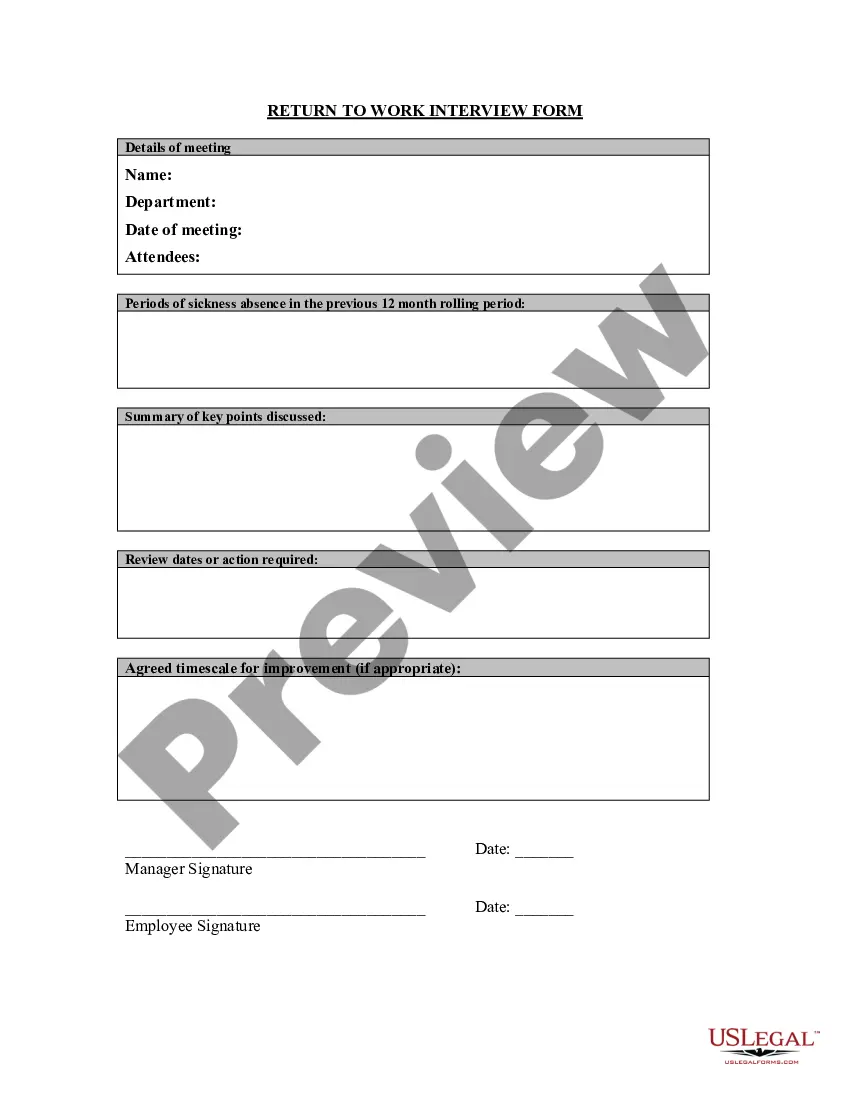
Return To Work Interview Form For Clients
Description

Get your form ready online
Our built-in tools help you complete, sign, share, and store your documents in one place.
Make edits, fill in missing information, and update formatting in US Legal Forms—just like you would in MS Word.
Download a copy, print it, send it by email, or mail it via USPS—whatever works best for your next step.
Sign and collect signatures with our SignNow integration. Send to multiple recipients, set reminders, and more. Go Premium to unlock E-Sign.
If this form requires notarization, complete it online through a secure video call—no need to meet a notary in person or wait for an appointment.
We protect your documents and personal data by following strict security and privacy standards.

Make edits, fill in missing information, and update formatting in US Legal Forms—just like you would in MS Word.

Download a copy, print it, send it by email, or mail it via USPS—whatever works best for your next step.

Sign and collect signatures with our SignNow integration. Send to multiple recipients, set reminders, and more. Go Premium to unlock E-Sign.

If this form requires notarization, complete it online through a secure video call—no need to meet a notary in person or wait for an appointment.

We protect your documents and personal data by following strict security and privacy standards.
Looking for another form?

How to fill out Return To Work Interview Form?
Securing a reliable location to obtain the most up-to-date and suitable legal documents is a significant part of navigating bureaucracy.
Choosing the correct legal paperwork demands precision and meticulousness, which is why it is vital to source samples of the Return To Work Interview Form For Clients exclusively from trusted providers, such as US Legal Forms.
Once you have the form on your device, you can modify it with the editor or print it out for manual completion. Relieve the stress associated with your legal documentation. Explore the extensive US Legal Forms collection where you can locate legal templates, assess their relevance to your needs, and download them immediately.
- Utilize the library navigation or search box to find your template.
- Review the form’s description to determine if it meets the criteria of your state and locality.
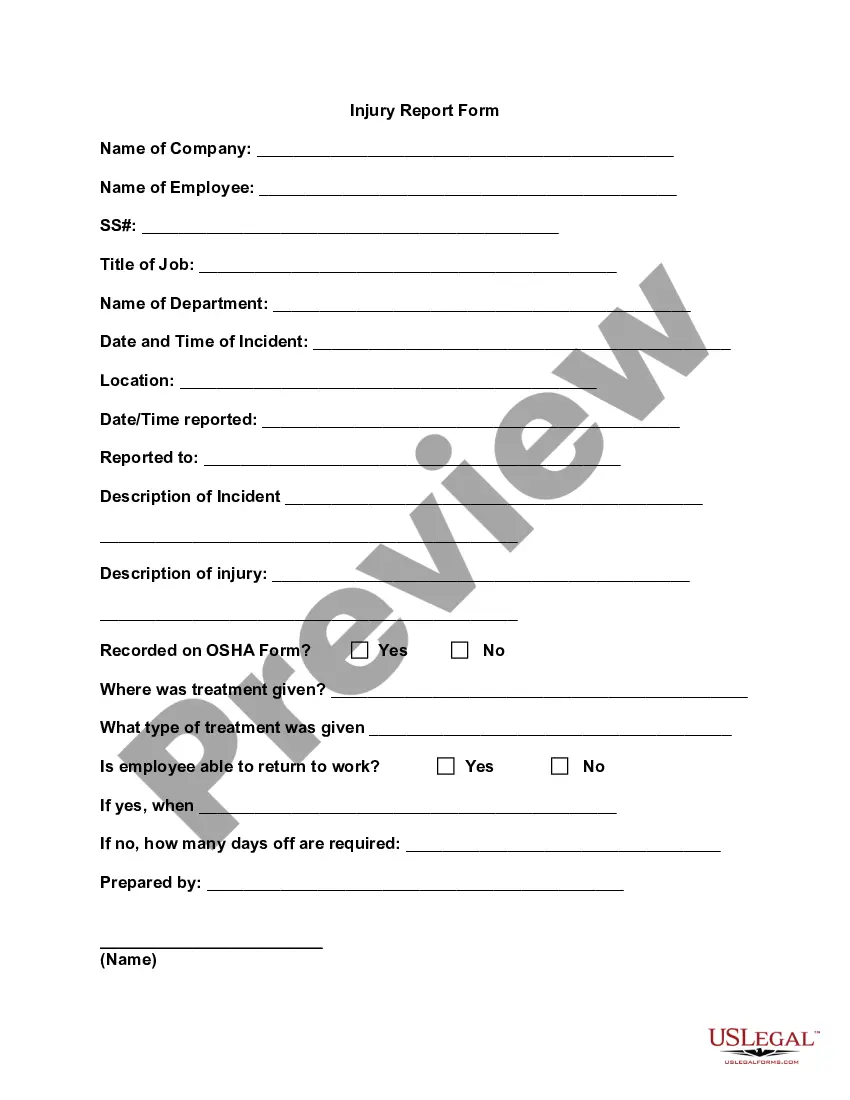
- Access the form preview, if available, to confirm the template is indeed what you require.
- Go back to the search and locate the proper document if the Return To Work Interview Form For Clients does not align with your needs.
- If you are confident about the form’s appropriateness, download it.
- As a registered user, click Log in to verify your identity and access your chosen forms in My documents.
- If you don’t have an account yet, click Buy now to purchase the form.
- Select the pricing option that suits your requirements.
- Proceed with the registration to complete your transaction.
- Conclude your purchase by selecting a payment method (credit card or PayPal).
- Choose the document format for downloading the Return To Work Interview Form For Clients.
Form popularity
FAQ
Talk about any work updates that happened while they were off. see if they need any support. agree on a plan for returning to work, if appropriate, for example a phased return to work. talk about what they would like other employees to know about their absence and what they would like to keep confidential.
Template for your return to work letter Dear Mr/Mrs/Ms [supervisor's name], I'd like to officially notify you of my intention to return to work with [employer] on the [date] and would like said date to be considered the conclusion of my maternity leave.
A phased return to work is when someone who's been absent gradually builds up to returning to work. For example: starting on reduced hours. doing work that is different to their usual job.
How to Write an Effective Return to Work Letter Address the Employee. As with any letter, start by addressing the recipient appropriately. ... Lay out the Reasons for Sending the Letter. ... Explain the Specifics of Their Return. ... Inform Employees of Any Changes to Their Role. ... Outline Policy or Office Changes that Affect Them.
Within the return to work form, managers and employees will need to typically provide details relating to their absence, such as: the duration of absence; the method used by employees to notify of their absence; the reason for absence; details about previous absences over the past calendar year (if applicable);