Work Employee Policy For Pregnancy
Description
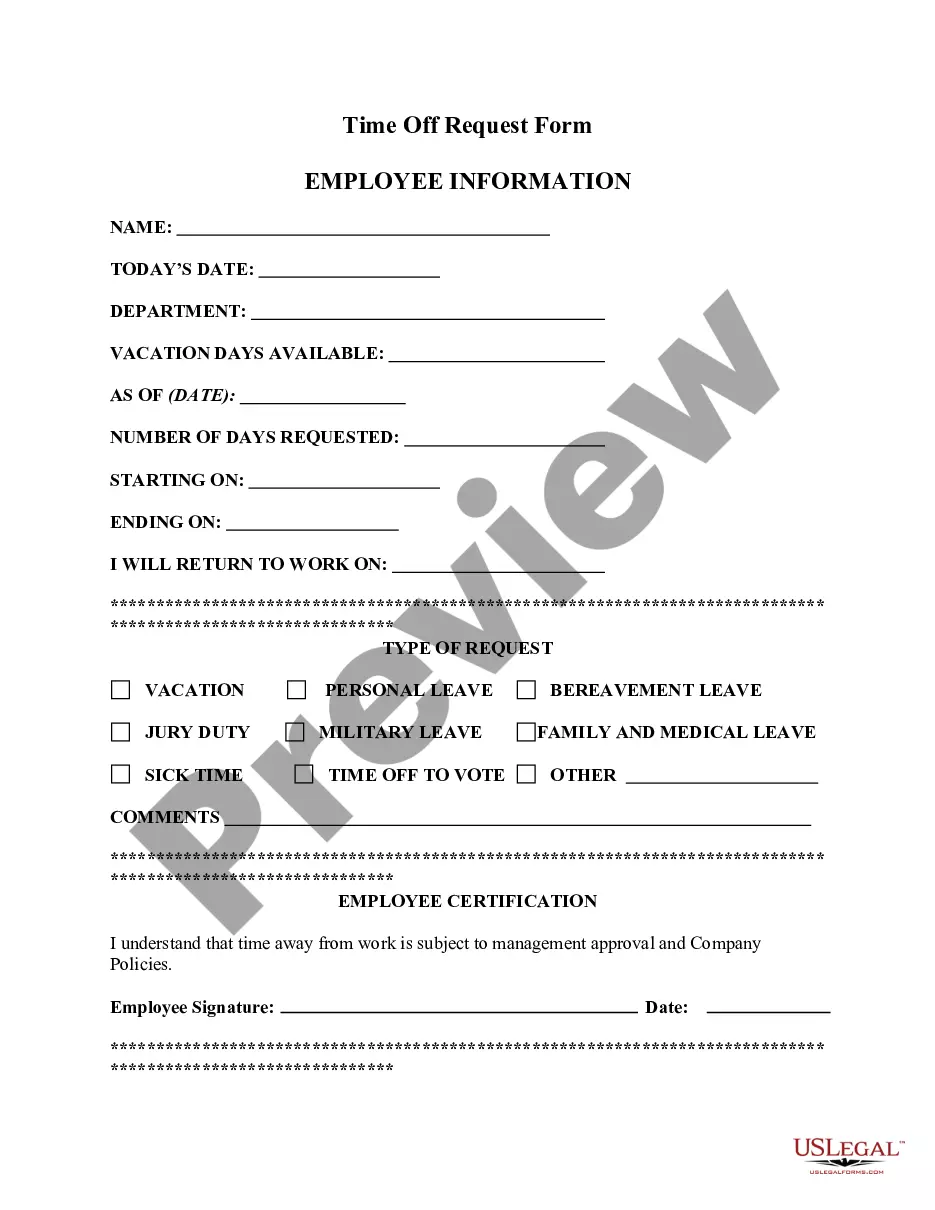

Get your form ready online
Our built-in tools help you complete, sign, share, and store your documents in one place.
Make edits, fill in missing information, and update formatting in US Legal Forms—just like you would in MS Word.
Download a copy, print it, send it by email, or mail it via USPS—whatever works best for your next step.
Sign and collect signatures with our SignNow integration. Send to multiple recipients, set reminders, and more. Go Premium to unlock E-Sign.
If this form requires notarization, complete it online through a secure video call—no need to meet a notary in person or wait for an appointment.
We protect your documents and personal data by following strict security and privacy standards.

Make edits, fill in missing information, and update formatting in US Legal Forms—just like you would in MS Word.

Download a copy, print it, send it by email, or mail it via USPS—whatever works best for your next step.

Sign and collect signatures with our SignNow integration. Send to multiple recipients, set reminders, and more. Go Premium to unlock E-Sign.

If this form requires notarization, complete it online through a secure video call—no need to meet a notary in person or wait for an appointment.

We protect your documents and personal data by following strict security and privacy standards.
Looking for another form?






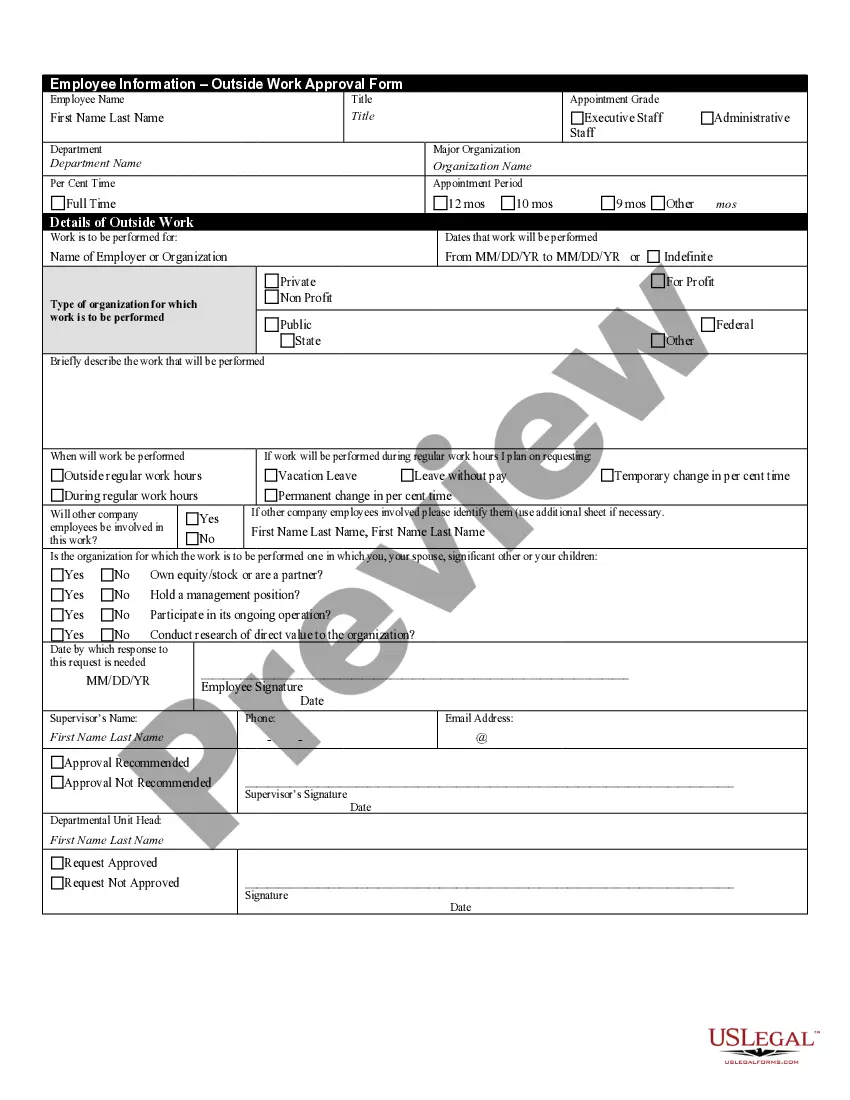
How to fill out Outside Work Approval Form?
Dealing with legal documents and processes can be a lengthy addition to your entire day.
Work Employee Policy For Pregnancy and similar forms typically necessitate you to search for them and figure out how to fill them out accurately.
For that reason, whether you are addressing financial, legal, or personal issues, utilizing a comprehensive and user-friendly online library of forms available will be highly beneficial.
US Legal Forms is the premier online platform for legal templates, featuring over 85,000 state-specific forms and various resources to help you complete your documentation swiftly.
Is this your first time using US Legal Forms? Register and create your account in just a few minutes, and you will gain access to the form library and Work Employee Policy For Pregnancy. Then, follow the steps outlined below to finalize your form: Ensure you have the correct form using the Preview feature and review the form description. Select Buy Now when ready, and choose the monthly subscription plan that suits you best. Click Download, then fill out, sign, and print the form. US Legal Forms boasts twenty-five years of experience helping clients manage their legal paperwork. Locate the form you need today and simplify any task effortlessly.
- Explore the collection of relevant documents accessible to you with just one click.
- US Legal Forms provides you with state- and county-specific forms available for download at any time.
- Protect your document management processes with a top-notch service that allows you to prepare any form in minutes without extra or concealed fees.
- Simply Log In to your account, locate Work Employee Policy For Pregnancy, and obtain it immediately from the My documents section.
- You can also access previously downloaded forms.
Form popularity
FAQ
There is no specific limit on the number of hours a pregnant woman can work, but employers should consider her health and well-being. Many organizations offer flexible scheduling options to accommodate the needs of pregnant employees. A well-crafted Work employee policy for pregnancy will address these considerations, ensuring that employees can balance work and health effectively.
Pregnancy policies in the workplace typically cover maternity leave, health benefits, and accommodations for pregnant employees. These policies should align with federal and state laws to provide adequate support. Reviewing the Work employee policy for pregnancy can help employees understand their rights and the resources available to them during this important time.
The policy for pregnant employees should outline their rights and the support available to them. This may include flexible work hours, maternity leave options, and health benefits. A comprehensive Work employee policy for pregnancy ensures that pregnant employees feel supported and valued in the workplace.
When an employee is pregnant, the employer must inform her about her rights and available benefits. It's crucial for employers to review their Work employee policy for pregnancy to ensure compliance with laws regarding maternity leave and accommodations. Additionally, they should maintain open communication with the employee to discuss her needs during this time.
A pregnant woman has several rights at work, including the right to reasonable accommodations for her condition. Employers must ensure that she is not discriminated against due to her pregnancy. The Work employee policy for pregnancy typically includes protections against unfair treatment and guarantees the right to take maternity leave.
Employers should treat pregnant employees fairly, and assess them on their merits and the requirements of the job. If a decision is taken to dismiss an employee, it must be based on relevant and objective performance criteria, and after a thorough inquiry.
When to tell your boss you're pregnant. Many women tend to wait until after their first trimester to announce their pregnancy at work, for several reasons. Most miscarriages occur during the first 13 weeks of pregnancy,1 so you may prefer to share your news after that timeframe has passed.
Your employer must conduct a risk assessment and remove risks or make alternative arrangements to protect your safety, and your baby's safety, when you are at work. You are entitled to reasonable paid time off to attend ante-natal appointments and classes which are advised by your midwife or medical practitioner.
After 26 weeks: There should be no extended work hours, with a 40-hour week being the maximum for the employee/patient. No travel further than 50 miles is allowed. Lifting is restricted to no more than 20 pounds. No climbing on ladders or stools is allowed.
Dear [name of employer], I am writing to notify you that I am pregnant. Please could you assess any health and safety risks that arise during my pregnancy or that may affect my baby and take reasonable action to remove any risks.