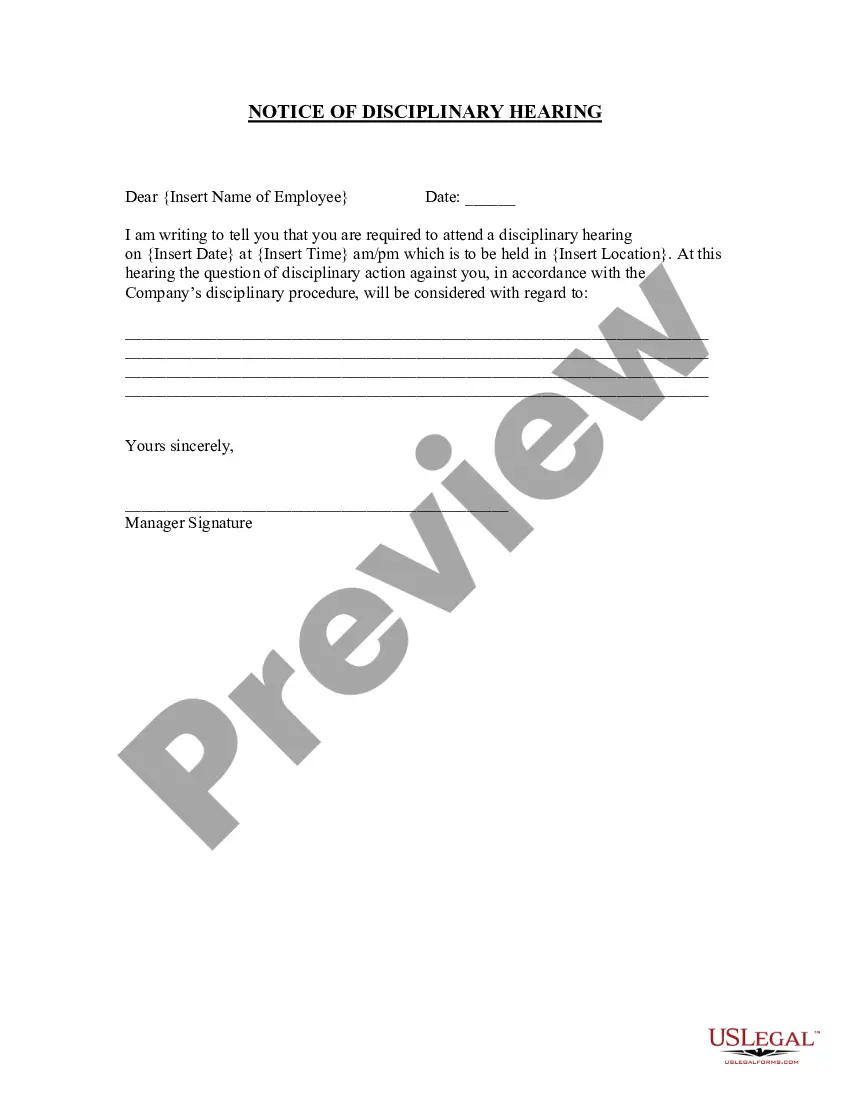
Notice For Disciplinary Hearing
Description
Get your form ready online
Our built-in tools help you complete, sign, share, and store your documents in one place.
Make edits, fill in missing information, and update formatting in US Legal Forms—just like you would in MS Word.
Download a copy, print it, send it by email, or mail it via USPS—whatever works best for your next step.
Sign and collect signatures with our SignNow integration. Send to multiple recipients, set reminders, and more. Go Premium to unlock E-Sign.
If this form requires notarization, complete it online through a secure video call—no need to meet a notary in person or wait for an appointment.
We protect your documents and personal data by following strict security and privacy standards.

Make edits, fill in missing information, and update formatting in US Legal Forms—just like you would in MS Word.

Download a copy, print it, send it by email, or mail it via USPS—whatever works best for your next step.

Sign and collect signatures with our SignNow integration. Send to multiple recipients, set reminders, and more. Go Premium to unlock E-Sign.

If this form requires notarization, complete it online through a secure video call—no need to meet a notary in person or wait for an appointment.

We protect your documents and personal data by following strict security and privacy standards.
Looking for another form?
How to fill out Notice Of Disciplinary Hearing?
Getting a go-to place to take the most current and appropriate legal samples is half the struggle of handling bureaucracy. Choosing the right legal documents demands precision and attention to detail, which is why it is crucial to take samples of Notice For Disciplinary Hearing only from reliable sources, like US Legal Forms. A wrong template will waste your time and delay the situation you are in. With US Legal Forms, you have little to be concerned about. You can access and check all the details about the document’s use and relevance for the situation and in your state or county.
Consider the following steps to complete your Notice For Disciplinary Hearing:
- Utilize the catalog navigation or search field to find your template.
- View the form’s information to check if it suits the requirements of your state and county.
- View the form preview, if available, to make sure the template is the one you are searching for.
- Go back to the search and look for the correct template if the Notice For Disciplinary Hearing does not match your needs.
- If you are positive about the form’s relevance, download it.
- If you are a registered customer, click Log in to authenticate and access your picked forms in My Forms.
- If you do not have an account yet, click Buy now to obtain the template.
- Select the pricing plan that suits your requirements.
- Go on to the registration to finalize your purchase.
- Finalize your purchase by choosing a transaction method (credit card or PayPal).
- Select the file format for downloading Notice For Disciplinary Hearing.
- Once you have the form on your gadget, you may alter it using the editor or print it and finish it manually.
Eliminate the inconvenience that comes with your legal documentation. Check out the comprehensive US Legal Forms library to find legal samples, check their relevance to your situation, and download them immediately.
Form popularity
FAQ
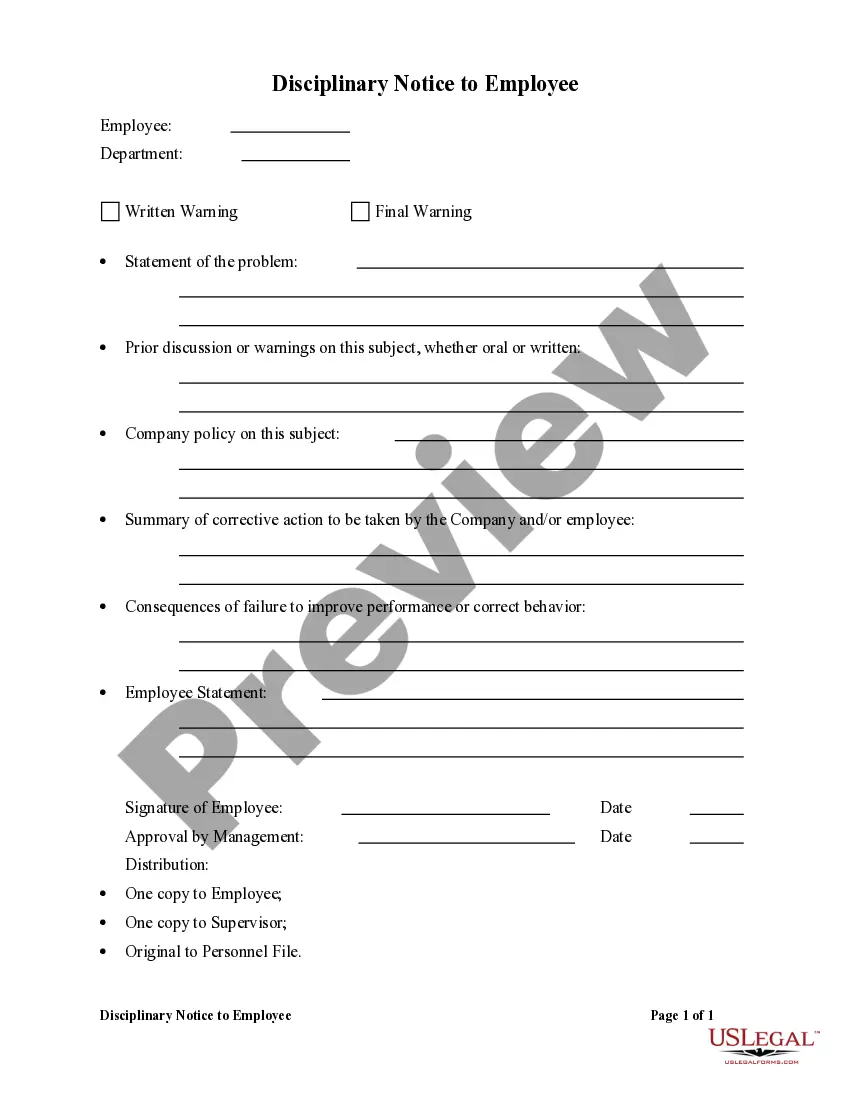
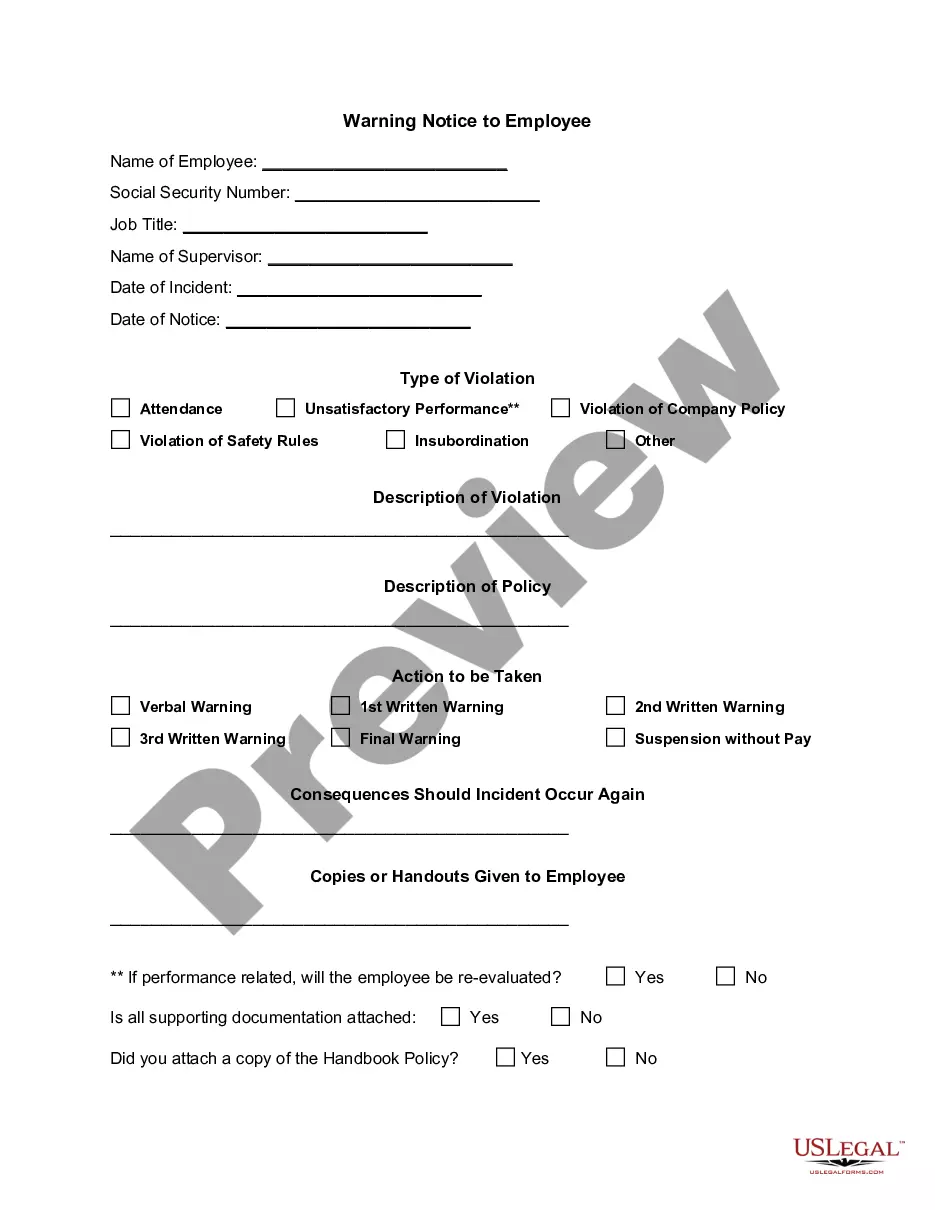
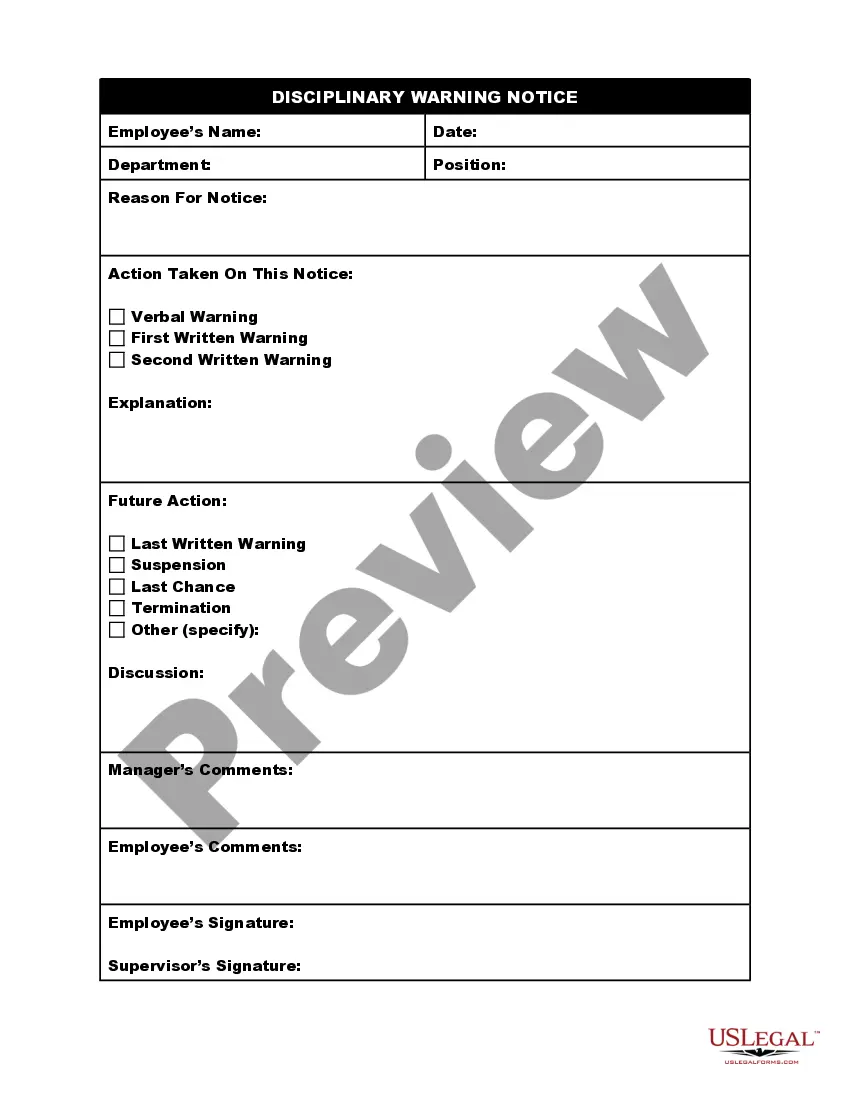
Every disciplinary action form should have these basic section in this general order: Employee information (e.g., name, date notice given, supervisor, etc.). Violation type (e.g., language, rudeness, disobedience, etc.). Violation details (e.g., date, time, and place violation occurred).
There are 4 common ways to challenge your disciplinary decision: Challenge the way the disciplinary action was taken against you. Challenge the evidence on which your employer based their decision. Challenge the decision your employer took. Give new evidence in support of your defence.
What to include in a disciplinary action form First and last name of the employee. Date of the incident. Summary of the issue or event, including witnesses, location, times and dates. Past events or behavior relating to current violation. Employee comments. Corrective actions and dates.
Guideline: Notice of a Disciplinary Hearing If an allegation involves gross misconduct, the allegation should commence with the words ?Gross Misconduct: Item of Disciplinary Code: ?? or ?Gross Misconduct in that you ?? this will alert the employee to the fact that the offence is seen as a serious one.
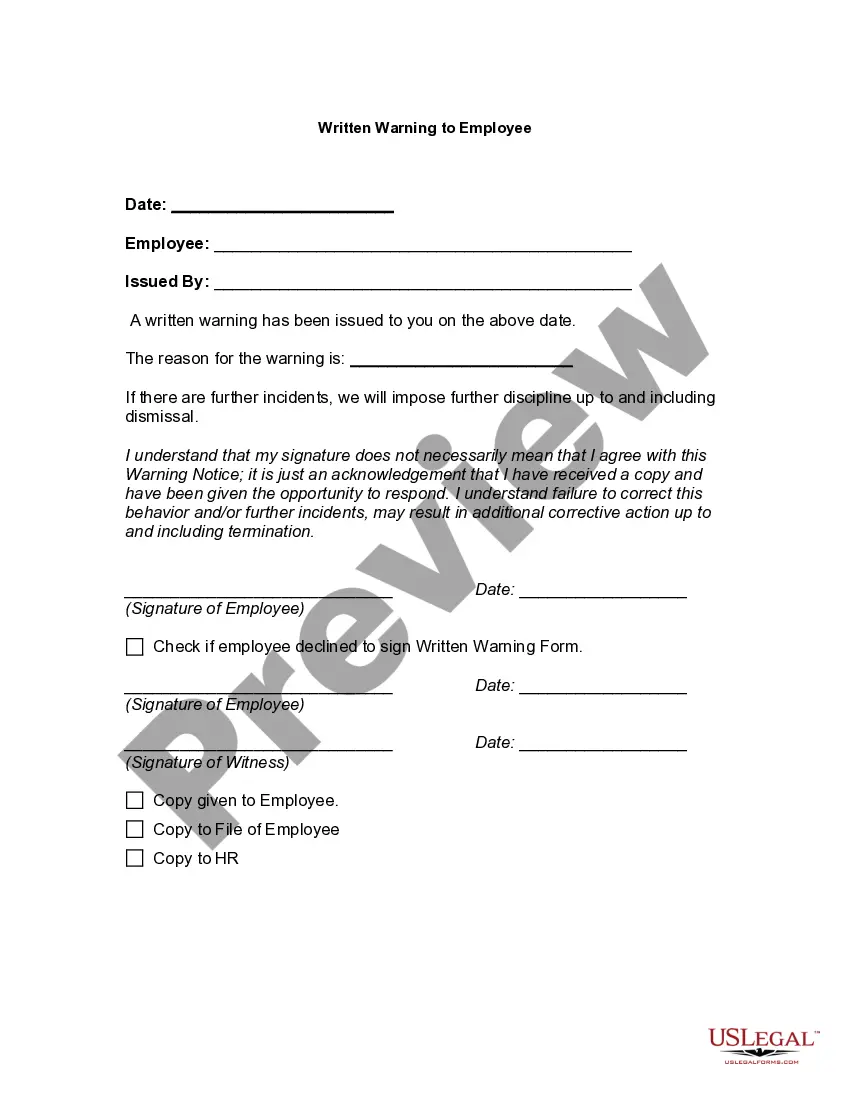
The letter should include clear details about what the behavior was, how it violated company policies, and any consequences that may result from future occurrences. Additionally, it should provide guidance on how the employee can improve their behavior moving forward.