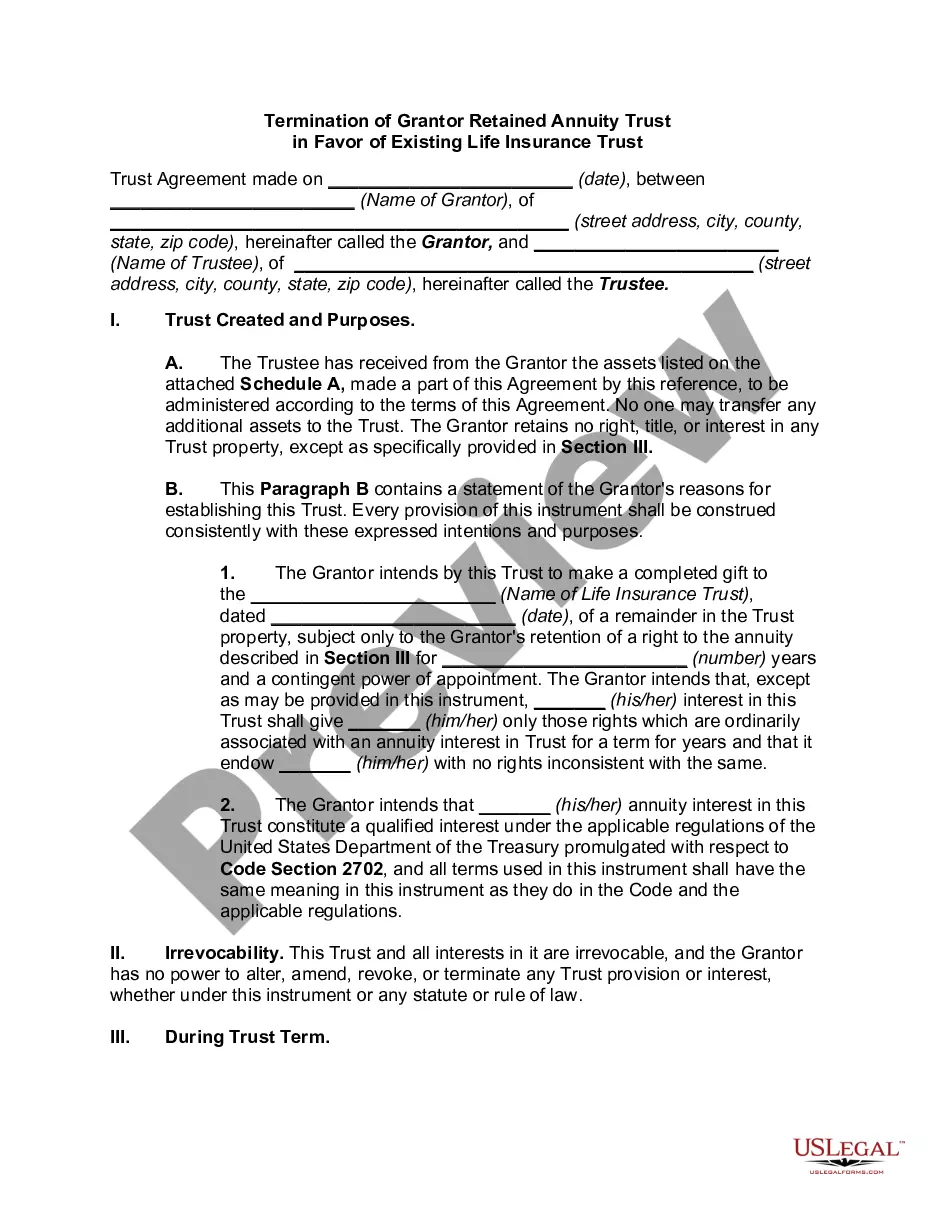
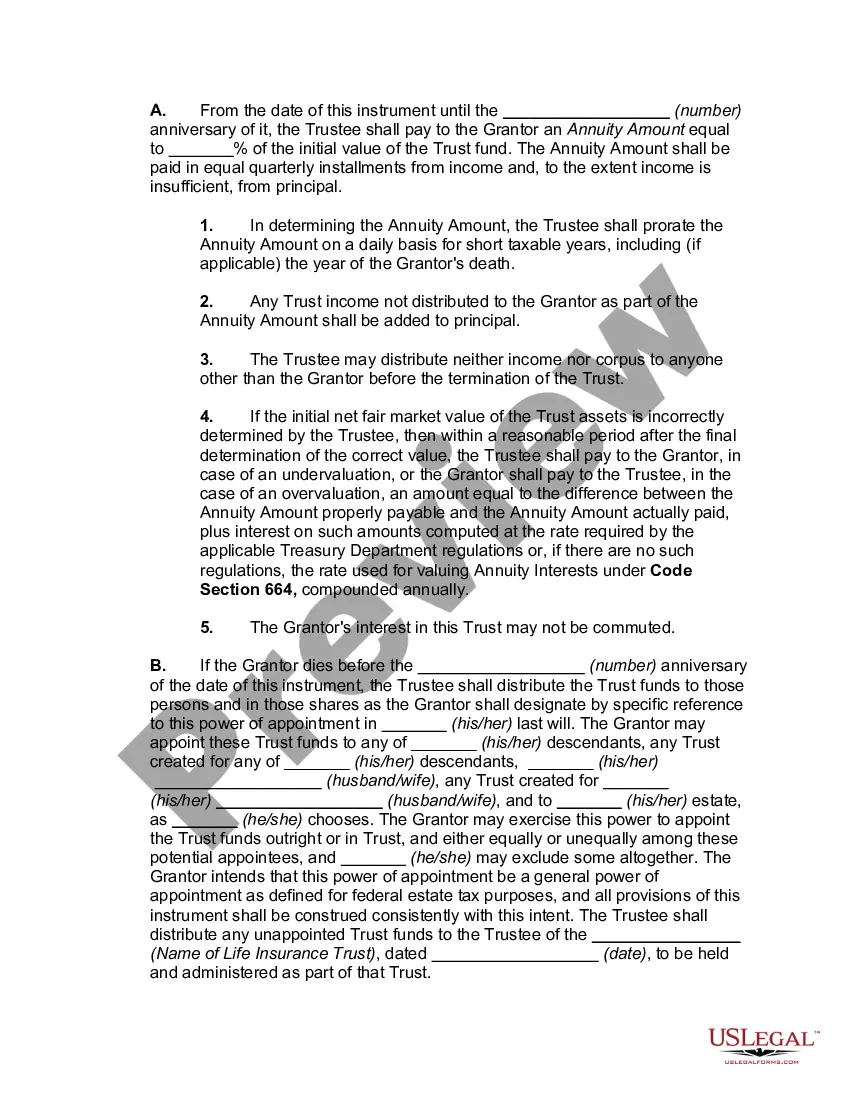
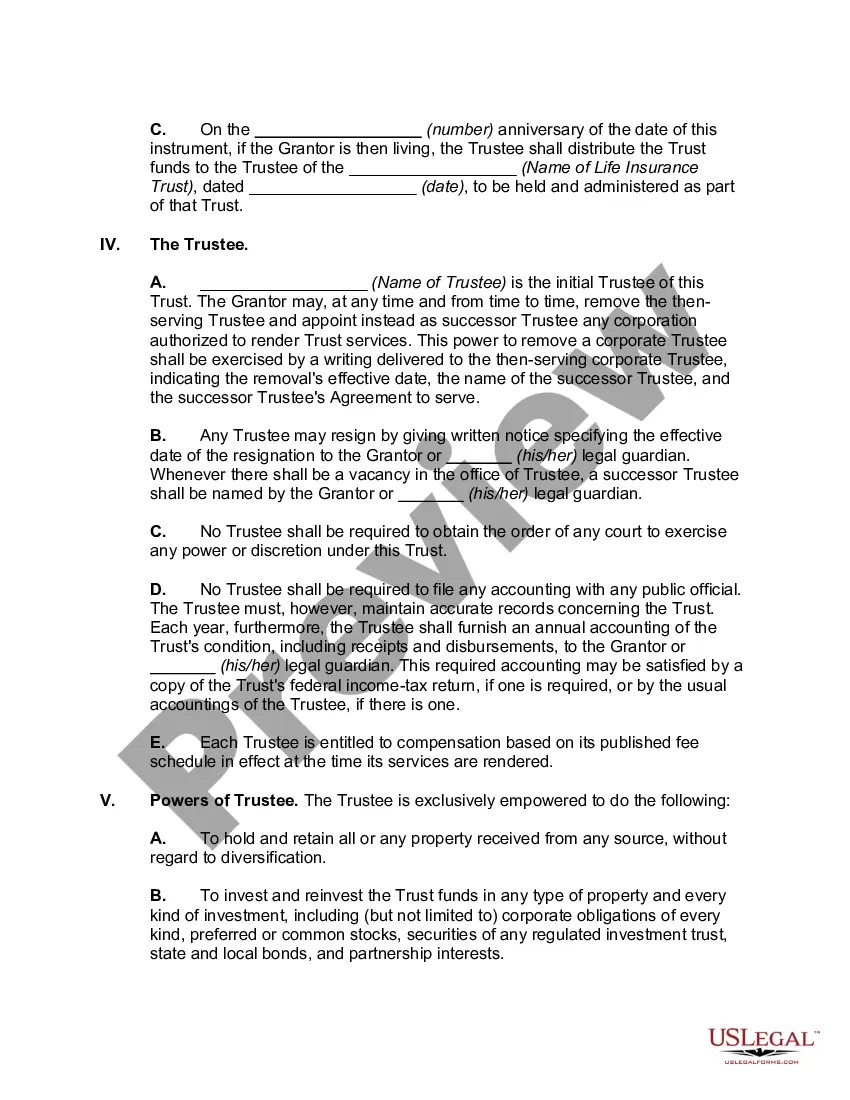
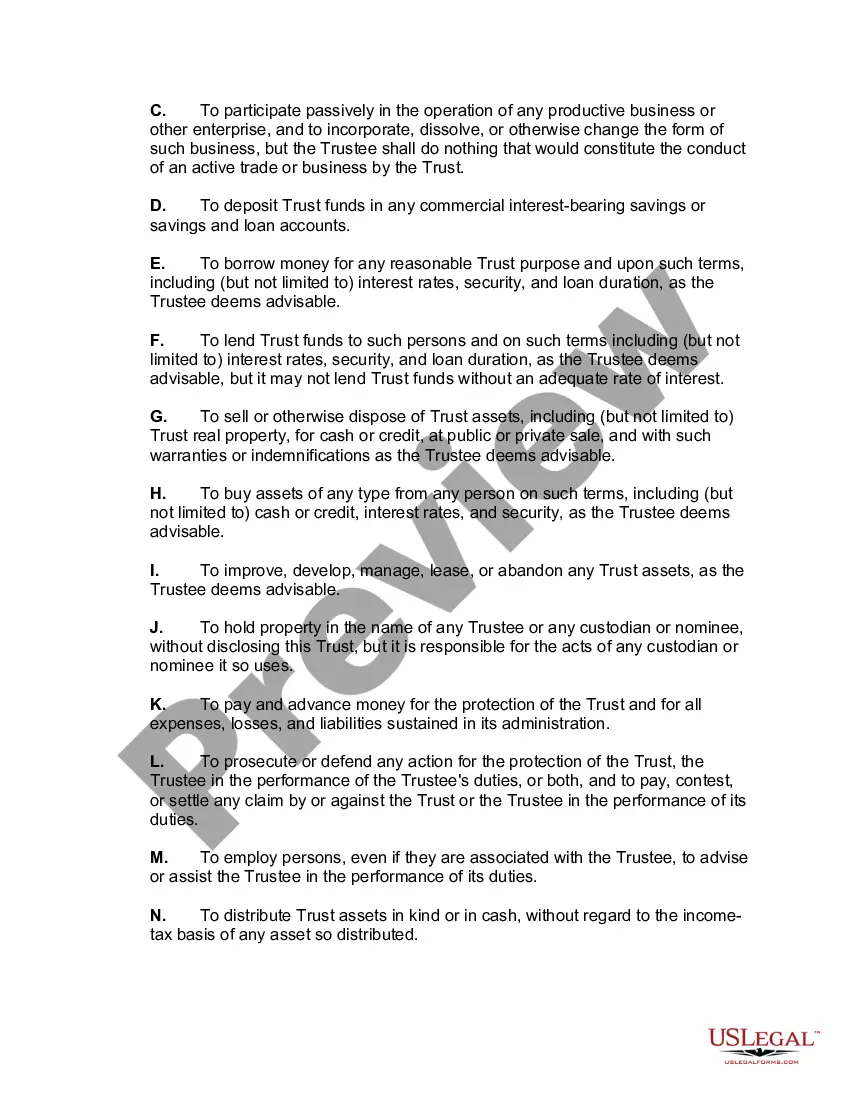
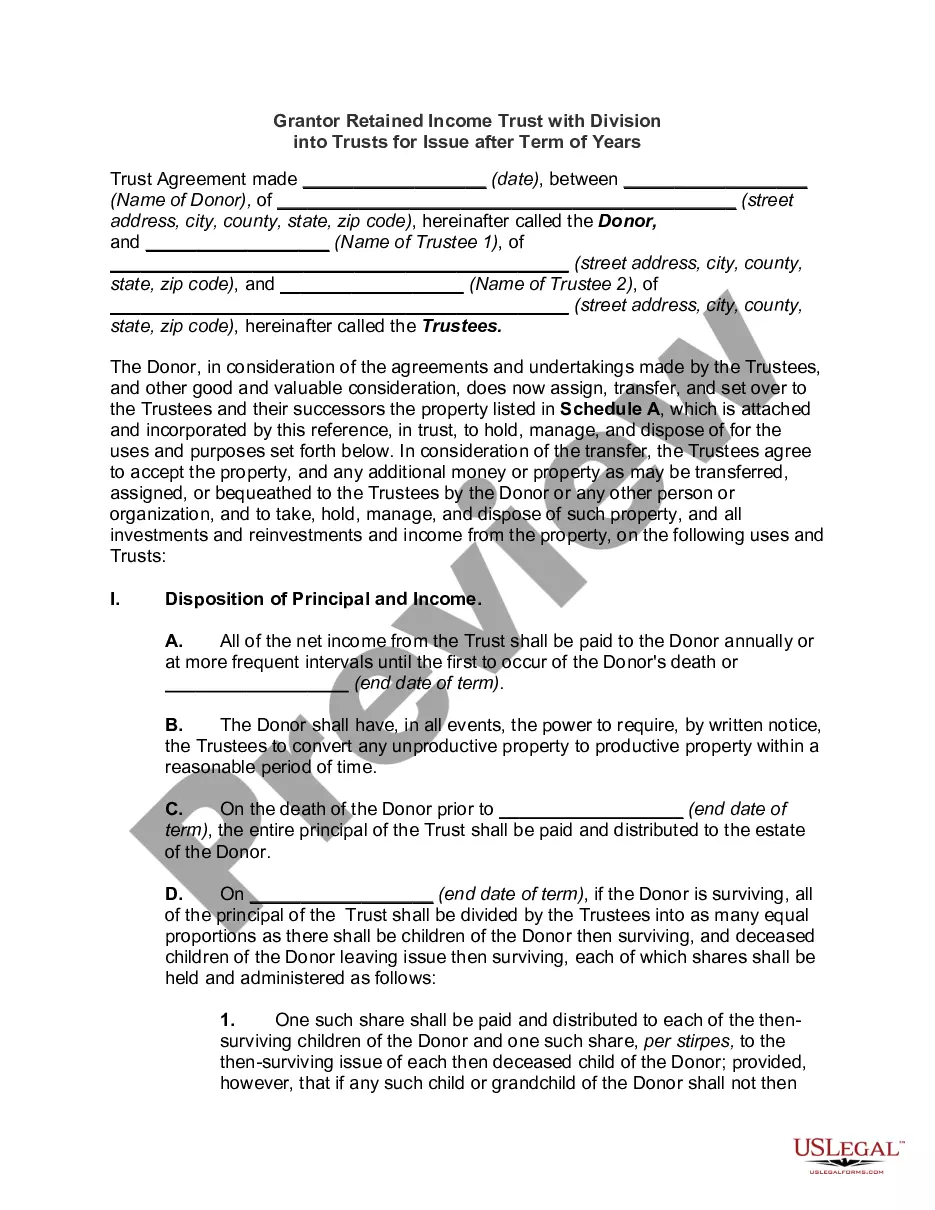
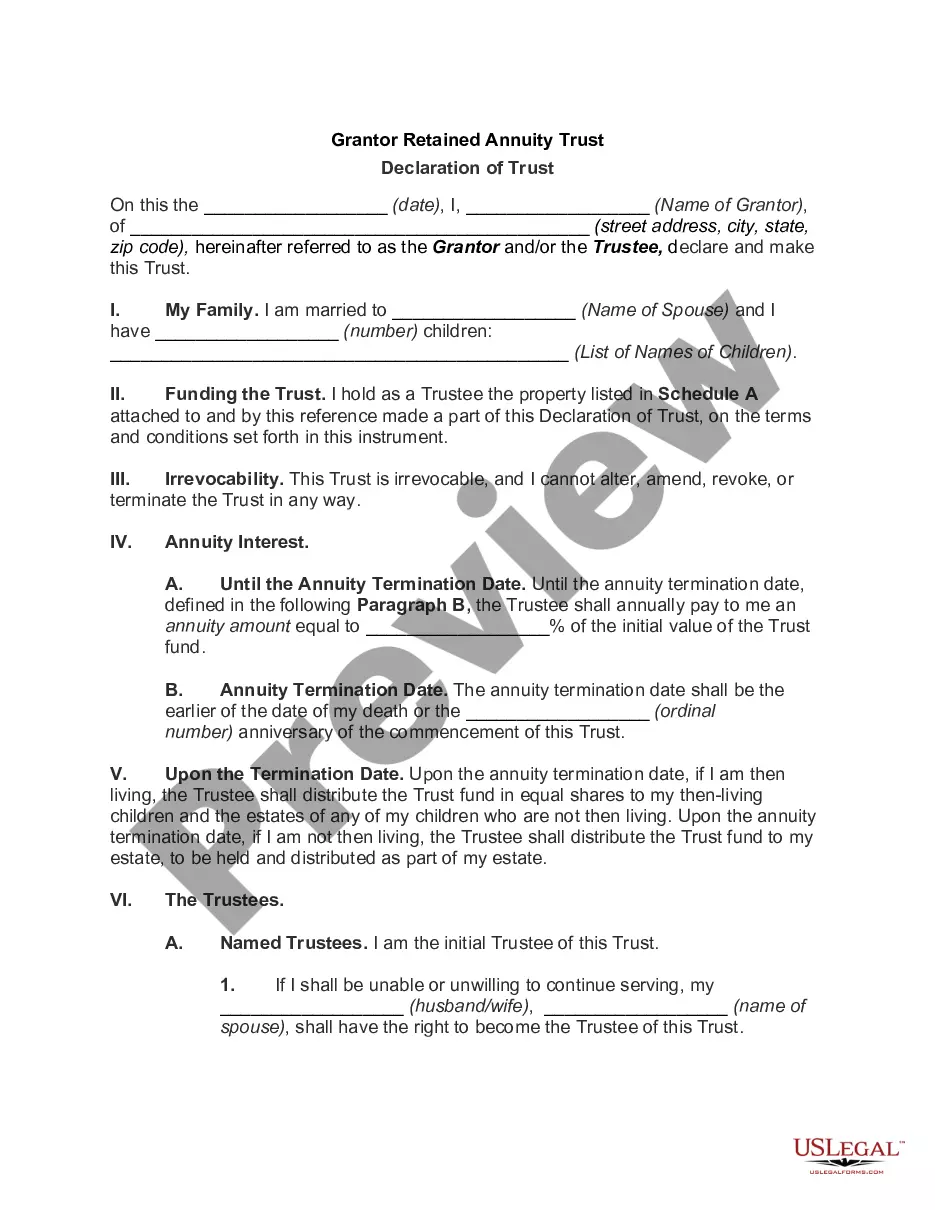
Grantor Retained Annuity Trust Grat
Description
Get your form ready online
Our built-in tools help you complete, sign, share, and store your documents in one place.
Make edits, fill in missing information, and update formatting in US Legal Forms—just like you would in MS Word.
Download a copy, print it, send it by email, or mail it via USPS—whatever works best for your next step.
Sign and collect signatures with our SignNow integration. Send to multiple recipients, set reminders, and more. Go Premium to unlock E-Sign.
If this form requires notarization, complete it online through a secure video call—no need to meet a notary in person or wait for an appointment.
We protect your documents and personal data by following strict security and privacy standards.

Make edits, fill in missing information, and update formatting in US Legal Forms—just like you would in MS Word.

Download a copy, print it, send it by email, or mail it via USPS—whatever works best for your next step.

Sign and collect signatures with our SignNow integration. Send to multiple recipients, set reminders, and more. Go Premium to unlock E-Sign.

If this form requires notarization, complete it online through a secure video call—no need to meet a notary in person or wait for an appointment.

We protect your documents and personal data by following strict security and privacy standards.
Looking for another form?
How to fill out Termination Of Grantor Retained Annuity Trust In Favor Of Existing Life Insurance Trust?
- If you're a returning user, log in to your account at US Legal Forms and navigate to your profile. Check your subscription status to ensure it's active before downloading.
- For first-time users, start by reviewing the available templates. Use the Preview mode to assess form descriptions and confirm they meet your specific requirements.
- Search for additional templates if necessary. If any discrepancies arise or if you're seeking different options, utilize the Search tab for assistance.
- Select and purchase the appropriate document. Click on the Buy Now button, choose your subscription plan, and create an account to access the full library.
- Complete your purchase by entering your payment information—either via credit card or PayPal—for a seamless transaction.
- Finally, download your GRAT form directly to your device and access it anytime through the My Forms section of your profile for future reference.
US Legal Forms stands out for its extensive repository, offering over 85,000 legal forms, making it more robust than competitors while providing various subscription plans to cater to different needs.
With access to expert assistance for document completion, US Legal Forms ensures that your legal documents are not only well-prepared but also legally valid. Start your smooth legal journey today!
Form popularity
FAQ
A grantor trust, including a Grantor Retained Annuity Trust (GRAT), typically does not need to file Form 1041 as the income is reported on the grantor's tax return. Since the grantor maintains control over the trust assets, they are treated as the owner for tax purposes. However, if the trust becomes irrevocable or has specific income circumstances, filing may be necessary. It's advisable to consult with a tax expert to navigate your trust's specific needs effectively.
Yes, a Grantor Retained Annuity Trust (GRAT) generally must file a tax return. While the individual who created the GRAT usually reports income on their personal returns, the GRAT itself may require its own filing if it generates taxable income. This ensures compliance with tax regulations. Utilizing platforms like US Legal Forms can help streamline the process of filing necessary forms for your GRAT.
Annuity payments from a Grantor Retained Annuity Trust (GRAT) can be taxable, depending on the individual's tax situation. The income generated from these annuity payments may be subject to federal and state income taxes. However, the primary benefit of a GRAT is to transfer wealth to beneficiaries with reduced estate taxes. Consulting with a tax professional can provide clarity on your specific tax obligations related to GRAT distributions.
A revocable trust allows you to maintain control over your assets, but it has some disadvantages, primarily concerning asset protection. Since you can change or dissolve the trust at any time, creditors can pursue claims against these assets. Additionally, revocable trusts do not provide immediate tax benefits, unlike irrevocable trusts such as the Grantor Retained Annuity Trust (GRAT). It is vital to understand these limitations when considering your estate planning options.
Setting up a Grantor Retained Annuity Trust (GRAT) involves several straightforward steps. First, consult with an estate planning attorney to review your financial situation and goals. Next, you'll need to draft the GRAT agreement, specifying the assets, annuity amount, and term lengths. Finally, fund the trust by transferring your chosen assets, ensuring compliance with IRS guidelines to maximize tax benefits.
A Grantor Retained Annuity Trust (GRAT) has some potential drawbacks, including the possibility of not fully achieving tax benefits if the grantor dies before the trust term ends. Additionally, if the assets appreciate significantly, the grantor may face higher taxes on the excess. Moreover, setting up a GRAT requires careful planning and adherence to IRS rules, which may seem complex for some individuals. Therefore, understanding these aspects is crucial while considering a GRAT.
Yes, a grantor retained annuity trust (GRAT) is a type of grantor trust. As the grantor, you maintain several rights and responsibilities throughout the life of the trust. This structure allows you to receive annuity payments while enabling the effective transfer of wealth. It’s an excellent tool for estate planning, particularly for those looking to minimize tax implications.
While both trust types offer unique benefits, the key difference lies in their structure and purpose. A grantor trust allows you to retain control over the assets and income, without immediate tax implications. Conversely, a grantor retained annuity trust (GRAT) particularly aims to transfer wealth to your heirs by providing you with annuity payments over time, thus reducing potential gift tax burdens.
A grantor retained annuity trust (GRAT) is designed to transfer wealth to beneficiaries with minimal gift tax implications. You, as the grantor, place assets into the trust and retain the right to receive annuity payments for a specified term. After this term ends, the remaining assets pass to your beneficiaries. This strategy can be particularly advantageous in a low-interest-rate environment.
A grantor trust allows the grantor to maintain control over the assets and the income during their lifetime. Essentially, the grantor can modify or revoke the trust whenever they choose, making it flexible. In contrast, a revocable trust also allows for changes while the grantor is alive. However, with a grantor retained annuity trust (GRAT), the focus shifts toward transferring wealth while minimizing gift taxes.