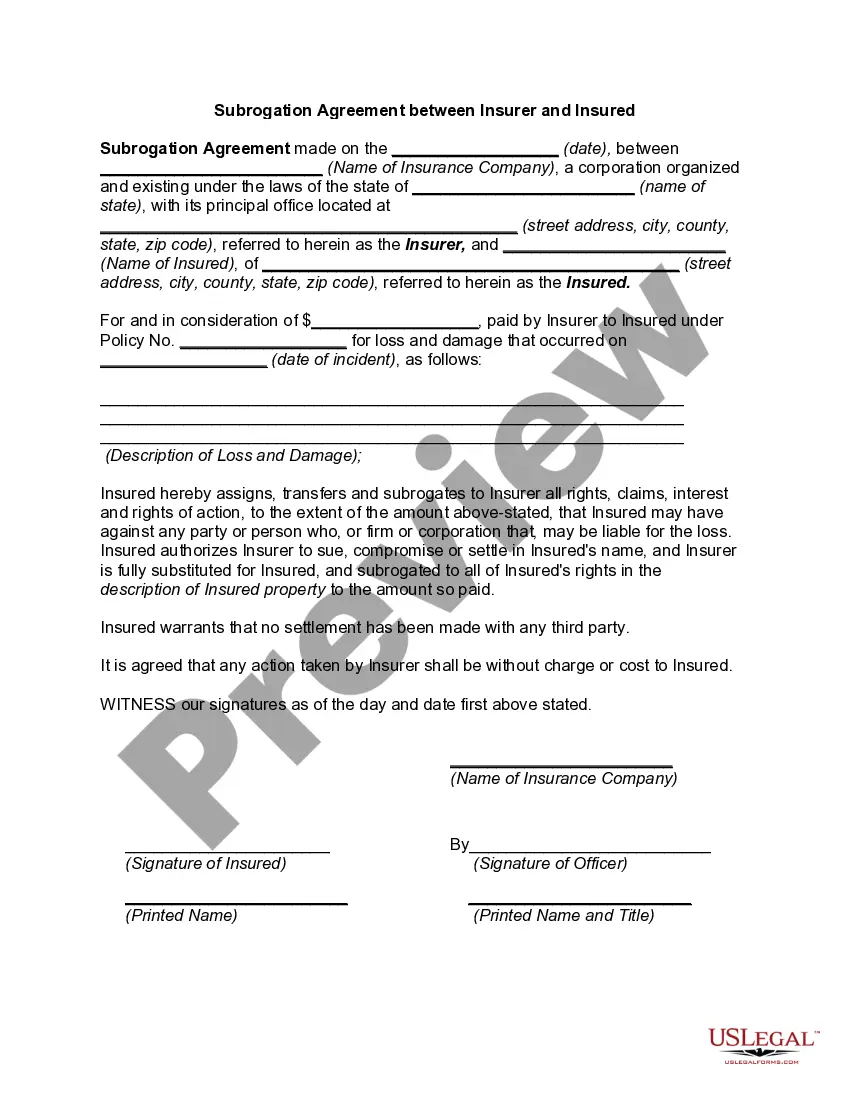
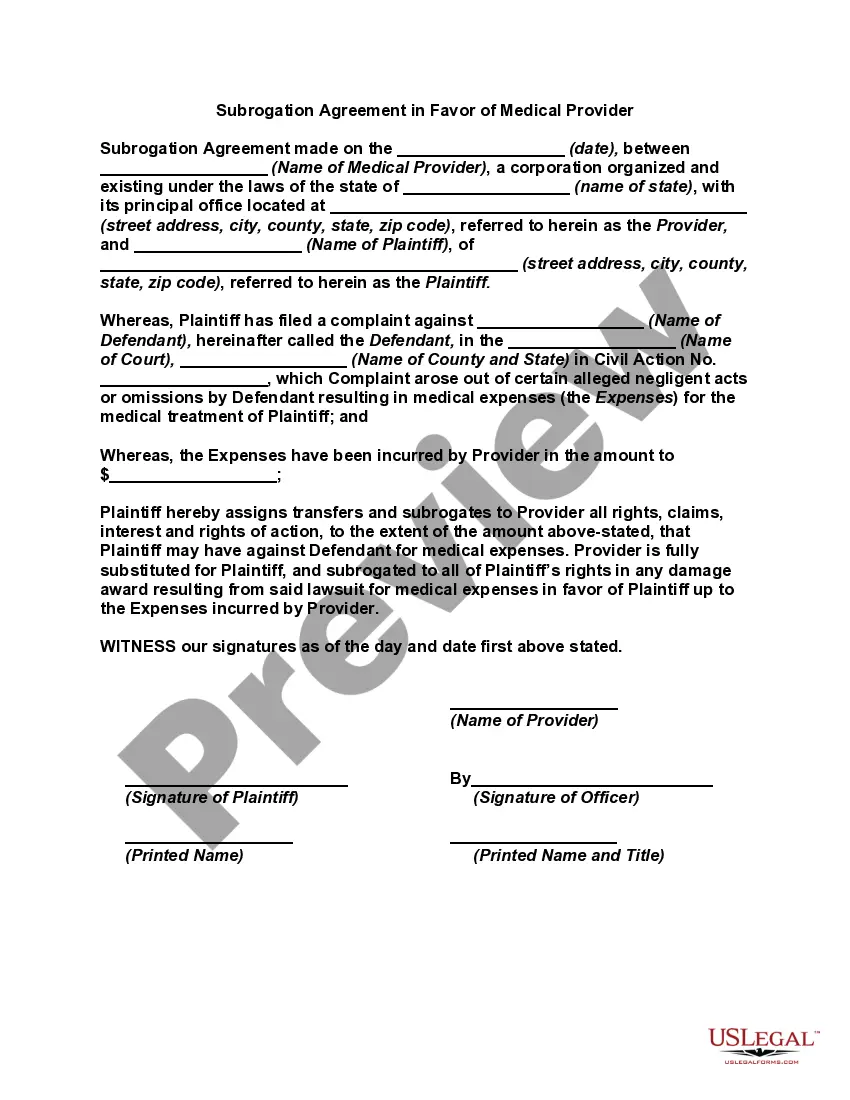
Subrogation For Insurance
Description
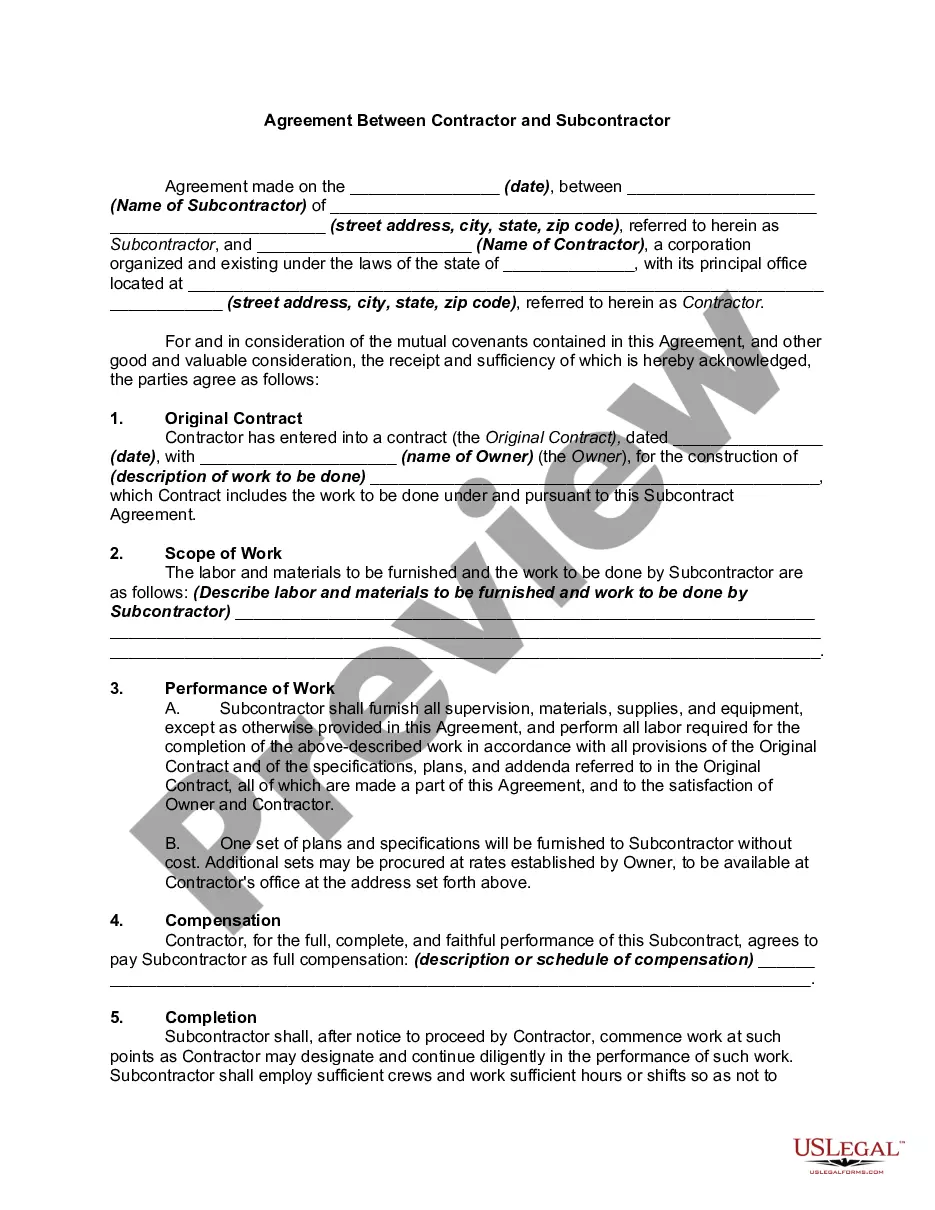
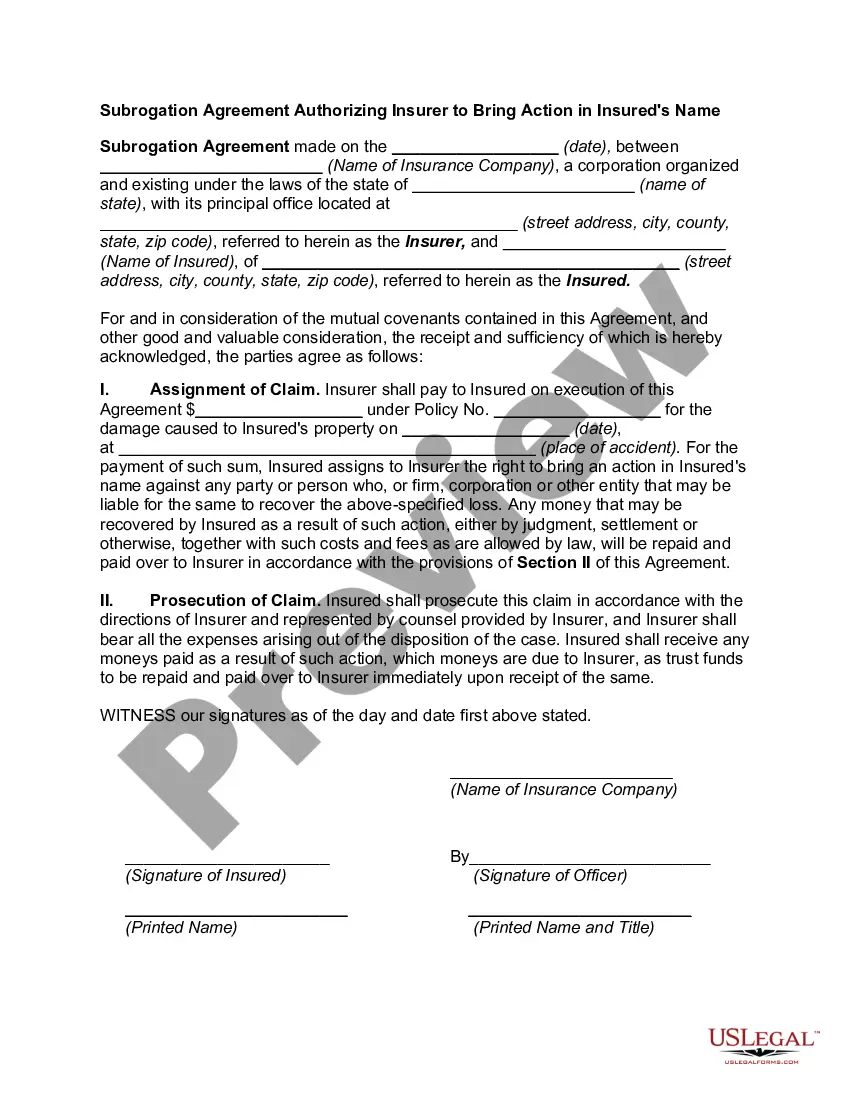
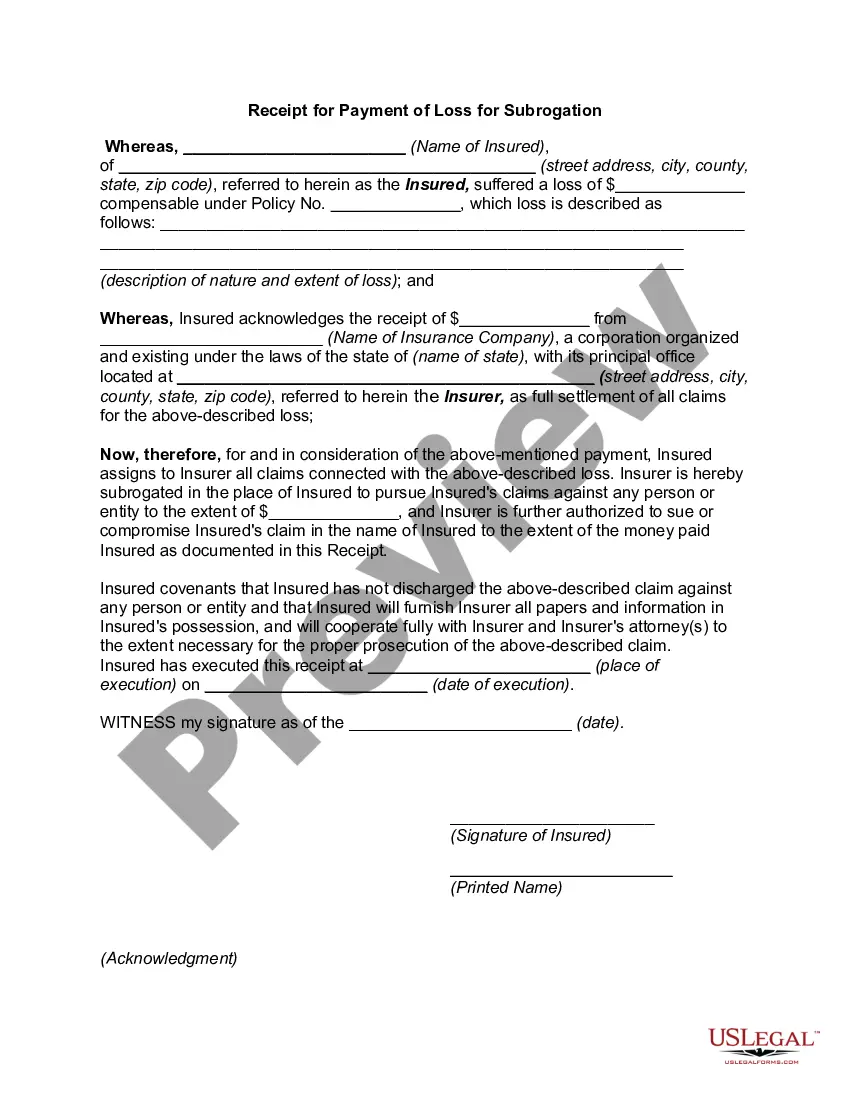
Get your form ready online
Our built-in tools help you complete, sign, share, and store your documents in one place.
Make edits, fill in missing information, and update formatting in US Legal Forms—just like you would in MS Word.
Download a copy, print it, send it by email, or mail it via USPS—whatever works best for your next step.
Sign and collect signatures with our SignNow integration. Send to multiple recipients, set reminders, and more. Go Premium to unlock E-Sign.
If this form requires notarization, complete it online through a secure video call—no need to meet a notary in person or wait for an appointment.
We protect your documents and personal data by following strict security and privacy standards.

Make edits, fill in missing information, and update formatting in US Legal Forms—just like you would in MS Word.

Download a copy, print it, send it by email, or mail it via USPS—whatever works best for your next step.

Sign and collect signatures with our SignNow integration. Send to multiple recipients, set reminders, and more. Go Premium to unlock E-Sign.

If this form requires notarization, complete it online through a secure video call—no need to meet a notary in person or wait for an appointment.

We protect your documents and personal data by following strict security and privacy standards.
Looking for another form?







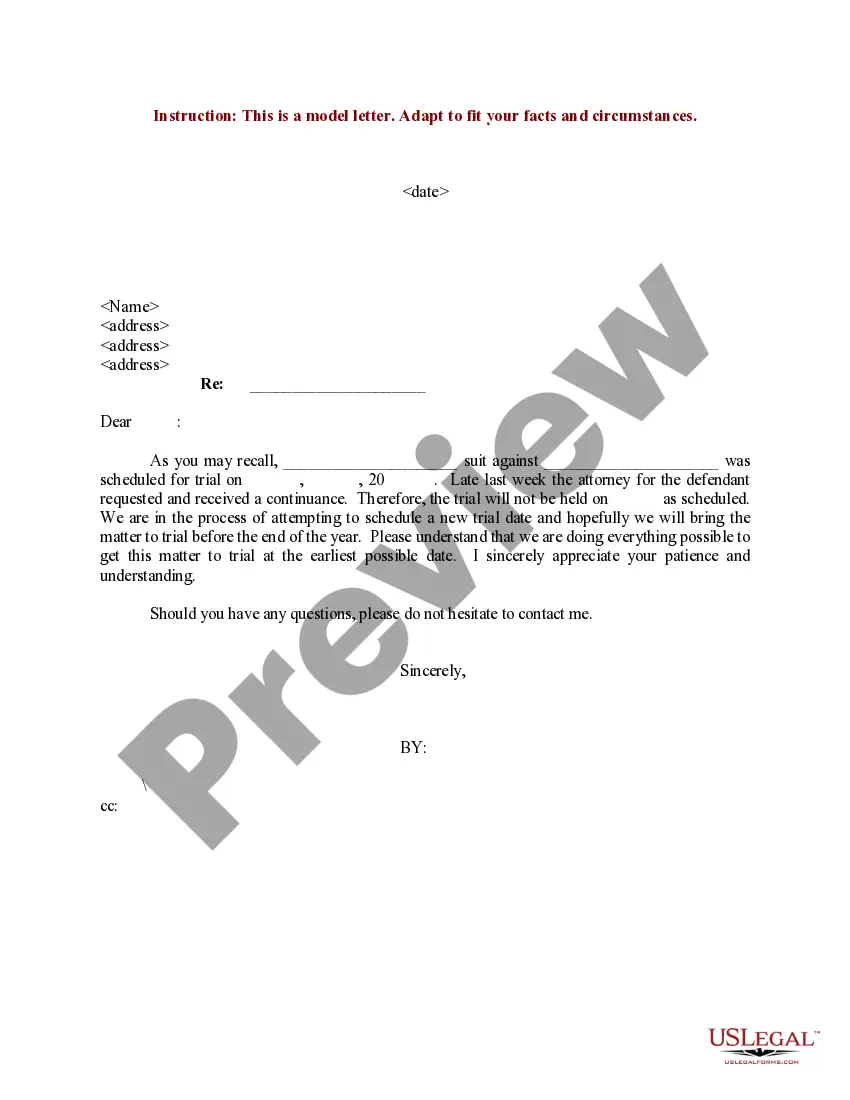

How to fill out Subrogation Agreement Between Insurer And Insured?
- If you're a returning user, log in to your account and download the necessary form by clicking the Download button. Validate your subscription, and if it’s expired, renew it according to your payment plan.
- For first-time users, start by reviewing the Preview mode and form descriptions to ensure you choose a template that meets your specific requirements.
- If you need a different template, utilize the Search tab above to find a more suitable document.
- Once you've found the right form, click on the Buy Now button and select your preferred subscription plan. You'll need to create an account to gain access to the comprehensive library.
- Proceed to checkout by entering your payment information via credit card or your PayPal account.
- After completing your purchase, download your document and save it on your device. You can always access your forms again from the My Forms section of your profile.
US Legal Forms stands out with an extensive library of over 85,000 meticulously crafted legal documents, ensuring users find what they need quickly and efficiently.
Experience the convenience of precise and legally sound document preparation today. Start your journey with US Legal Forms and simplify your legal processes!
Form popularity
FAQ
To deal with subrogation for insurance effectively, maintain clear documentation of your loss and communication with your insurer. Stay informed about the progress of your claim and any subrogation efforts they undertake. Being proactive can often lead to a smoother resolution. For helpful resources and templates, consider exploring uslegalforms.
Examples of subrogation claims include auto accident reimbursement, property damage recovery following a fire caused by a third party, and medical expenses after an injury due to another's negligence. In each case, after your insurance pays, the company seeks compensation from those responsible. Understanding these examples can help you better manage expectations in similar situations. Our platform offers resources to assist with these claims.
An example of subrogation for insurance could be if another driver causes an accident, and you file a claim with your insurer. Once your insurer covers your repairs, they may pursue the at-fault driver's insurance for reimbursement. This process not only keeps your premiums from rising but also holds the responsible party accountable. Utilizing services like uslegalforms can make navigating these processes easier.
In a subrogation claim, the responsible third party usually pays for the damages incurred. After your insurance company settles your claim, it may seek compensation from the negligent party's insurance provider. This process ultimately helps you recover costs without taking the financial hit yourself. Knowing this can guide you in how to approach your own claims.
Subrogation for insurance refers to the process where an insurance company seeks reimbursement from a third party responsible for a loss. Essentially, after paying your claim, your insurer steps into your shoes to pursue the party at fault. This helps keep insurance costs manageable for policyholders. Understanding this concept can empower you when dealing with claims.
Subrogation claims are typically handled by insurance adjusters or specialized subrogation teams within insurance companies. These professionals assess the claims and coordinate the recovery process from the responsible third parties. When managing subrogation for insurance, it's important to have experienced individuals in your corner to navigate the complexities. UsLegalForms can provide tools to simplify document preparation and support you throughout this process.
The burden of proof for subrogation lies with the insurance company seeking to reclaim funds from a liable party. This means the insurer must produce evidence showing the extent of the loss and that the third party is responsible for it. In subrogation for insurance, clarity and thoroughness in presenting this evidence are vital. Platforms like UsLegalForms can assist in organizing the required documents to meet this burden.
Proof of subrogation is a declaration that confirms your insurance company’s right to pursue recovery from a third party. This proof might include receipts, invoices, or a detailed accounting of expenses incurred due to the incident. When engaging in subrogation for insurance claims, having clear proof helps establish your case. You can streamline this process using UsLegalForms to generate the necessary paperwork.
Subrogation documents are essential records that facilitate the process of reclaiming funds from a third party after an insurance claim. These documents typically include the original insurance policy, proof of loss, and any correspondence related to the claim. When dealing with subrogation for insurance, accurate documentation is crucial to ensure a smooth recovery process. Using platforms like UsLegalForms can help you create and manage these important documents effectively.
Subrogation in insurance allows your insurer to recover funds after settling your claim. For instance, consider you file a claim due to a fire caused by a neighbor's negligent actions. Your insurance company will compensate you for your losses and then pursue your neighbor to recover those costs. By using subrogation for insurance, your insurer not only helps you but also works to keep insurance rates fair for everyone.