Executor Estate State With Beneficiaries
Description
Get your form ready online
Our built-in tools help you complete, sign, share, and store your documents in one place.
Make edits, fill in missing information, and update formatting in US Legal Forms—just like you would in MS Word.
Download a copy, print it, send it by email, or mail it via USPS—whatever works best for your next step.
Sign and collect signatures with our SignNow integration. Send to multiple recipients, set reminders, and more. Go Premium to unlock E-Sign.
If this form requires notarization, complete it online through a secure video call—no need to meet a notary in person or wait for an appointment.
We protect your documents and personal data by following strict security and privacy standards.

Make edits, fill in missing information, and update formatting in US Legal Forms—just like you would in MS Word.

Download a copy, print it, send it by email, or mail it via USPS—whatever works best for your next step.

Sign and collect signatures with our SignNow integration. Send to multiple recipients, set reminders, and more. Go Premium to unlock E-Sign.

If this form requires notarization, complete it online through a secure video call—no need to meet a notary in person or wait for an appointment.

We protect your documents and personal data by following strict security and privacy standards.
Looking for another form?


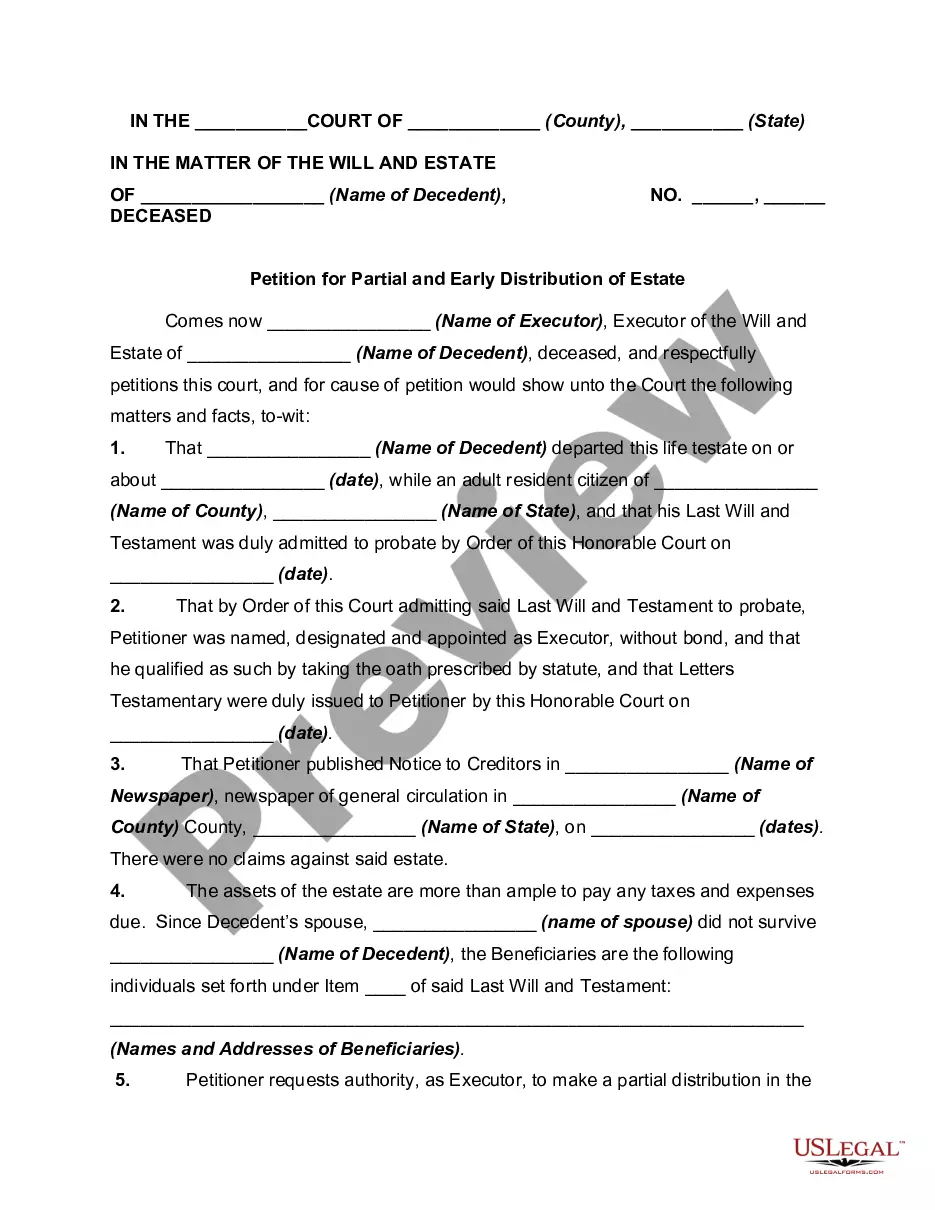
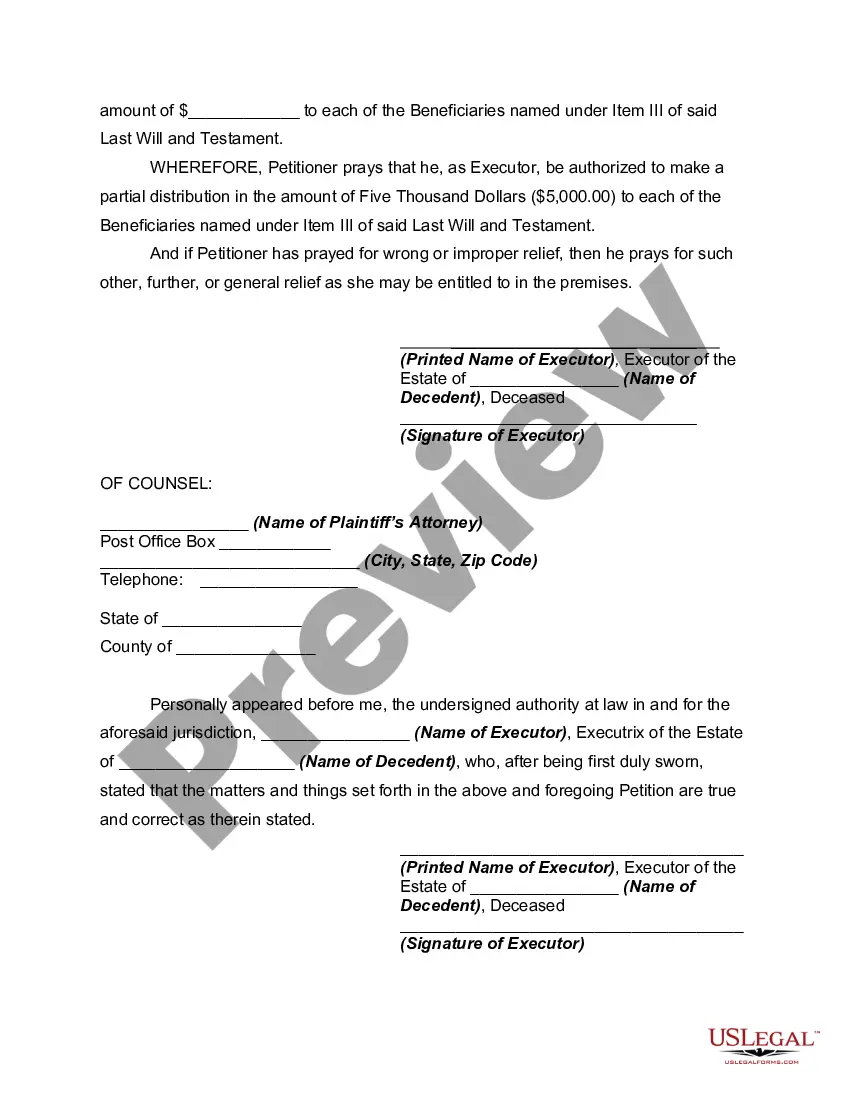
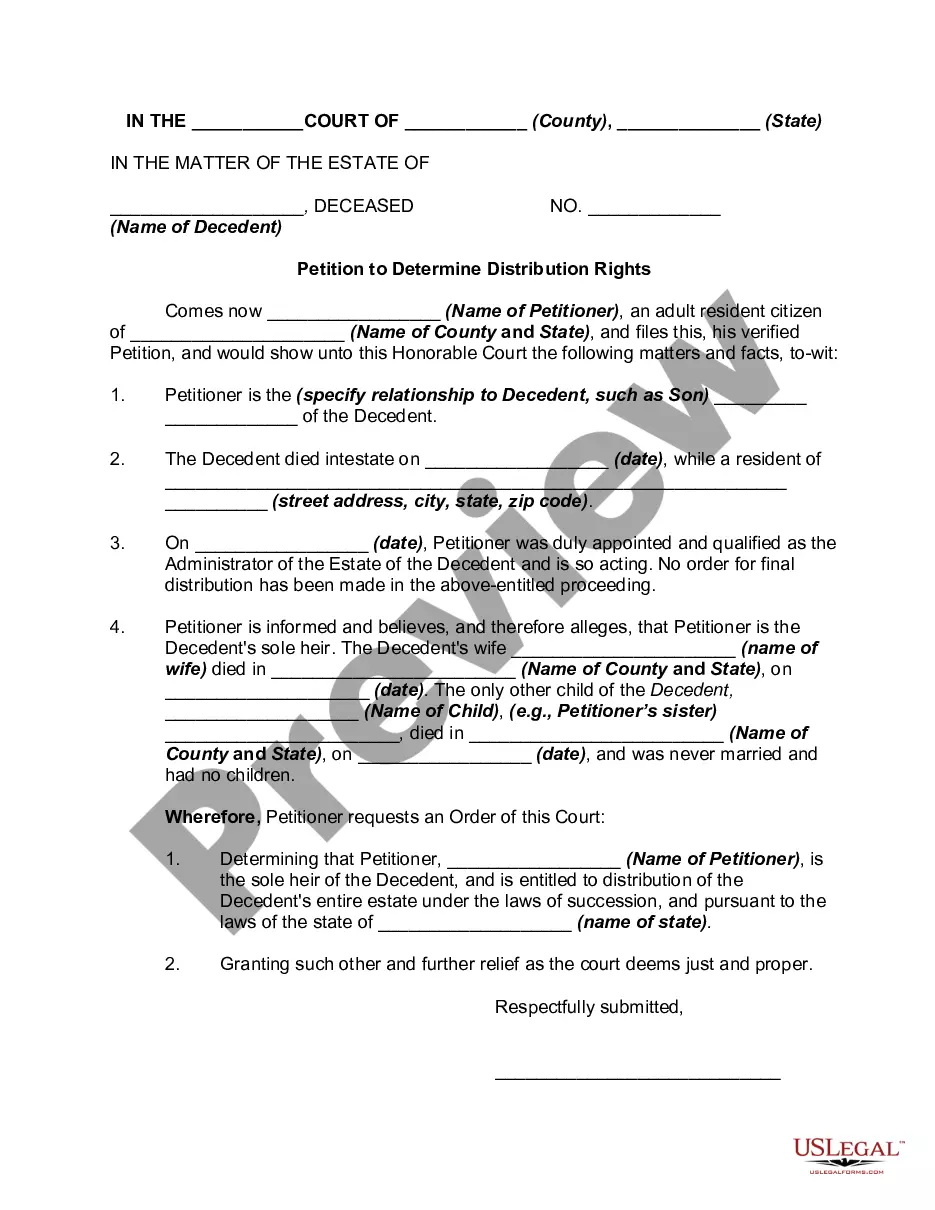
How to fill out Petition For Partial And Early Distribution Of Estate?
It’s widely acknowledged that you cannot instantaneously become a law professional, nor can you quickly master how to efficiently produce Executor Estate State With Beneficiaries without possessing a specific background. Compiling legal documents is a labor-intensive task that necessitates specialized training and expertise. So why not entrust the preparation of the Executor Estate State With Beneficiaries to the experts.
With US Legal Forms, which features one of the most extensive repositories of legal documents, you can locate everything from court documents to templates for internal communications. We understand how important it is to comply with federal and local regulations. That’s why, on our platform, all templates are tailored to specific locations and are current.
Here’s how to get started with our site and acquire the form you need in just minutes.
You can revisit your documents via the My documents tab at any moment. If you’re a current client, you can simply Log In, and locate and download the template from the same tab.
Regardless of the intention behind your forms—be it financial and legal, or personal—our platform has you covered. Give US Legal Forms a try now!
- Locate the document you require using the search bar at the top of the page.
- Examine it (if this option is available) and review the accompanying description to determine if Executor Estate State With Beneficiaries meets your needs.
- Restart your search if you need another form.
- Create a free account and select a subscription plan to purchase the form.
- Click Buy now. Once the payment is processed, you can download the Executor Estate State With Beneficiaries, fill it out, print it, and send or mail it to the necessary individuals or organizations.
Form popularity
FAQ
Yes, the executor of an estate can also be a beneficiary, and this arrangement is quite common. This dual role can allow for a more personal touch in administering the estate since the executor understands the wishes of the deceased firsthand. However, it is important to maintain transparency with all beneficiaries to avoid potential conflicts. Ultimately, the executor must act impartially and serve the best interests of the entire estate.
The first step as an executor is to locate and review the deceased's will. This document provides direction on how to distribute assets and names beneficiaries. After understanding your responsibilities, you should apply for probate, which is the legal process that validates the will. This step is vital as it gives you the authority to manage the estate in accordance with the executor estate state with beneficiaries.
Filling out estate paperwork can seem daunting, but it is essential for managing your executor estate state with beneficiaries. Start by gathering necessary documents, including the will, death certificate, and any financial records. You may find templates or forms through platforms like US Legal Forms, which can guide you in completing these documents accurately. Properly filled paperwork helps avoid delays and ensures that your estate is processed efficiently.
Choosing the right executor of your estate is crucial for ensuring a smooth process among beneficiaries. Typically, you should appoint someone you trust, such as a family member or a close friend, who understands your wishes. It is also important that this individual is organized, reliable, and willing to take on the responsibilities associated with the role. Ultimately, the best executor is someone who will act in the best interest of the estate and its beneficiaries.
The best person to serve as an executor of a will is someone trustworthy, organized, and capable of handling financial matters. This person should ideally be familiar with the deceased's wishes and willing to communicate with the beneficiaries. Selecting an impartial friend or family member, or even a professional executor, can often lead to smoother estate management. Consulting US Legal Forms can provide additional insights on selecting the right executor for your estate.
An executor can distribute an estate to beneficiaries after settling debts and fulfilling all estate obligations, including taxes. They must also ensure that the probate court approves the distribution plan. Once these conditions are met, the executor can proceed with distributing assets according to the will or state laws. For clarity on these steps and forms, you can explore the resources available through US Legal Forms.
An executor is appointed through the will of the deceased, where they designate an individual to manage their estate. If the will is not present, the court steps in to appoint an executor, adhering to state laws regarding estate distribution. This appointment serves to streamline the probate process, ensuring that the executor can act on behalf of the beneficiaries. For more detailed procedures, US Legal Forms provides templates and guidance to assist you.
To get an executor of an estate, the testator must name someone in their will as the executor. If no will exists, the court appoints an executor, usually based on state laws and the wishes of the beneficiaries. It is advisable to discuss this process with a legal professional to ensure a smooth selection that aligns with the interests of all involved parties. Utilizing resources from US Legal Forms can guide you in understanding these processes effectively.
Absolutely, the same person can serve as both the executor and beneficiary in an executor estate state with beneficiaries. However, this dual role can complicate matters, particularly if disputes arise. Having a clear understanding of duties and being aware of potential biases is crucial. Utilizing resources like USLegalForms can simplify the documentation process and provide guidance for those in this situation.
Yes, an executor in an executor estate state with beneficiaries can also be a beneficiary. This situation can create a unique dynamic, as the individual must balance their duties as an executor with their interests as a beneficiary. Ensuring clarity in the executor's responsibilities is vital to minimize any potential conflicts of interest. Legal advice can help maintain fairness and transparency throughout the estate process.