Estate Probate Questions For Probate
Description
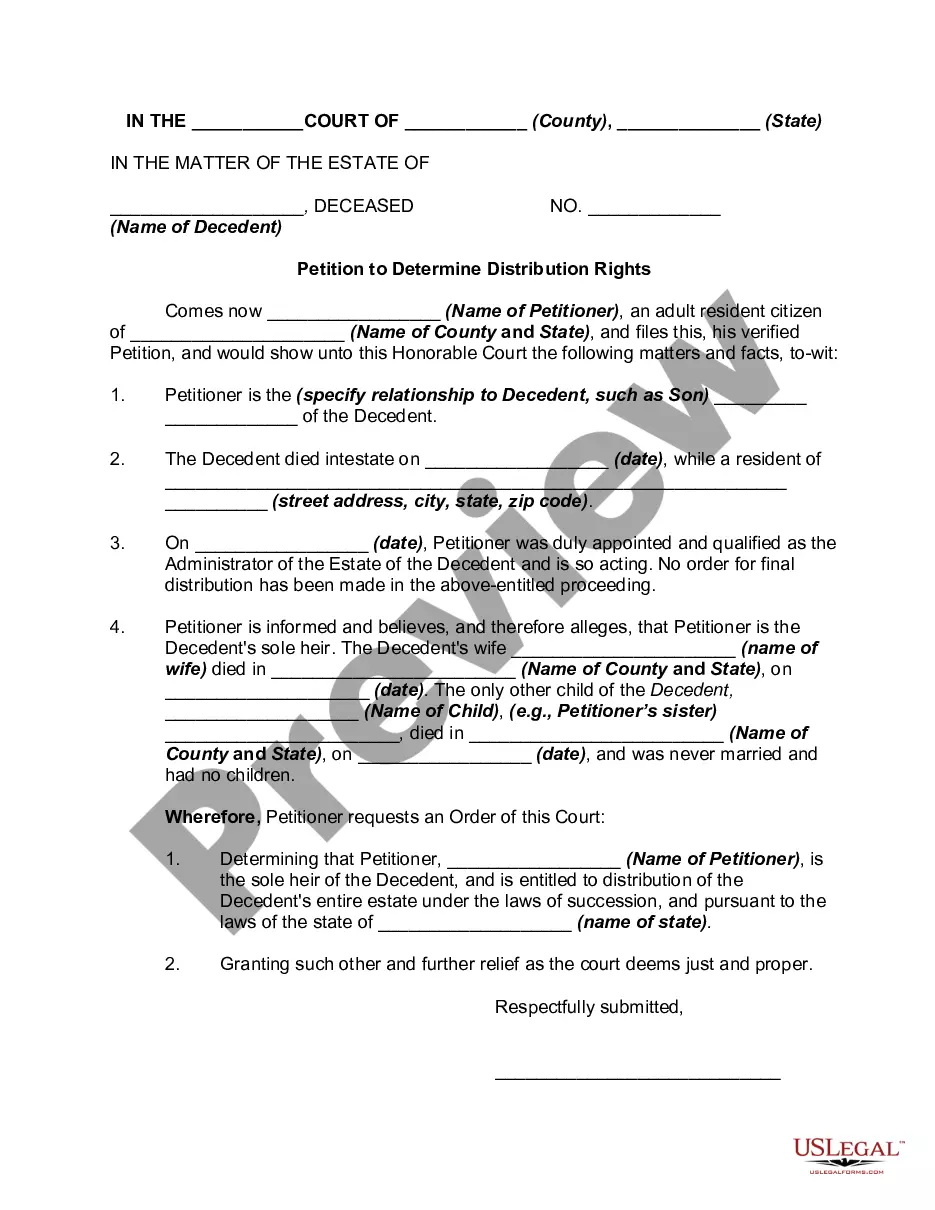
Get your form ready online
Our built-in tools help you complete, sign, share, and store your documents in one place.
Make edits, fill in missing information, and update formatting in US Legal Forms—just like you would in MS Word.
Download a copy, print it, send it by email, or mail it via USPS—whatever works best for your next step.
Sign and collect signatures with our SignNow integration. Send to multiple recipients, set reminders, and more. Go Premium to unlock E-Sign.
If this form requires notarization, complete it online through a secure video call—no need to meet a notary in person or wait for an appointment.
We protect your documents and personal data by following strict security and privacy standards.

Make edits, fill in missing information, and update formatting in US Legal Forms—just like you would in MS Word.

Download a copy, print it, send it by email, or mail it via USPS—whatever works best for your next step.

Sign and collect signatures with our SignNow integration. Send to multiple recipients, set reminders, and more. Go Premium to unlock E-Sign.

If this form requires notarization, complete it online through a secure video call—no need to meet a notary in person or wait for an appointment.

We protect your documents and personal data by following strict security and privacy standards.
Looking for another form?
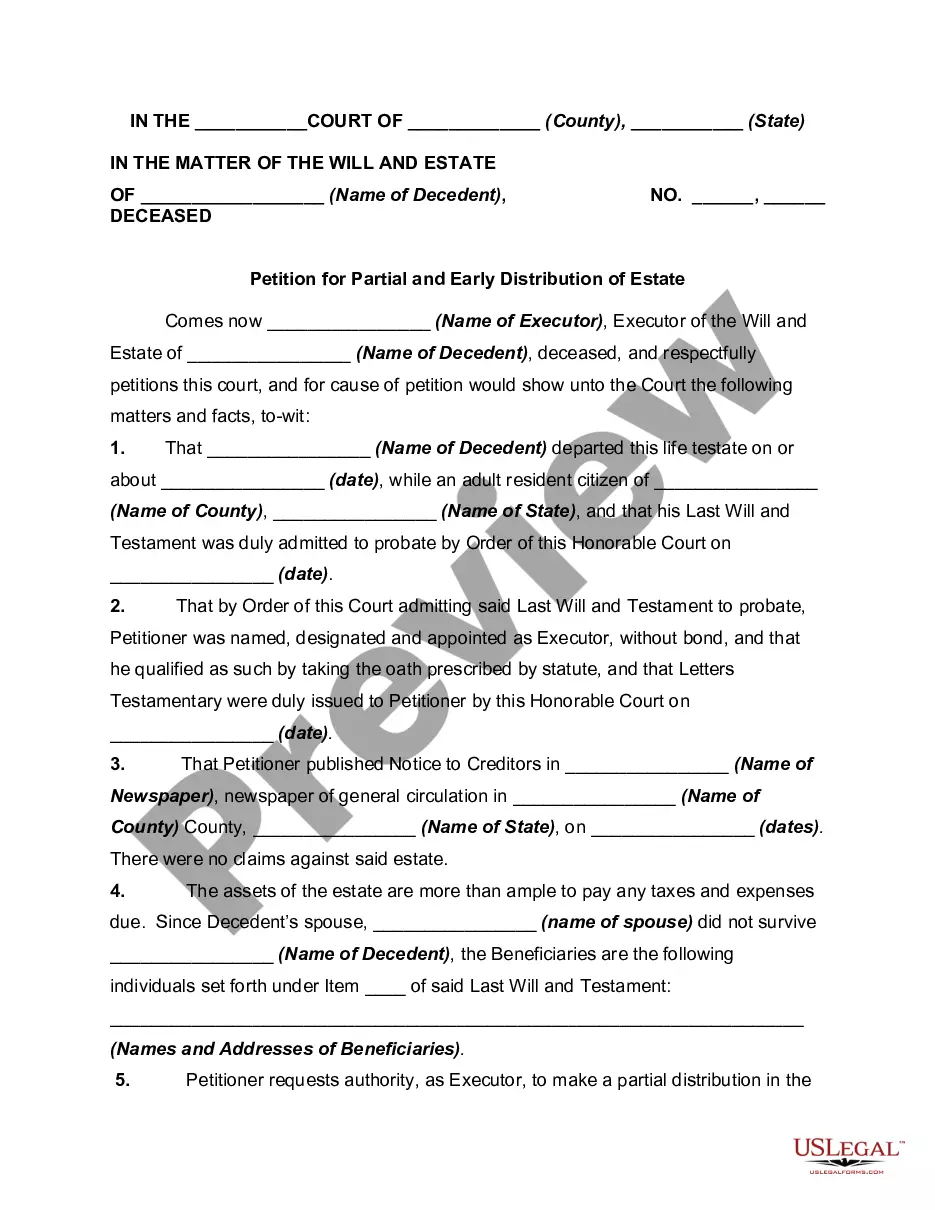
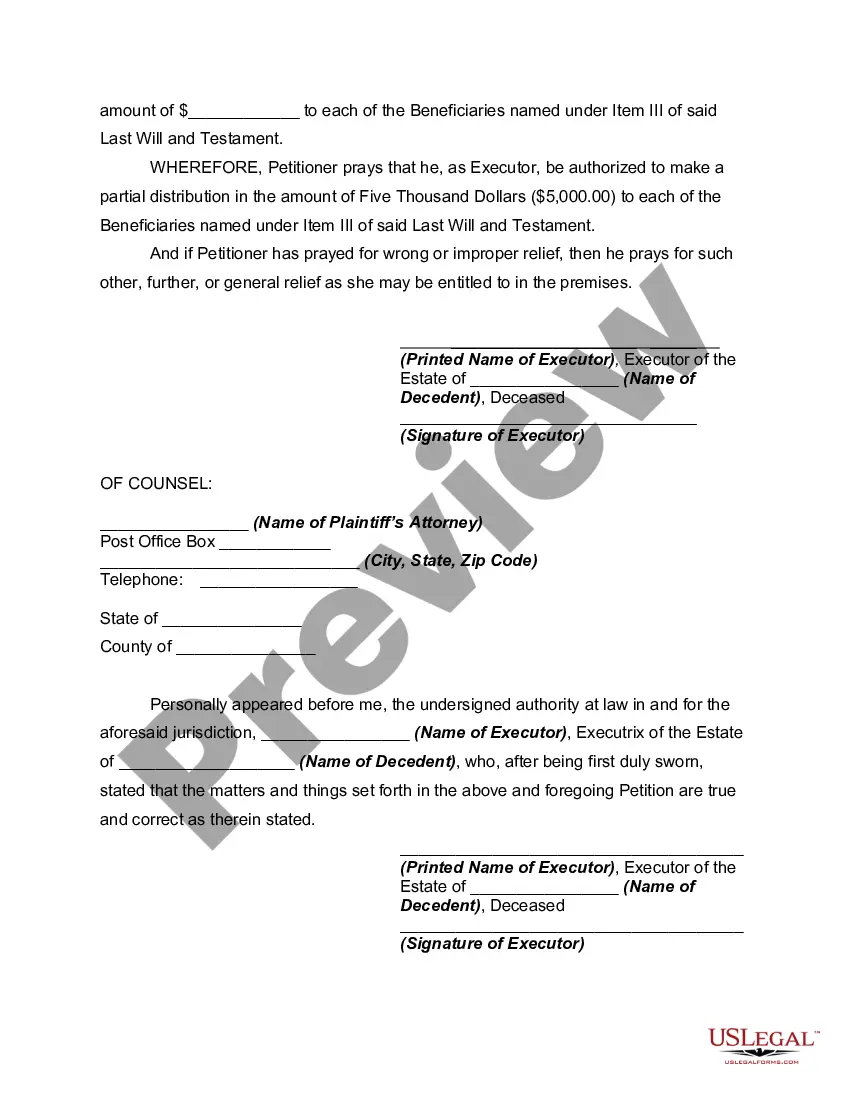
How to fill out Petition For Partial And Early Distribution Of Estate?
Regardless of whether for corporate reasons or personal issues, everyone must confront legal matters at some point in their lifetime.
Filling out legal documents requires meticulous care, starting with choosing the correct form template.
Once it is saved, you can fill out the form using editing software or print it and complete it by hand. With a vast catalog of US Legal Forms available, you will never have to waste time searching for the correct template online. Utilize the library's simple navigation to find the appropriate template for any situation.
- For instance, if you select an incorrect version of the Estate Probate Questions For Probate, it will be rejected upon submission.
- Therefore, it is essential to have a reliable source of legal documents like US Legal Forms.
- If you need to obtain a template for Estate Probate Questions For Probate, follow these straightforward steps.
- Utilize the search bar or the catalog navigation to locate the template you require.
- Review the description of the form to confirm it matches your circumstances, state, and county.
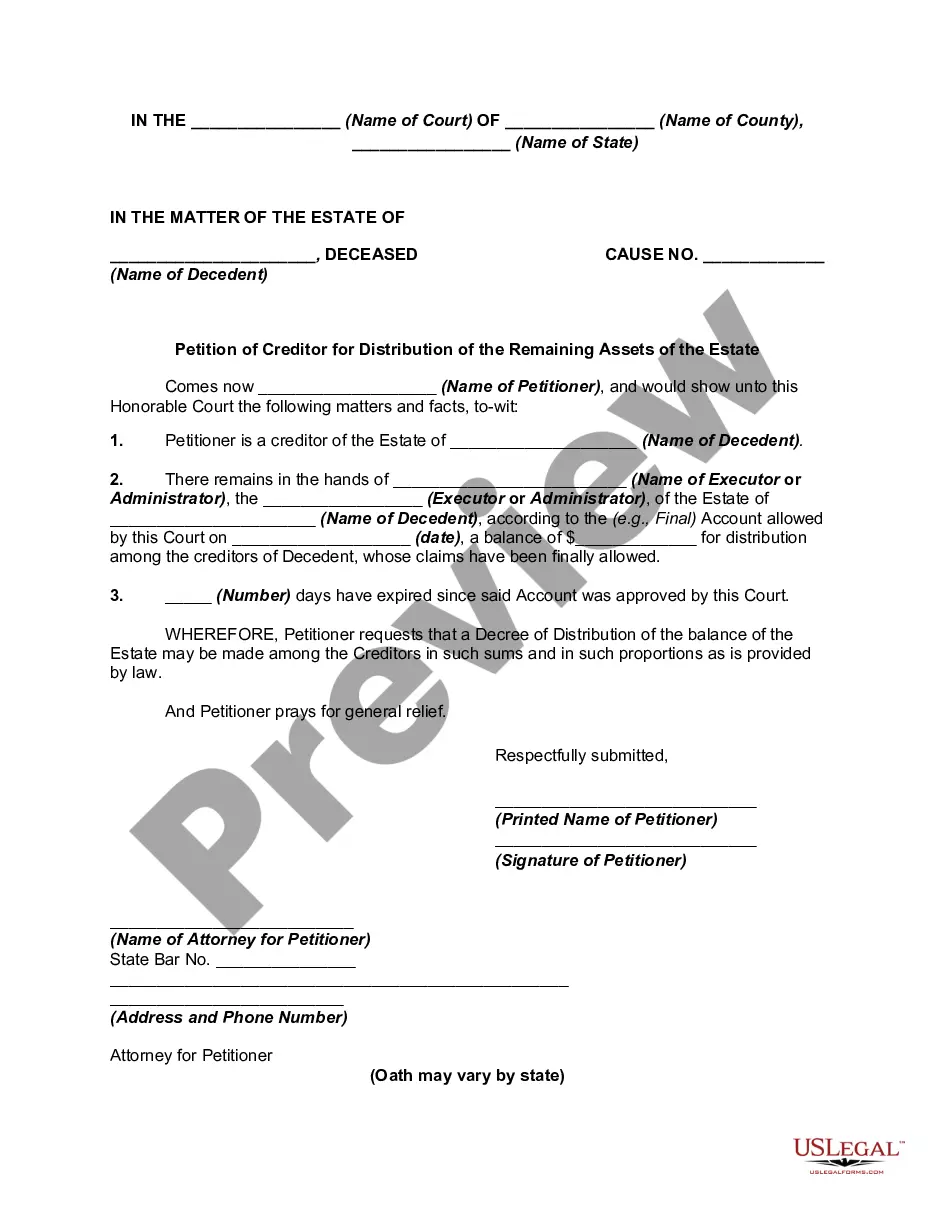
- Click on the preview of the form to examine it.
- If it is not the correct document, return to the search feature to find the Estate Probate Questions For Probate sample that you need.
- Acquire the template when it fulfills your needs.
- If you already possess a US Legal Forms account, simply click Log in to access previously saved documents in My documents.
- If you do not yet have an account, you can purchase the form by selecting Buy now.
- Choose the suitable pricing option.
- Complete the registration form for your profile.
- Select your payment method: credit card or PayPal.
- Choose the desired document format and download the Estate Probate Questions For Probate.
Form popularity
FAQ
Typically, an estate enters probate within a few weeks after death, and this timing is a common estate probate question for probate. However, this timeline can be influenced by various factors, such as the will's complexity and local laws. Generally, it is wise to start the process as soon as possible to ensure a smooth administration of the estate. Utilizing resources like USLegalForms can streamline your approach to handling probate effectively.
Preparing for probate court requires gathering essential documents such as the will, death certificate, and asset inventory, which are critical estate probate questions for probate. You should also understand the probate process, including timelines and expectations, to show respect for the court's procedures. It may be beneficial to consult an attorney or use platforms like USLegalForms to obtain the necessary forms and guidance. With the right preparation, you can approach your court date with assurance.
When you step into probate court, the key estate probate questions for probate often revolve around the validity of the will, the identification of heirs, and the management of estate assets. The judge may inquire about the deceased's debts, outstanding taxes, and how the estate will be divided among beneficiaries. Expect also to explain the whereabouts of important documents and any disputes that may arise. Thorough preparation will help you navigate these questions with confidence.
Assets held in joint ownership, such as jointly-owned homes or bank accounts, will not be included in the decedent's probate estate. The surviving owner's rights to these assets remain intact after one owner's passing. This stipulation helps in ensuring that the transition of ownership is efficient and seamless. For assistance with your estate planning, UsLegalForms can provide valuable resources and templates.
Establishing a living trust is one of the best methods to avoid probate. With a living trust, you can transfer your assets into the trust while you're alive, managing your property according to your wishes. Upon your death, the assets in the trust will pass directly to your beneficiaries without going through probate. To learn more about setting up a living trust, UsLegalForms offers comprehensive guidance.
probate property includes assets that pass directly to a beneficiary, bypassing the probate process. Common examples are jointlyowned real estate and payableondeath bank accounts. These arrangements allow a smoother transfer of assets and reduce the burden on your heirs. For clarity on your estate planning needs, explore resources and tools at UsLegalForms.
Certain types of accounts, such as retirement accounts and life insurance policies, typically avoid probate. These accounts often have designated beneficiaries who directly receive the assets upon your passing. This means that your loved ones can access the funds quickly and without the delays commonly associated with probate. For personalized guidance on estate planning, consider utilizing the services of UsLegalForms.
Typically, you have a limited period, often between three to six months after a person's death, to file for probate. However, some states may have specific rules that dictate this timeframe. Staying informed about these details can prevent any delays, addressing common estate probate questions for probate effectively.
During a probate hearing, several questions may arise regarding the validity of the will, the identity of the heirs, and the total value of the estate. The judge will seek clarity on these topics to ensure proper legal proceedings. Exploring these estate probate questions for probate can help you prepare for what to expect during a hearing.
The necessity of probate is usually determined by the executor or administrator of the estate, often appointed by the court. Additionally, an estate attorney can provide valuable insight into whether probate is needed based on the assets involved. This aspect is central to addressing various estate probate questions for probate.