Final Account Estate Form With Trustee
Description
Get your form ready online
Our built-in tools help you complete, sign, share, and store your documents in one place.
Make edits, fill in missing information, and update formatting in US Legal Forms—just like you would in MS Word.
Download a copy, print it, send it by email, or mail it via USPS—whatever works best for your next step.
Sign and collect signatures with our SignNow integration. Send to multiple recipients, set reminders, and more. Go Premium to unlock E-Sign.
If this form requires notarization, complete it online through a secure video call—no need to meet a notary in person or wait for an appointment.
We protect your documents and personal data by following strict security and privacy standards.

Make edits, fill in missing information, and update formatting in US Legal Forms—just like you would in MS Word.

Download a copy, print it, send it by email, or mail it via USPS—whatever works best for your next step.

Sign and collect signatures with our SignNow integration. Send to multiple recipients, set reminders, and more. Go Premium to unlock E-Sign.

If this form requires notarization, complete it online through a secure video call—no need to meet a notary in person or wait for an appointment.

We protect your documents and personal data by following strict security and privacy standards.
Looking for another form?










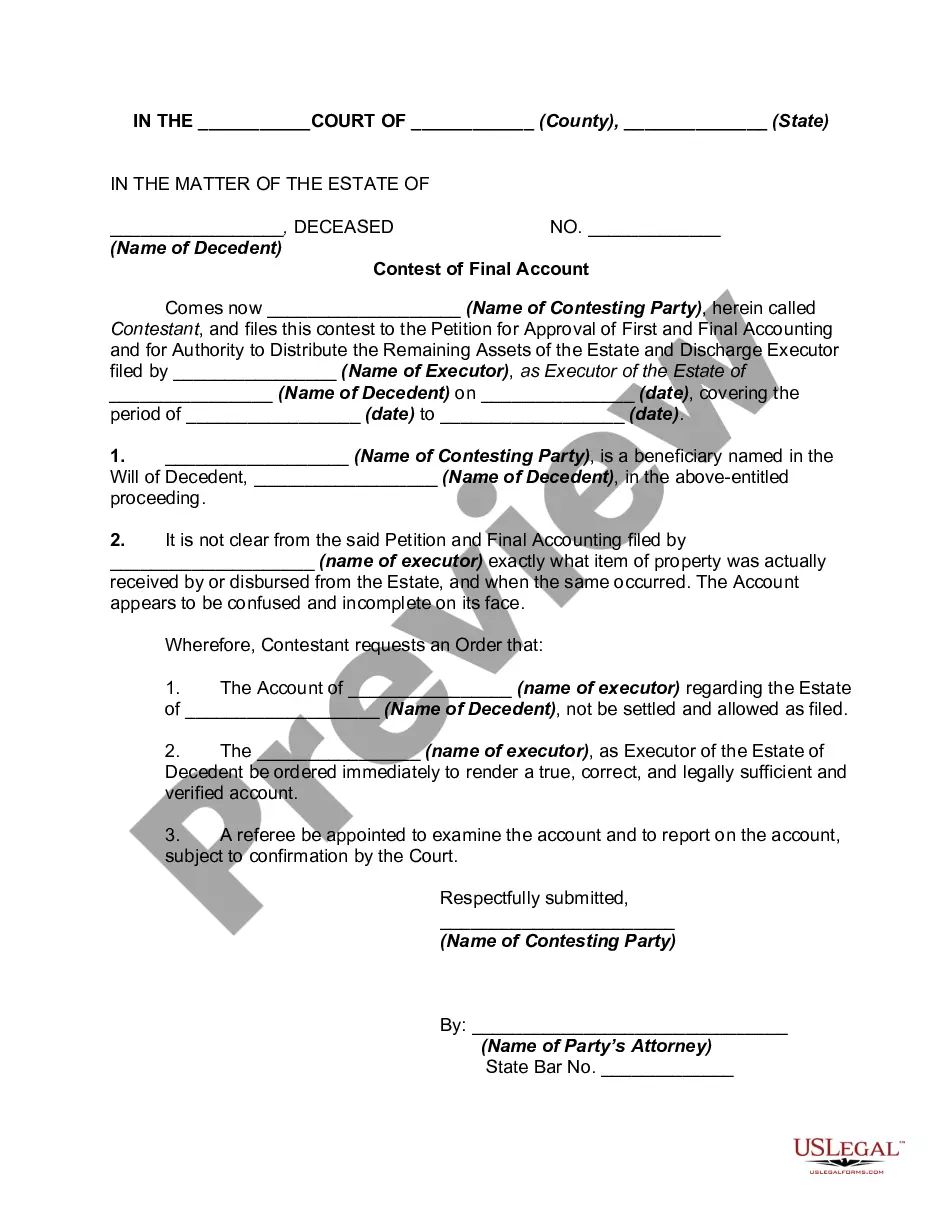
How to fill out Contest Of Final Account And Proposed Distributions In A Probate Estate?
Engaging with legal paperwork and processes can be a lengthy addition to your schedule.
Final Account Estate Form with Trustee and similar documents frequently require you to locate them and understand how to fill them out proficiently.
Thus, if you are managing financial, legal, or personal issues, having a comprehensive and accessible online collection of forms readily available will be immensely beneficial.
US Legal Forms is the leading online resource for legal templates, comprising over 85,000 state-specific forms and a range of tools to help you complete your paperwork effortlessly.
Is this your first experience with US Legal Forms? Create and establish a free account in just a few minutes, granting you access to the form library and Final Account Estate Form with Trustee. Then, follow the steps outlined below to complete your form.
- Explore the collection of pertinent documents available to you with a single click.
- US Legal Forms provides you with state- and county-specific forms anytime for immediate download.
- Protect your document management processes by utilizing a premium service that enables you to prepare any form within minutes without any additional or hidden fees.
- Simply Log In to your account, search for Final Account Estate Form With Trustee, and obtain it immediately from the My documents section.
- You can also access forms you have previously downloaded.
Form popularity
FAQ
All beneficiaries do not need to formally approve estate accounts; however, it is best practice for the Executor(s) and main beneficiaries to sign the estate accounts to show a legal agreement across all parties. Nevertheless, the beneficiaries are entitled to receive a copy of them and review the information.
Every state sets the priority ing to which claims must be paid. The estate's beneficiaries only get paid once all the creditor claims have been satisfied. Usually, estate administration fees, funeral expenses, support payments, and taxes have priority over other claims.
An Executor or Administrator has a statutory duty to produce a final Estate Account which can be enforced by the Court. This account will illustrate what money has come in and out of the Estate, listing all assets, liabilities (debts), administration expenses and the final amount to be distributed to the Beneficiaries.
A Final Account is a complete record detailing the assets, receipts, and disbursements made during a probate administration.
To begin the inheritance distribution process, you must submit the will through probate. After the probate court reviews the will, it's authorized to an executor, and the executor then legally transfers all assets?again, after settling taxes and debts.