Transmutation Agreement Texas With Us
Description
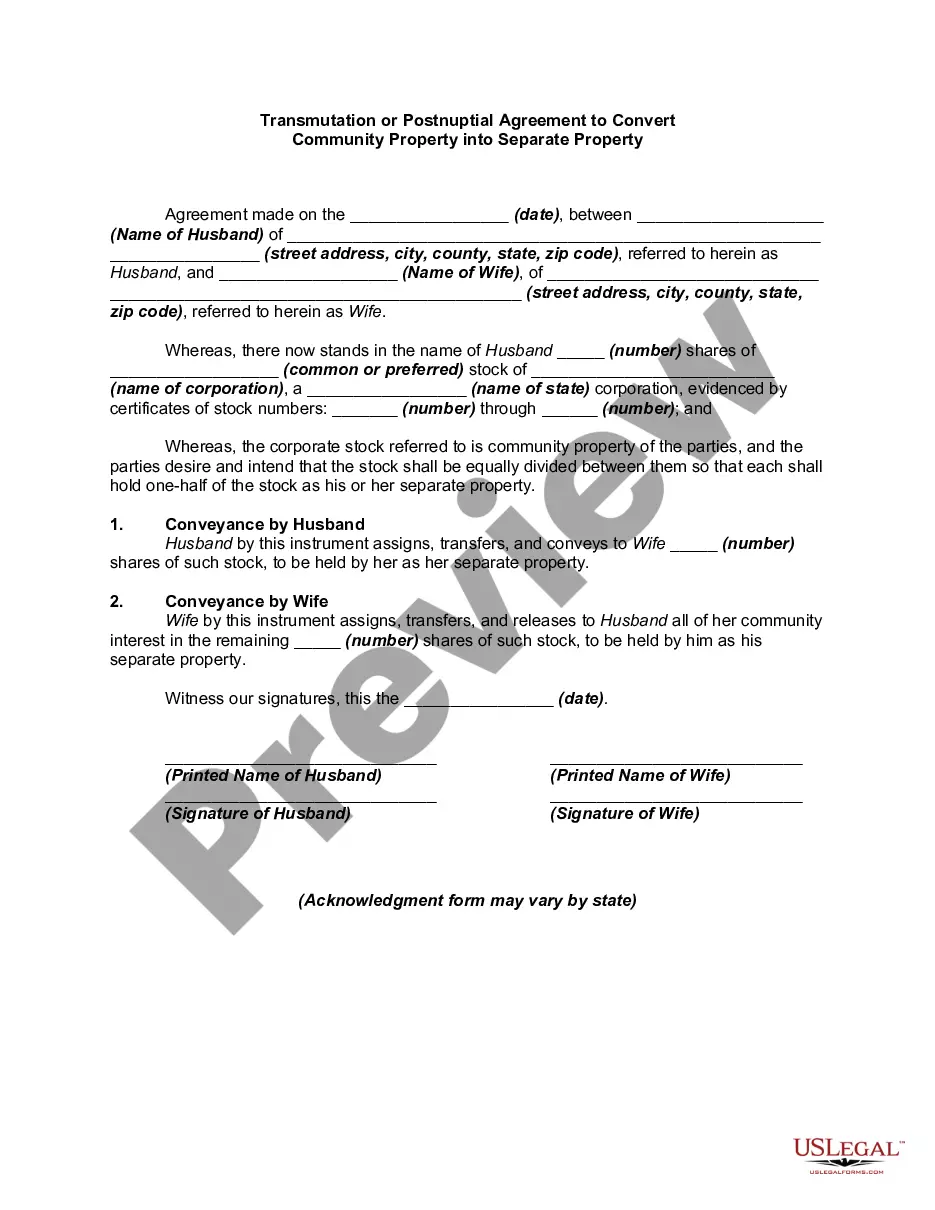
How to fill out Transmutation Or Postnuptial Agreement To Convert Community Property Into Separate Property?
- Log into your US Legal Forms account if you're a returning user and download the required template. Ensure your subscription is active; if it’s expired, renew based on your payment plan.
- For first-time users, start by reviewing the preview mode and form description to find the correct transmutation agreement that aligns with your specific needs and local requirements.
- If your search reveals any discrepancies, utilize the Search tab to explore additional templates that may better suit your situation.
- When you've identified the correct document, click on the Buy Now button and select your preferred subscription plan while registering for an account for full access.
- Complete your purchase by entering your payment information, either through credit card or PayPal.
- Finally, download your form and save it on your device. You can access this document anytime through the My Forms section of your profile.
Conclusion: Acquiring a transmutation agreement in Texas is seamless with US Legal Forms. Our extensive collection of over 85,000 editable legal forms ensures you have the right resources readily available.
Start your journey towards legal clarity today by visiting us for your legal document needs!
Form popularity
FAQ
In Texas, a spouse can claim part of the retirement benefits based on the duration of the marriage. Benefits accrued during the marriage are generally considered community property. To address retirement assets effectively, explore a transmutation agreement Texas with us, as it can clarify the terms before you reach a divorce settlement.
In Texas, there is no specific time requirement to claim a share of community property in a divorce. As long as the property was acquired during the marriage, you are eligible for a division regardless of the marriage's length. To best protect your interests, consider drafting a transmutation agreement Texas with us that outlines property rights, safeguarding your assets from the outset.
In Texas, community property laws dictate that assets acquired during the marriage are typically divided equally. However, separate property remains with the original owner. To ensure that you understand the implications of property division, consider a transmutation agreement Texas with us, which helps clarify the ownership status before a divorce occurs.
To transmute separate property to community property in Texas, you can create a transmutation agreement. This legal document explicitly states your intention to change the ownership status of the property. Working with us can streamline this process, ensuring compliance with Texas laws for your transmutation agreement. With our support, you can confidently navigate these legal waters.
In Texas, the burden of proof lies with the spouse claiming the property as separate. This person must provide clear and convincing evidence that the property was acquired prior to marriage or through gift or inheritance. A transmutation agreement in Texas with us can assist in outlining the ownership, making it easier to prove your claim if necessary. This proactive step can save you from potential disputes later on.
Splitting property in Texas typically involves identifying whether the property is classified as community or separate. If the property is community property, it will usually be divided equally. Utilizing a transmutation agreement in Texas with us can help you document any agreed changes in property ownership or classification. This can simplify the process and ensure both parties have a clear understanding of their rights.
In Texas, community property includes assets acquired during marriage, while separate property refers to assets owned by either spouse before marriage or received as gifts or inheritances. Understanding the distinction is crucial when you navigate a transmutation agreement in Texas with us, as this agreement can change the classification of certain properties. By clearly defining your assets, you can effectively manage your financial interests in case of divorce.
No, marrying does not automatically make you responsible for your spouse's debts. Each partner is typically liable for their own debts unless they sign agreements that state otherwise. To better manage your financial responsibilities, consider a transmutation agreement Texas with us to ensure clarity in ownership and liability.
To protect yourself from your husband's debt, consider establishing a transmutation agreement Texas with us. This legal document can help clarify ownership of assets and liabilities. Additionally, maintaining separate accounts and refraining from co-signing loans can further safeguard your financial standing.
In Texas, a wife can be held responsible for her husband's debt, but this usually depends on how the debt was incurred and whether it was joint or separate. If the debt is solely in the husband's name, the wife typically has no obligation. However, understanding the implications of a transmutation agreement Texas with us can provide clarity and potentially protect your financial interests.