Testamentary Trust Sample
Description

Get your form ready online
Our built-in tools help you complete, sign, share, and store your documents in one place.
Make edits, fill in missing information, and update formatting in US Legal Forms—just like you would in MS Word.
Download a copy, print it, send it by email, or mail it via USPS—whatever works best for your next step.
Sign and collect signatures with our SignNow integration. Send to multiple recipients, set reminders, and more. Go Premium to unlock E-Sign.
If this form requires notarization, complete it online through a secure video call—no need to meet a notary in person or wait for an appointment.
We protect your documents and personal data by following strict security and privacy standards.

Make edits, fill in missing information, and update formatting in US Legal Forms—just like you would in MS Word.

Download a copy, print it, send it by email, or mail it via USPS—whatever works best for your next step.

Sign and collect signatures with our SignNow integration. Send to multiple recipients, set reminders, and more. Go Premium to unlock E-Sign.

If this form requires notarization, complete it online through a secure video call—no need to meet a notary in person or wait for an appointment.

We protect your documents and personal data by following strict security and privacy standards.
Looking for another form?


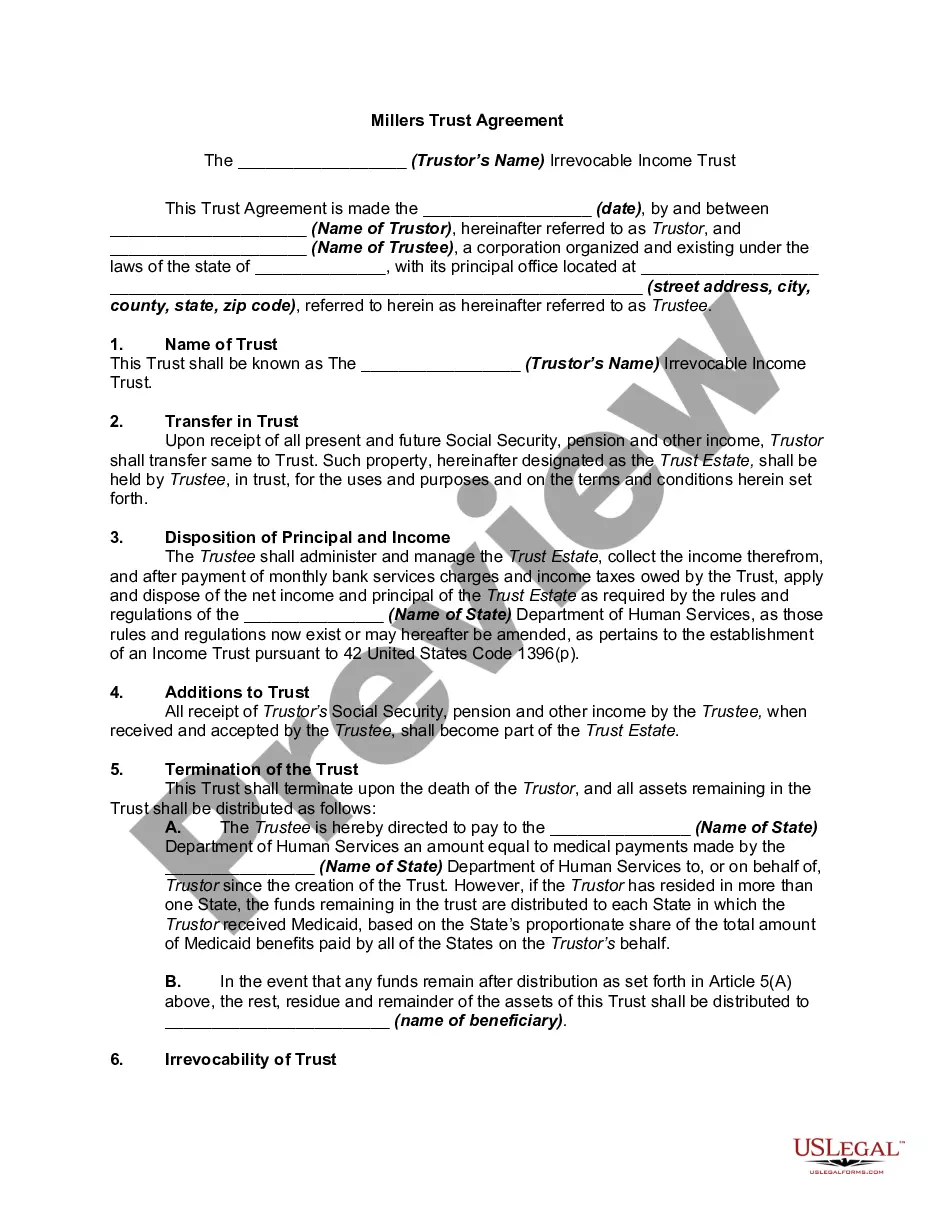
How to fill out Qualified Income Miller Trust?
- If you're a returning user of US Legal Forms, log into your account and download the needed testamentary trust template by clicking on the Download button. Ensure your subscription is up to date; renew it if necessary.
- For first-time users, start by exploring the Preview mode to read the form description. Check that the testamentary trust sample meets your specific legal needs and jurisdiction requirements.
- If the selected template does not fit your needs, use the Search tab to discover other options that might be more suitable.
- Purchase the selected document by clicking the Buy Now button and choosing your preferred subscription plan. You'll need to create an account to access the full range of resources.
- Proceed to payment by entering your credit card information or using your PayPal account to complete the subscription purchase.
- Download your completed testamentary trust form. You can access it anytime from the My Forms section of your profile.
Utilizing US Legal Forms allows individuals and attorneys to quickly access a comprehensive library of legal forms, ensuring that the testamentary trust you create is both easy to fill out and legally sound.
Start your journey to solidify your legacy today. Visit US Legal Forms to get your testamentary trust sample now!
Form popularity
FAQ
Creating a DIY testamentary trust is possible, but it requires a thorough understanding of legal requirements. A testamentary trust sample can serve as a useful guide, illustrating how to structure your trust according to your wishes. However, securing professional assistance through platforms like USLegalForms can enhance your peace of mind. Their templates and guidance ensure your trust meets all legal standards.
While a testamentary trust sample offers several benefits, it also has notable disadvantages. For instance, these trusts do not take effect until the testator's death, causing potential delays in asset distribution. Furthermore, they usually go through probate, which can incur additional costs and fees. Being aware of these downsides helps you make informed decisions about your estate planning.
The legal terminology associated with testamentary typically includes references to wills, estates, and trusts. A testamentary trust sample falls under this nomenclature, representing a trust established by the provisions of a will. Understanding these terms is vital, as they clarify how such documents will influence asset distribution. Seeking assistance, like through USLegalForms, can ensure your estate plan employs the right legal terminology.
When something is described as testamentary, it refers to provisions made in connection with a will or trust that takes effect upon someone's death. This is essential in understanding how testamentary trust samples function. For example, a trust created in a will dictates how assets are distributed after the testator passes away. In essence, testamentary arrangements govern posthumous asset management.
Testamentary capacity requires four essential elements: the ability to understand the nature of the act, the ability to know the extent of your property, the ability to comprehend the impact of decisions, and the ability to recall family relationships. If an individual can fulfill these criteria, they can create a valid testamentary document. This affirmation secures their wishes, reflected in a testamentary trust sample. Ensuring these elements are met is crucial for effective estate planning.
A testamentary trust sample is an excellent illustration of how a testamentary document functions. For instance, a will might state that upon a person's death, their assets will be placed into a trust for their minor children. This ensures the children's financial needs are met until they reach adulthood. Such examples showcase how a testamentary trust can protect and manage assets according to the deceased's wishes.
One disadvantage of a testamentary trust is that it only takes effect upon the grantor's death, meaning there is no immediate control over assets. Additionally, this type of trust may go through probate, potentially leading to delays and added costs. Being aware of these factors is essential; however, having a testamentary trust sample can help individuals plan effectively and minimize complications.
To establish a testamentary trust, you will typically need a legally binding will, which outlines the trust provisions. You may also require additional documents like a death certificate and any prior estate planning paperwork. Using platforms like USLegalForms can simplify the process by providing sample documents and guidance for creating your testamentary trust.
A testamentary trust example can be a trust created to provide for a disabled family member. The trust can allocate funds for their care, medical expenses, and daily needs, ensuring their financial security. By detailing the terms in a will, the grantor makes it clear how these resources should be used, protecting the beneficiary while honoring their legacy.
A common example of a testamentary trust is one set up for minor children. In this case, a trust may be created in a will to manage funds until the children reach a certain age. This arrangement allows the assets to be distributed responsibly and according to specific instructions, aligning with the grantor's intentions.