Taxable Income For Trust
Description

Get your form ready online
Our built-in tools help you complete, sign, share, and store your documents in one place.
Make edits, fill in missing information, and update formatting in US Legal Forms—just like you would in MS Word.
Download a copy, print it, send it by email, or mail it via USPS—whatever works best for your next step.
Sign and collect signatures with our SignNow integration. Send to multiple recipients, set reminders, and more. Go Premium to unlock E-Sign.
If this form requires notarization, complete it online through a secure video call—no need to meet a notary in person or wait for an appointment.
We protect your documents and personal data by following strict security and privacy standards.

Make edits, fill in missing information, and update formatting in US Legal Forms—just like you would in MS Word.

Download a copy, print it, send it by email, or mail it via USPS—whatever works best for your next step.

Sign and collect signatures with our SignNow integration. Send to multiple recipients, set reminders, and more. Go Premium to unlock E-Sign.

If this form requires notarization, complete it online through a secure video call—no need to meet a notary in person or wait for an appointment.

We protect your documents and personal data by following strict security and privacy standards.
Looking for another form?










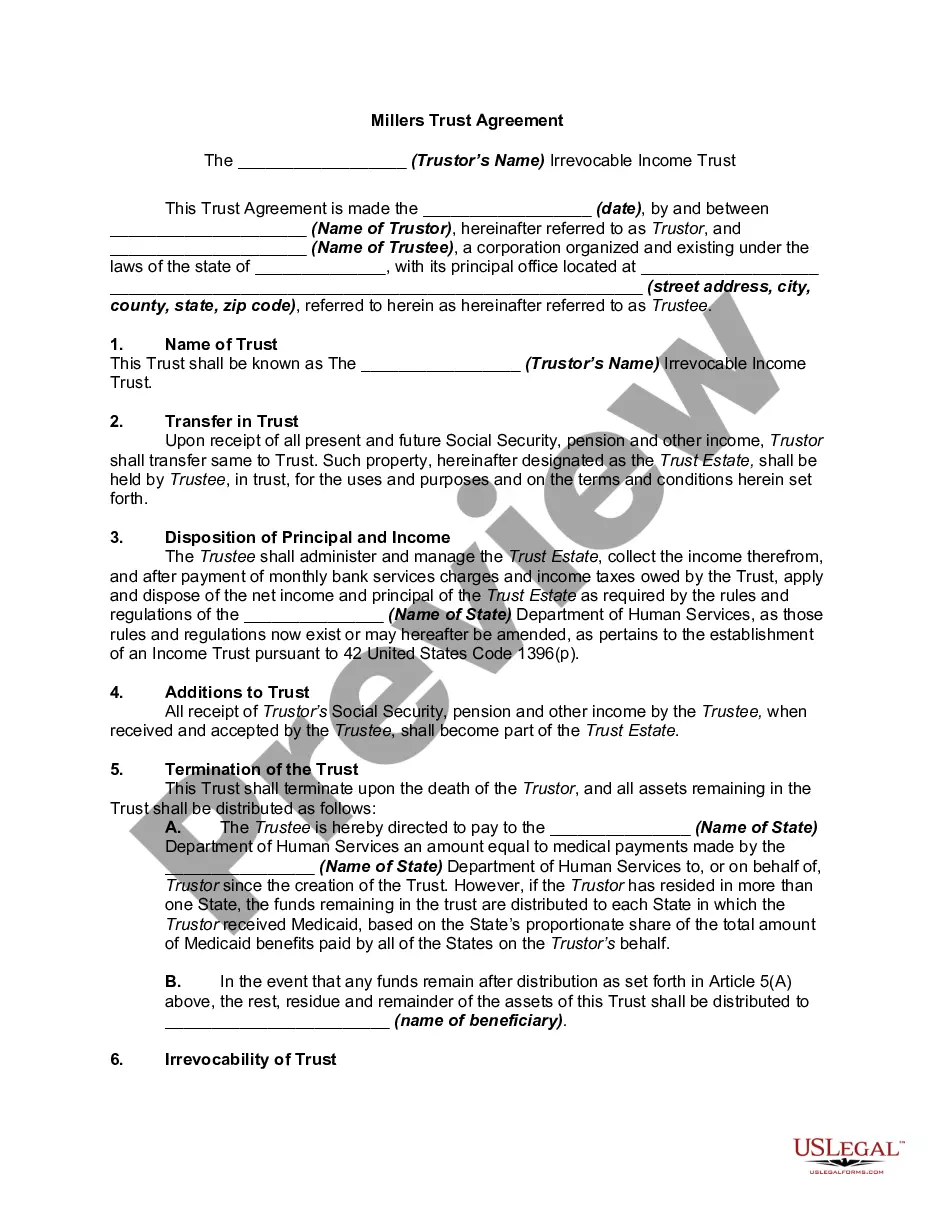
How to fill out Qualified Income Miller Trust?
- For returning users, log in to your account and select the required form template by clicking the Download button. Ensure your subscription is active; if not, renew it accordingly.
- If you're a new user, begin by exploring the Preview mode. Assess the form description to confirm it meets your requirements and local jurisdiction rules.
- Search for alternative templates if the previous one doesn't suit your needs. Utilize the Search tab at the top to find the appropriate documentation.
- Once you find the suitable form, proceed to purchase by clicking the Buy Now button and choosing your preferred subscription plan. An account registration is necessary for full access.
- Complete your purchase by entering your credit card information or opting for PayPal to finalize your subscription.
- Download your chosen form to your device. You can also access it later via the My Forms section of your profile.
By following these steps, you can ensure that you secure the necessary forms for managing your taxable income for trust efficiently.
Leverage the benefits of US Legal Forms today and take the hassle out of your legal documentation process! Sign up now!
Form popularity
FAQ
Calculating trust net income requires you to assess all income the trust has generated during the year. Start by totaling revenues such as interest, dividends, and gains from asset sales, then deduct related expenses like management fees. This will give you an accurate figure for net income, which is a critical component in determining the taxable income for trust.
Yes, trust income must be reported on tax returns both at the trust level and by the beneficiaries. Trusts file IRS Form 1041 for their income, while beneficiaries report their share through their individual returns. Understanding how to report this income ensures you correctly calculate your taxable income for trust, helping you remain compliant.
Certain trusts may exploit tax advantages known as loopholes, allowing income to be taxed at lower personal rates. Techniques include shifting income between beneficiaries or using tax-exempt investment vehicles. However, utilizing these loopholes carefully is key, as they must align with regulations to avoid complications in your taxable income for trust.
Yes, beneficiaries often receive a Form 1099 for trust income, particularly if they receive distributions from the trust. This form reports the amount of income earned by the trust and the portion distributed to the beneficiary. By receiving a 1099, you are informed of your share of taxable income for trust, which you must report on your tax return.
To calculate distributable net income (DNI) for a trust, start by totaling the trust's taxable income, then make necessary adjustments. This includes adding back tax-exempt income and deducting specific expenses. Understanding DNI is essential, as it dictates how much income beneficiaries receive and need to report, thus impacting the overall taxable income for trust.
Calculating trust taxable income involves determining all income generated by the trust, minus allowable deductions. First, aggregate all income sources such as interest, dividends, and rental income. Then, subtract legitimate expenses, and you will find the taxable income for trust, which is crucial for accurate tax reporting.
A trust appears on an income tax return through IRS Form 1041, which is specifically designed for estates and trusts. This form outlines the taxable income for trust, detailing various sources of income, deductions, and distributions to beneficiaries. Additionally, beneficiaries report their share of the trust's income on their individual tax returns, which enhances your understanding of the overall taxable income for trust.
Wealthy individuals often use trusts to strategically manage their taxable income for trust, leveraging tax advantages legally available to them. By placing assets in trusts, they can reduce their taxable estates and effectively defer taxes. These strategies can involve different types of trusts, each with unique benefits. Using platforms like US Legal Forms can help you understand how to set up these trusts correctly and comply with tax laws.
The trust fund loophole typically allows individuals to minimize their taxable income for trust through various strategies. This can include shifting income to lower tax brackets or utilizing tax-exempt investments. However, understanding the nuances requires expertise in tax law. Engaging with a legal professional can help you navigate these complexities to ensure your trust fund strategy complies with regulations while optimizing benefits.
Filling out a 1041 estate tax return requires careful attention to detail, especially concerning the taxable income for trust. Start by gathering all relevant financial documents, including income statements and deductions related to the trust. When completing the form, ensure you accurately report all income generated by the trust. For assistance in navigating this process, consider using US Legal Forms to access resources tailored to help you file correctly.