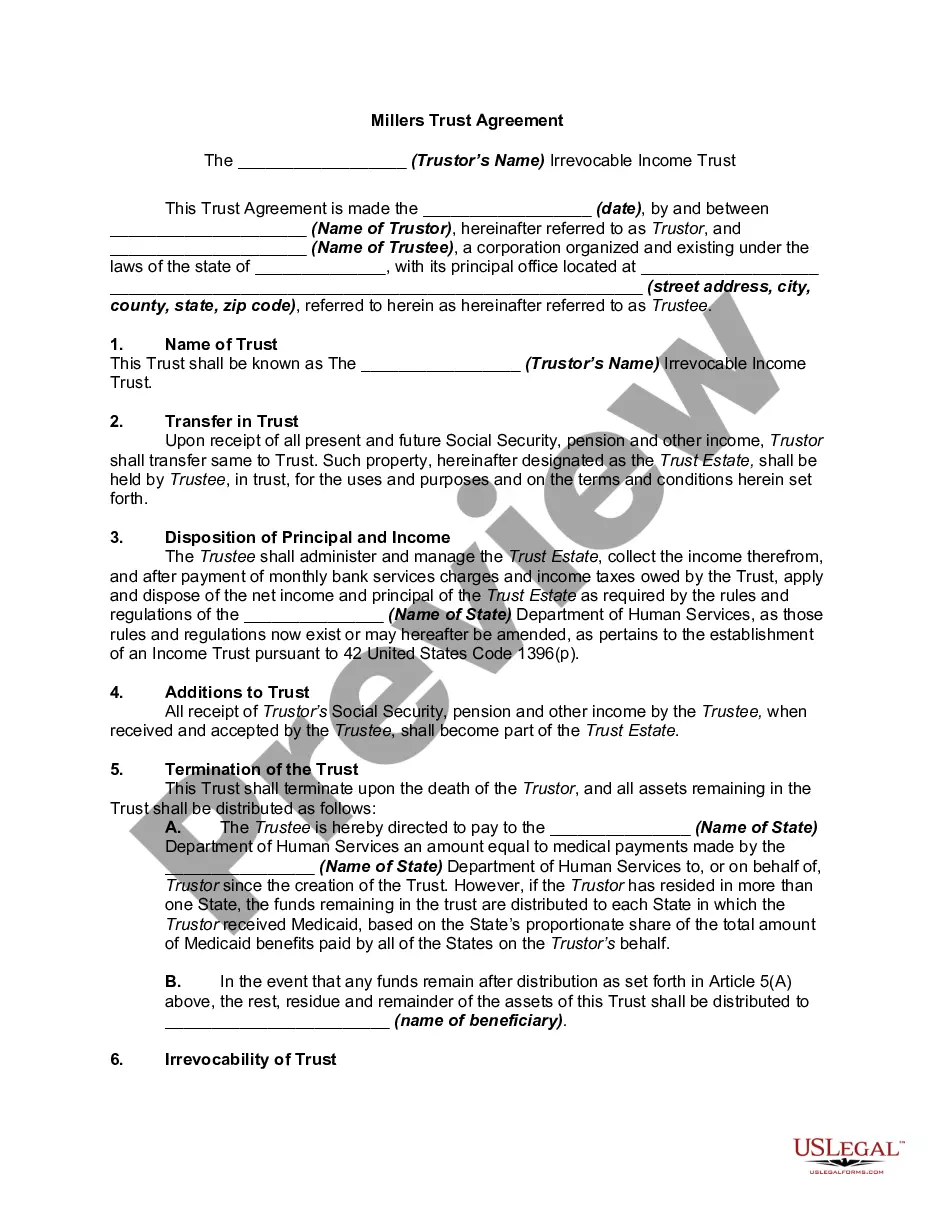
Grantir Trust
Description

Get your form ready online
Our built-in tools help you complete, sign, share, and store your documents in one place.
Make edits, fill in missing information, and update formatting in US Legal Forms—just like you would in MS Word.
Download a copy, print it, send it by email, or mail it via USPS—whatever works best for your next step.
Sign and collect signatures with our SignNow integration. Send to multiple recipients, set reminders, and more. Go Premium to unlock E-Sign.
If this form requires notarization, complete it online through a secure video call—no need to meet a notary in person or wait for an appointment.
We protect your documents and personal data by following strict security and privacy standards.

Make edits, fill in missing information, and update formatting in US Legal Forms—just like you would in MS Word.

Download a copy, print it, send it by email, or mail it via USPS—whatever works best for your next step.

Sign and collect signatures with our SignNow integration. Send to multiple recipients, set reminders, and more. Go Premium to unlock E-Sign.

If this form requires notarization, complete it online through a secure video call—no need to meet a notary in person or wait for an appointment.

We protect your documents and personal data by following strict security and privacy standards.
Looking for another form?







How to fill out Qualified Income Miller Trust?
- Begin by visiting the US Legal Forms website and log in to your account if you're a returning user. Ensure that your subscription is active for uninterrupted access.
- If you're a new user, familiarize yourself with the available forms. Browse through the Preview mode to select the document that aligns with your requirements and local jurisdiction.
- If you need to explore different options, utilize the Search function to find other templates that suit your specific needs.
- Once you've identified the correct form, click on the 'Buy Now' button and select your preferred subscription plan. Registration will be necessary to access the full library.
- Proceed to payment by entering your credit card details or opting for PayPal. Ensure the transaction is completed successfully.
- Lastly, download your selected form to your device. You can access your documents at any time in the 'My Forms' section of your account.
Following these steps ensures a smooth experience with US Legal Forms, allowing you to create documents with confidence and accuracy.
Start your journey today and explore the benefits of streamlined legal documentation. Take action now and experience how US Legal Forms can grant trust to your legal ventures!
Form popularity
FAQ
The primary purpose of a grantor trust is to provide the grantor with control over their assets while enjoying tax advantages. This trust structure allows the grantor to manage the assets during their lifetime without the complications of a separate trust tax return. It efficiently simplifies estate planning and can facilitate the eventual transfer of assets to beneficiaries.
While both types of trusts allow the grantor to maintain control, a grantor trust specifically refers to the way income is taxed. A revocable trust is merely a testamentary document that can be altered or revoked by the grantor during their lifetime. Thus, all grantor trusts are revocable trusts, but not all revocable trusts qualify as grantor trusts for tax purposes.
The main difference lies in the control and tax implications. In a grantor trust, the grantor retains control over the assets and is responsible for the income taxes generated. Conversely, a non-grantor trust is a separate tax entity, meaning it pays its own taxes on any income it generates. This distinction influences how assets are managed and taxed.
A grantor trust is a legal arrangement where the person who creates the trust retains control over the assets within it. This means that for tax purposes, the grantor is usually required to report the trust's income on their personal tax return. Essentially, a grantor trust offers flexibility for the grantor, allowing them to manage their assets while potentially enjoying certain tax benefits.
Typically, a grantor trust does not require an Employer Identification Number (EIN) if the grantor is still alive. Instead, you can use your Social Security Number for tax purposes. However, if the trust becomes irrevocable or has multiple grantors, obtaining an EIN may be necessary.
Failing to file a trust tax return can lead to penalties and interest on unpaid taxes. Furthermore, it may trigger an audit by the IRS, creating more complications. It is essential to stay up to date with your tax obligations to avoid negative consequences.
The grantor of the trust is responsible for reporting its income. This means that even if the trust generates income, you will include that on your personal tax return. Understanding this responsibility is crucial for tax planning and compliance.
Generally, a tax return is not required for a grantor trust as its income is attached to the grantor's return. However, if the trust becomes irrevocable, it may need to file its own tax return. Always assess your specific situation to ensure compliance with tax regulations.
Setting up a grantor trust involves drafting a trust document that outlines the terms and beneficiaries. You can begin by consulting with a legal professional to ensure compliance with state laws. Additionally, US Legal Forms offers resources and templates that can simplify the creation of your grantor trust.
To report income from an irrevocable grantor trust, you still include this income on your personal income tax return. It's crucial to keep accurate records of the income and expenses related to the trust. If you're unsure how to report this, consider using US Legal Forms to gain access to the necessary documents and guidance.