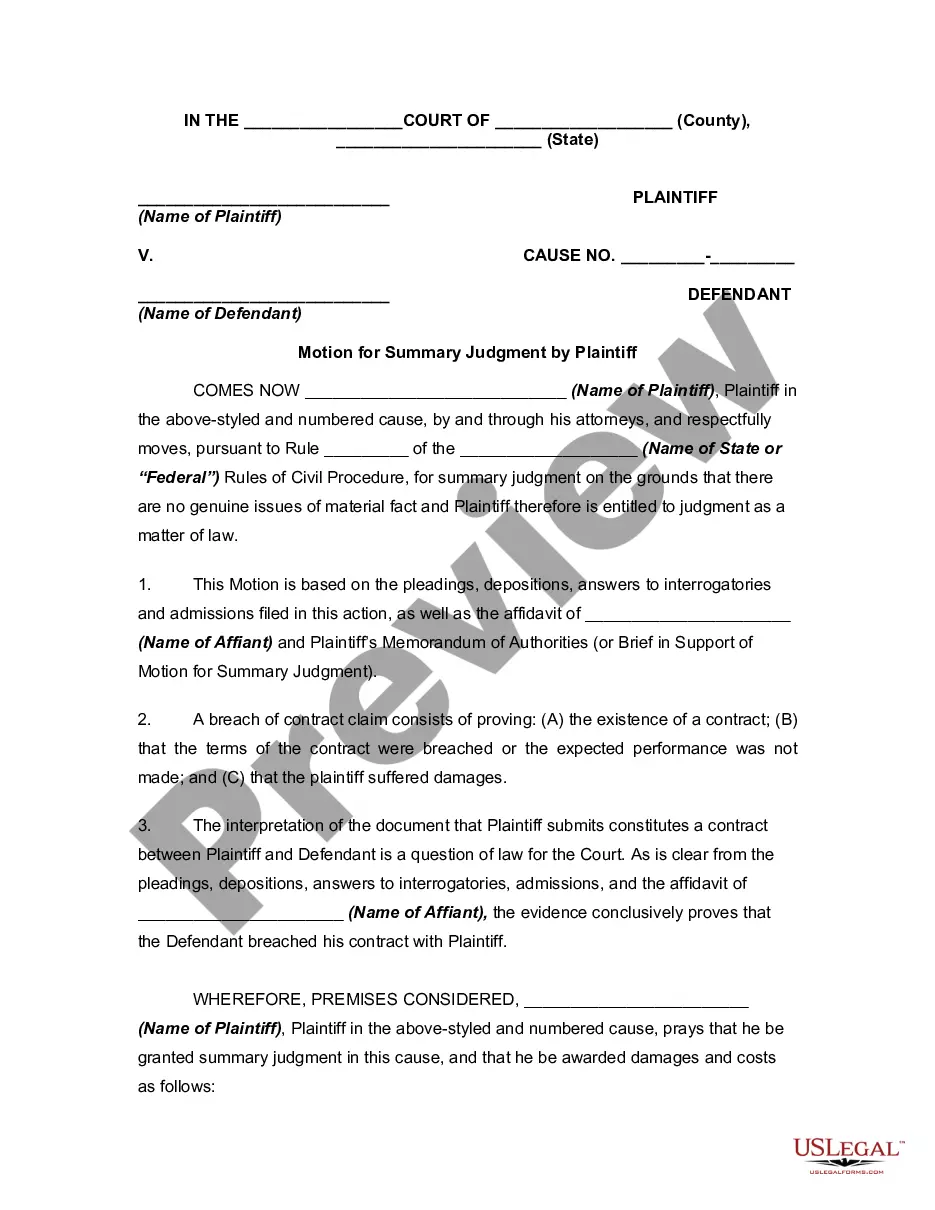
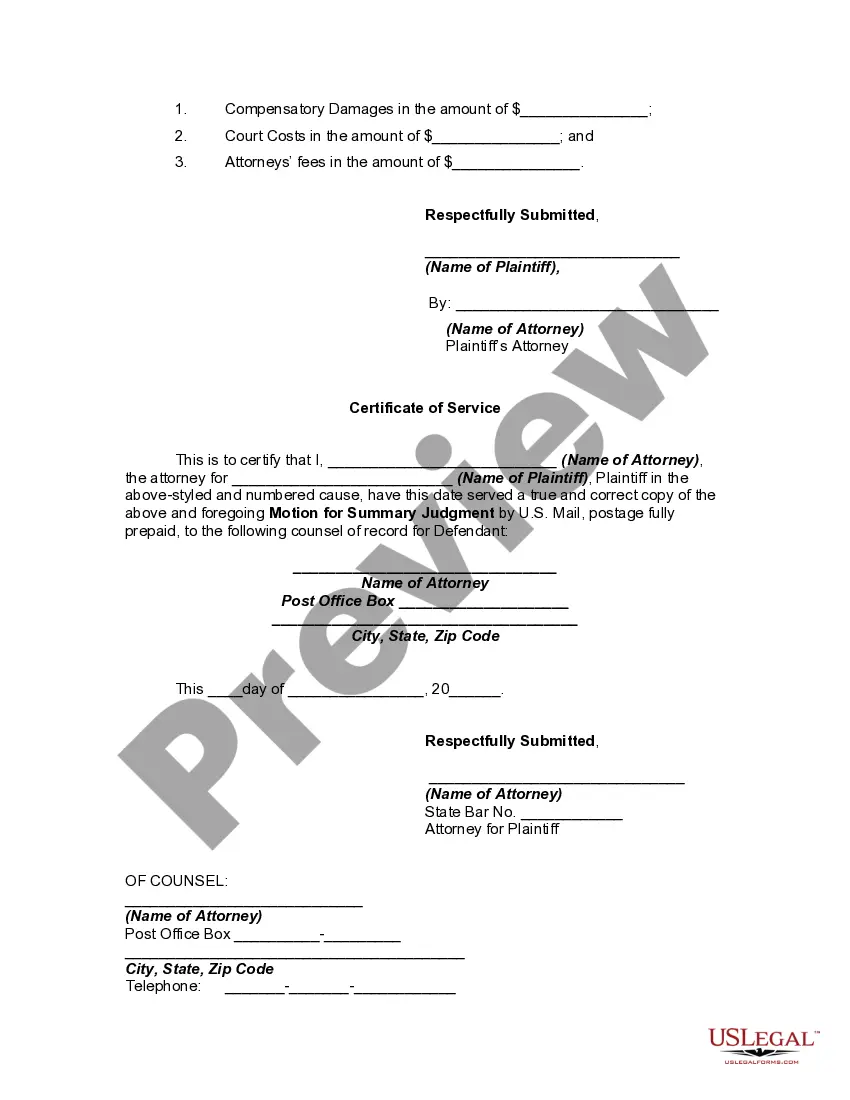
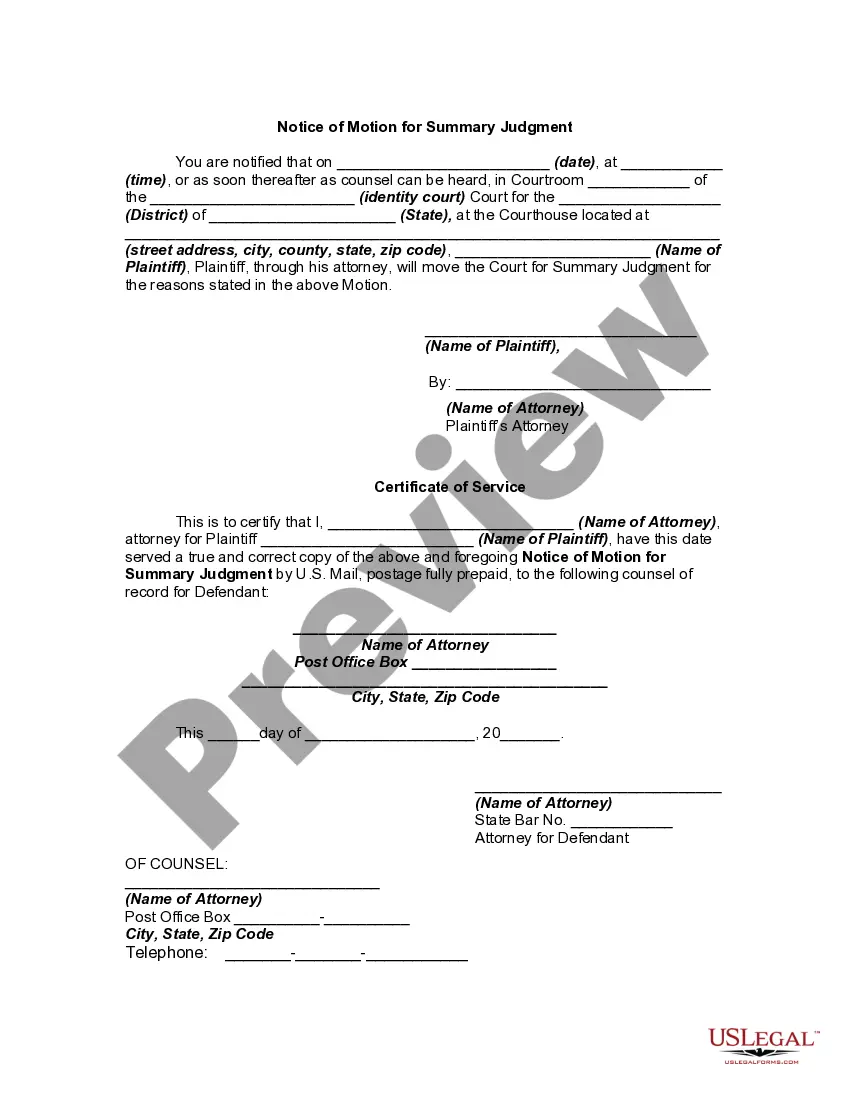
Plaintiffs Motion For Summary Judgment With Motion
Description
Get your form ready online
Our built-in tools help you complete, sign, share, and store your documents in one place.
Make edits, fill in missing information, and update formatting in US Legal Forms—just like you would in MS Word.
Download a copy, print it, send it by email, or mail it via USPS—whatever works best for your next step.
Sign and collect signatures with our SignNow integration. Send to multiple recipients, set reminders, and more. Go Premium to unlock E-Sign.
If this form requires notarization, complete it online through a secure video call—no need to meet a notary in person or wait for an appointment.
We protect your documents and personal data by following strict security and privacy standards.

Make edits, fill in missing information, and update formatting in US Legal Forms—just like you would in MS Word.

Download a copy, print it, send it by email, or mail it via USPS—whatever works best for your next step.

Sign and collect signatures with our SignNow integration. Send to multiple recipients, set reminders, and more. Go Premium to unlock E-Sign.

If this form requires notarization, complete it online through a secure video call—no need to meet a notary in person or wait for an appointment.

We protect your documents and personal data by following strict security and privacy standards.
Looking for another form?

How to fill out Motion For Summary Judgment By Plaintiff For Breach Of Contract?
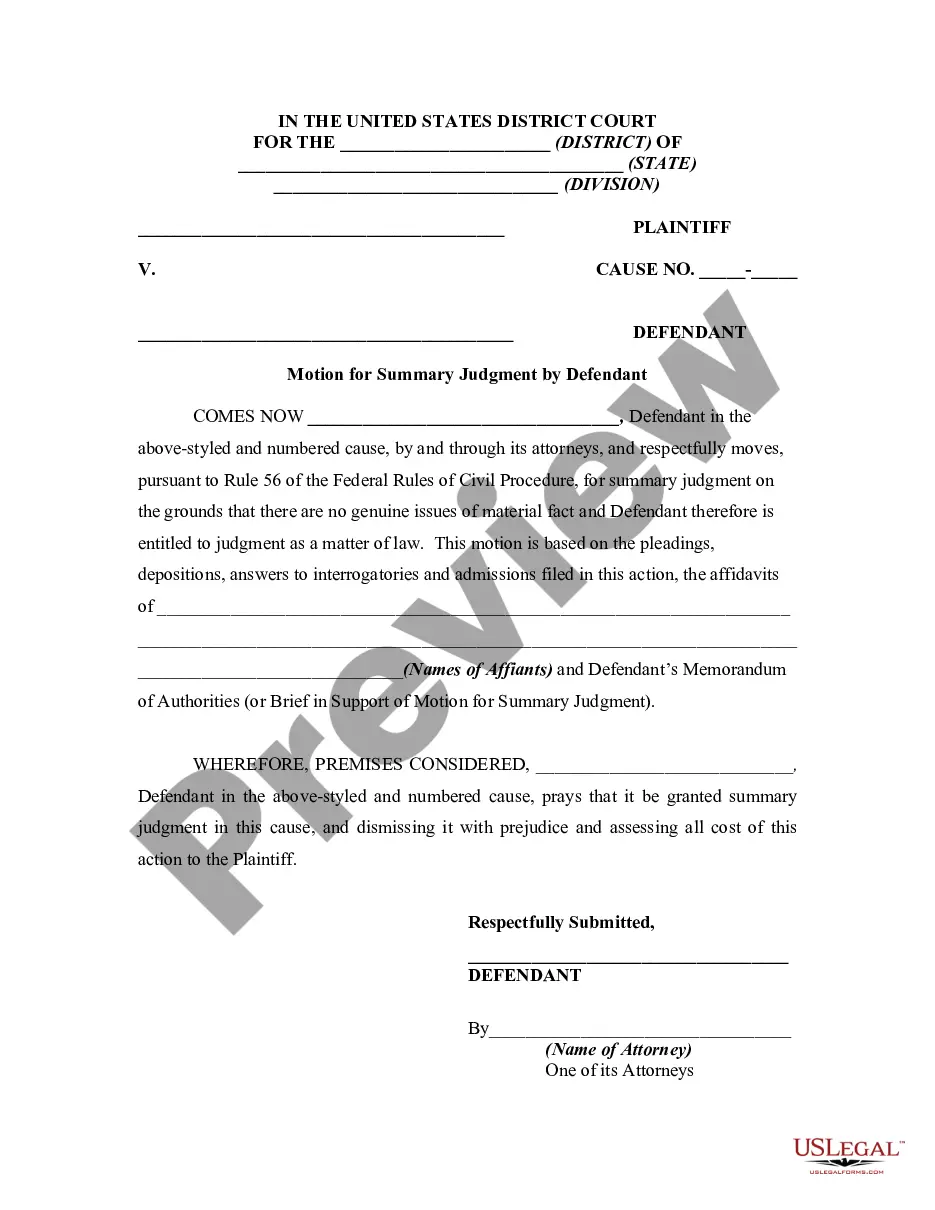
The Plaintiff's Request for Summary Judgment Accompanied by Motion you see on this page is a reusable formal model crafted by professional attorneys in compliance with federal and local statutes and guidelines.
For over 25 years, US Legal Forms has supplied individuals, companies, and legal representatives with more than 85,000 validated, state-specific documents for any business and personal situation. It is the fastest, most straightforward, and most reliable way to acquire the documentation you require, as the service assures the utmost level of data protection and anti-virus security.
Utilize the same document again whenever necessary. Access the My documents tab in your account to redownload any previously downloaded forms.
- Search for the form you need and examine it.
- Scan through the file you looked for and preview it or check the form description to ensure it meets your needs. If it does not, utilize the search function to find the correct one. Click Buy Now when you have found the template you need.
- Register and Log In.
- Select the payment plan that fits you and create an account. Use PayPal or a credit card to process a swift payment. If you already possess an account, Log In and check your subscription to proceed.
- Obtain the fillable document.
- Select the format you want for your Plaintiffs Motion For Summary Judgment With Motion (PDF, DOCX, RTF) and download the template onto your device.
- Complete and sign the form.
- Print out the model to fill it out by hand. Alternatively, use an online multifunctional PDF editor to swiftly and accurately complete and sign your document with a valid signature.
Form popularity
FAQ
The odds of winning a summary judgment can vary significantly based on the details of your case. Generally, a clear presentation of facts and strong evidence supporting your legal claims can improve your chances. Courts usually grant summary judgments when there is no genuine dispute over material facts. Thus, understanding how to craft effective arguments against a plaintiffs’ motion for summary judgment with motion is crucial for success.
To object to a motion for summary judgment, you must first read the motion carefully and understand its arguments. Next, gather evidence and legal precedents that support your case. You will then draft an objection, clearly explaining your reasons and citing relevant rules or case law. Utilizing resources like USLegalForms can help you create a well-structured objection to the plaintiffs' motion for summary judgment with motion.
To object to a motion for summary judgment, you need to file an opposition to the motion with the court. Your opposition must present evidence, legal arguments, and any pertinent documents that counter the motion. Effectively addressing a plaintiffs motion for summary judgment with motion can significantly affect the outcome of your case.
The odds of winning a plaintiff motion for summary judgment can vary significantly based on the specific circumstances of the case. Generally, plaintiffs face challenges due to the strict scrutiny from the courts, which requires compelling evidence to support their claims. However, with thorough preparation and clear evidence, plaintiffs can improve their chances of success.
Filing a plaintiff motion for summary judgment carries certain risks. If the court denies the motion, it may strengthen the defendant's position, leading to a more aggressive defense. Additionally, the costs associated with drafting and presenting the motion can be substantial, and if not executed correctly, it may hinder the plaintiff's case.
To beat a motion for summary judgment, present clear and credible evidence that raises substantial questions about key facts. Craft a solid narrative that illustrates why the case should proceed to trial. Engaging in thorough preparation is essential, especially when leveraging the Plaintiffs motion for summary judgment with motion to find weaknesses in the opposing party’s case. This strategic approach can lead to overcoming the motion.
Briefly describe the relevant undisputed facts of the case. Describe why summary judgment should be granted. I look for opportunities here to grab the judge's attention by telling him or her that I am dropping one of my arguments, and stating why. This lets the judge know I am not going to waste the court's time.
Replies should be succinctly stated. If the response to a fact is ?undisputed,? the reply should also state ?undisputed.? If you contend that despite a response of ?disputed,? the non-moving party has failed to raise a genuine dispute of material fact, you should succinctly state why.
The chance of success in these cases is less than 10% [1]. Another study found that summary judgment is mostly granted in Title VII cases, for example, cases involving equal pay or employment discrimination [2]. When it comes to federal cases, summary judgments are filed in 17% of total cases.
In this case, you must be able to prove the amount you are owed. If you are the defendant, you can apply for summary judgment on the ground that there is no merit to all or part of the claim that the plaintiff is making against you.