Define Trustee Of A Trust
Description

Get your form ready online
Our built-in tools help you complete, sign, share, and store your documents in one place.
Make edits, fill in missing information, and update formatting in US Legal Forms—just like you would in MS Word.
Download a copy, print it, send it by email, or mail it via USPS—whatever works best for your next step.
Sign and collect signatures with our SignNow integration. Send to multiple recipients, set reminders, and more. Go Premium to unlock E-Sign.
If this form requires notarization, complete it online through a secure video call—no need to meet a notary in person or wait for an appointment.
We protect your documents and personal data by following strict security and privacy standards.

Make edits, fill in missing information, and update formatting in US Legal Forms—just like you would in MS Word.

Download a copy, print it, send it by email, or mail it via USPS—whatever works best for your next step.

Sign and collect signatures with our SignNow integration. Send to multiple recipients, set reminders, and more. Go Premium to unlock E-Sign.

If this form requires notarization, complete it online through a secure video call—no need to meet a notary in person or wait for an appointment.

We protect your documents and personal data by following strict security and privacy standards.
Looking for another form?






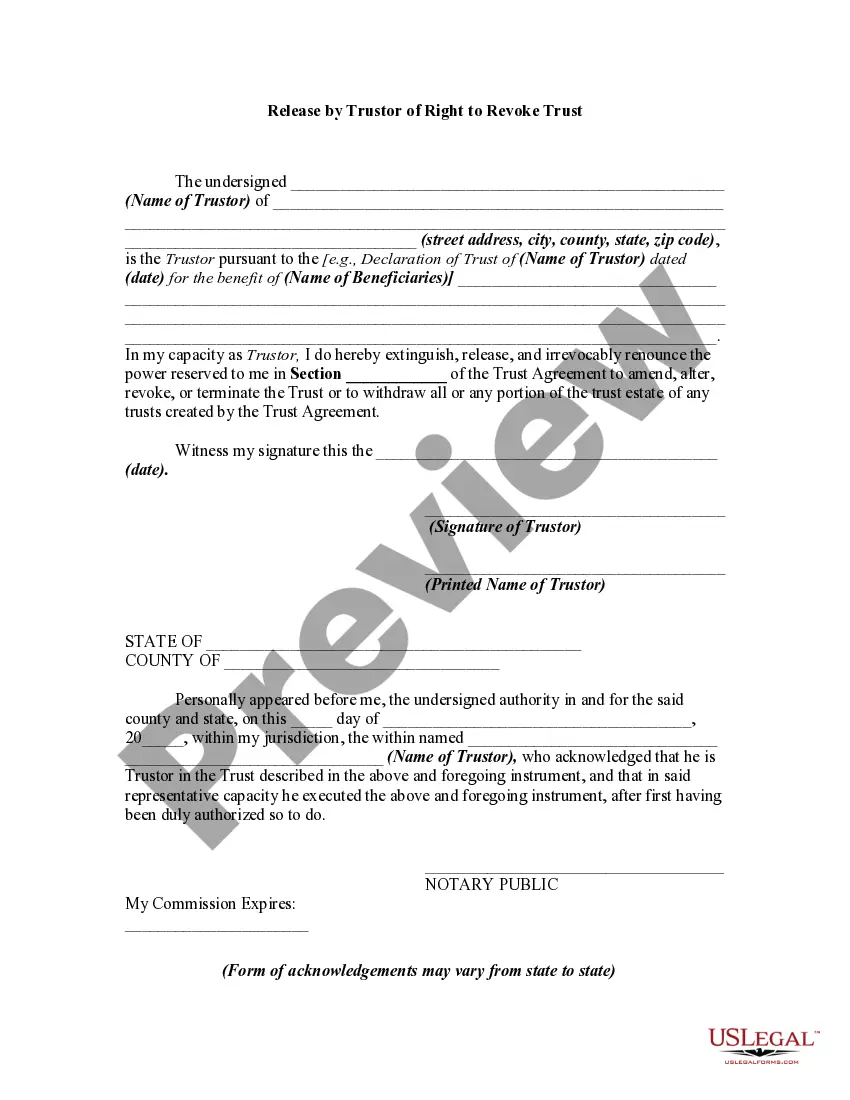
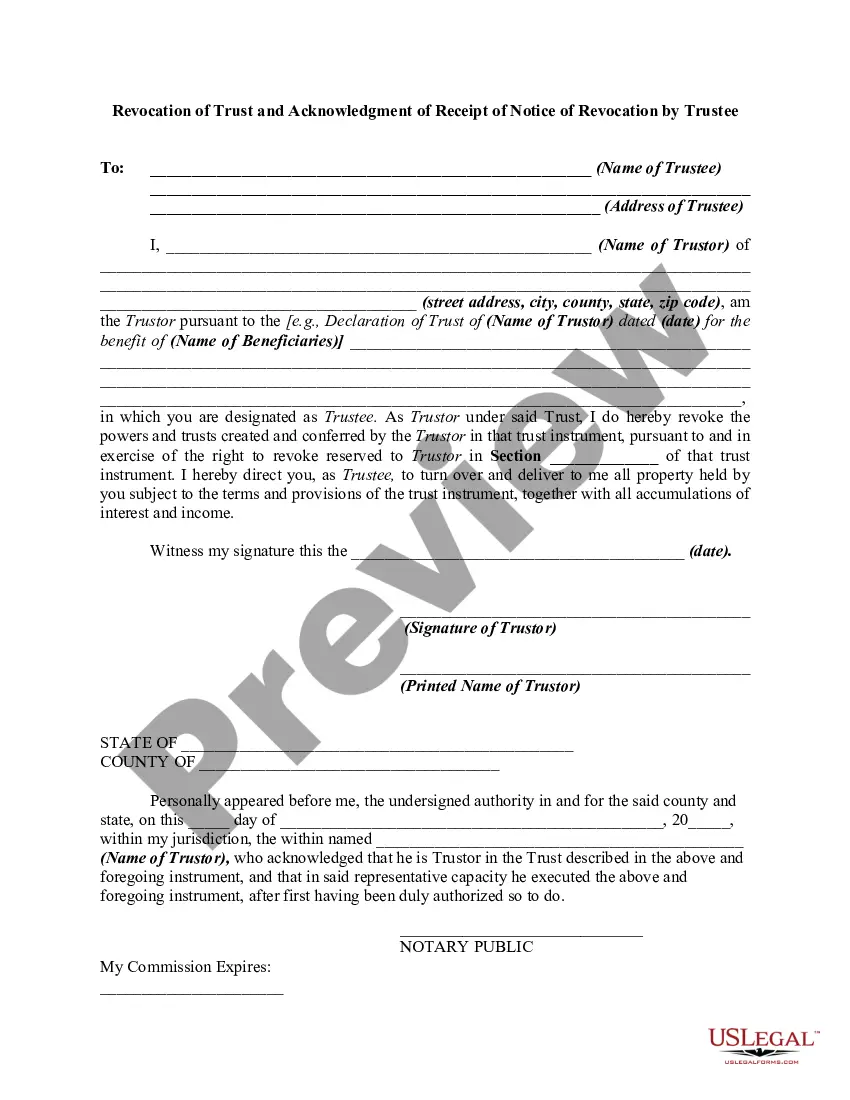
How to fill out Release By Trustor Of Right To Revoke Trust?
Legal administration can be exasperating, even for seasoned professionals.
When you're looking for a Definition of Trustee Of A Trust and lack the opportunity to invest time seeking the right and current version, the ordeal can be taxing.
US Legal Forms accommodates all your needs, from personal to corporate documentation, all collected in one convenient location.
Leverage cutting-edge tools to complete and manage your Definition of Trustee Of A Trust.
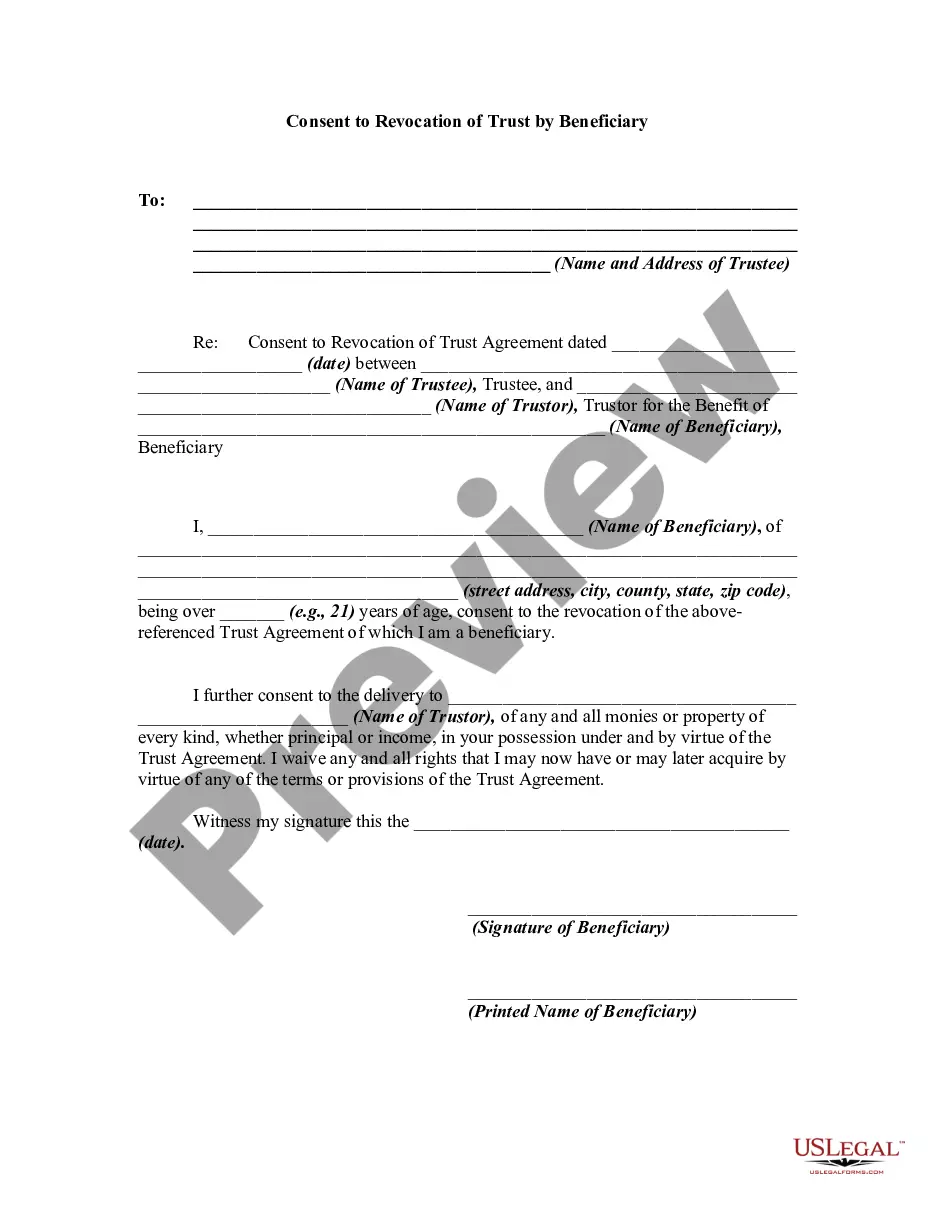
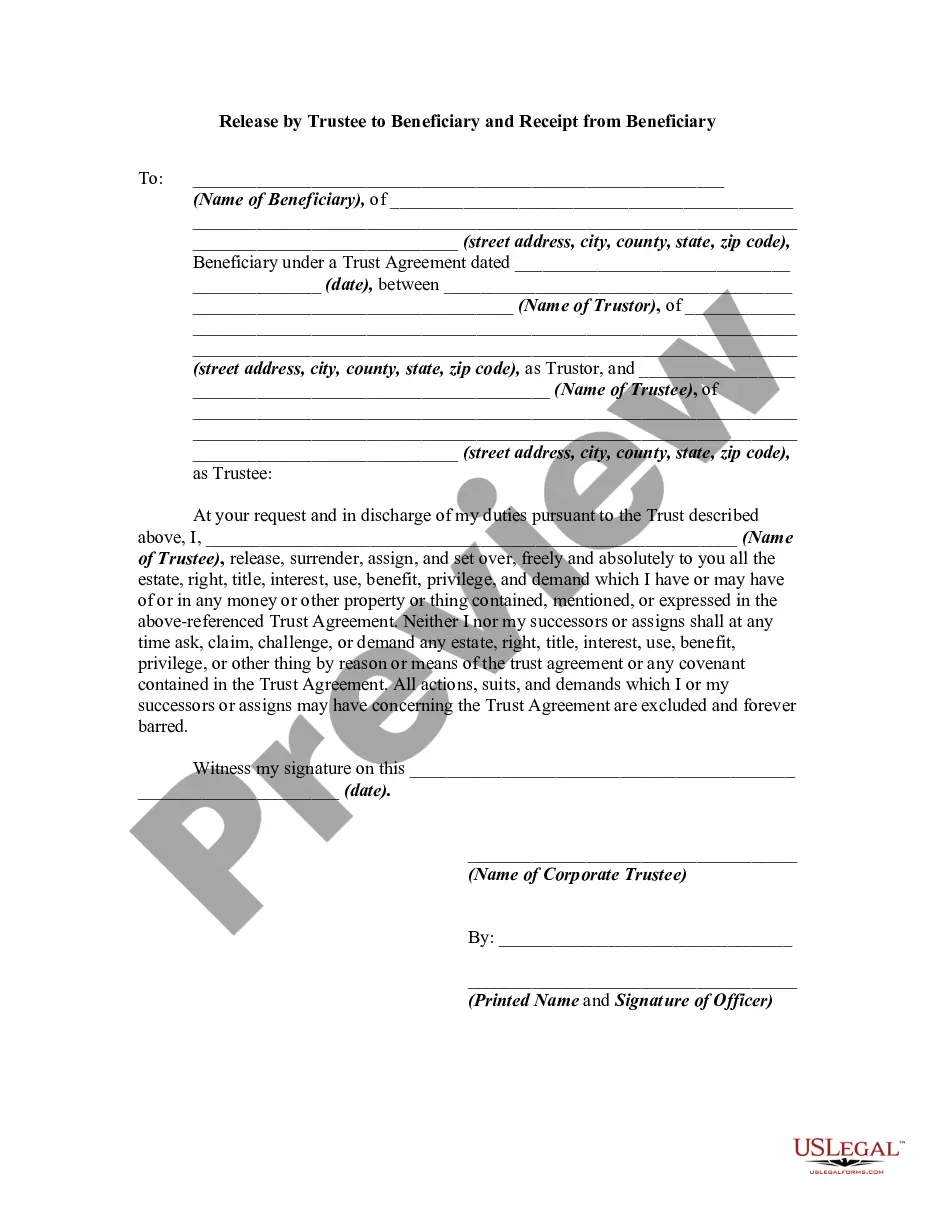
Here are the steps to follow after you access the form you desire: Validate that it is the correct document by previewing it and reviewing its description.
- Gain access to a repository of articles, guides, and handbooks pertinent to your situation and requirements.
- Conserve effort and time searching for the documents you need, and use US Legal Forms’ sophisticated search and Review feature to locate Definition of Trustee Of A Trust and obtain it.
- If you hold a membership, Log Into your US Legal Forms account, look for the form, and retrieve it.
- Check the My documents tab to review the documents you've previously downloaded and manage your files as you prefer.
- Should this be your initial experience with US Legal Forms, create a free account and enjoy unlimited access to all the benefits of the library.
- Utilize a powerful online form library that can revolutionize the way you handle these matters effectively.
- US Legal Forms is an industry frontrunner in digital legal forms, boasting more than 85,000 state-specific legal documents accessible to you at any time.
- Access to state- or locality-specific legal and commercial forms.
Form popularity
FAQ
You can typically find out who is the trustee of a trust by reviewing the trust document itself, which explicitly defines this role. If you cannot access the document directly, reaching out to the trustor or attorney who created the trust may provide clarity. Public records may also disclose trustee details if the trust has been formally administered. Additionally, uslegalforms offers various resources that can assist you in gathering this information more efficiently.
In most cases, the trustee of a trust is often a family member, close friend, or a professional such as an attorney or a financial advisor. The primary goal is to define trustee of a trust as someone who can handle the trust responsibly and honor the intentions of the trustor. This role can be fulfilled by an individual or institution, depending on the complexity of the trust and the assets involved. Ultimately, it’s crucial that the trustee is someone you trust implicitly.
To define trustee of a trust, you need to consider several factors such as the trust's purpose and the relationship of potential candidates to the trustor. Often, the trustor selects an individual they trust to manage the assets and fulfill the terms of the trust. It's essential to choose someone with integrity, good judgment, and a thorough understanding of the responsibilities involved. You may also find that guidance from legal documents or estate planners can clarify this decision.
Definition: Trustee is an individual who is responsible for a property or an organization on behalf of some other individual or a third party. Description: Trustee is supposed to make profitable decision for the entity under it authorization.
A good trustee possesses a combination of certain personal attributes, technical skills, and administrative capabilities: Personal attributes include sound judgment, empathy, integrity, impartiality, fairness, and confidentiality.
A trustee is a person who takes responsibility for managing money or assets that have been set aside in a trust for the benefit of someone else. As a trustee, you must use the money or assets in the trust only for the beneficiary's benefit.
A trustee can be an individual, such as a family member, friend, or trusted advisor (e.g., lawyer or accountant) or an institution, such as a bank or trust company. Each type of trustee has strengths and weaknesses which should be carefully weighed by the donor (see below).
The broadest sense of the term trustee applies to someone held to a fiduciary duty similar in some respects to that of a trustee proper. For example, the directors of a bank may be trustees for the depositors, directors of a corporation are trustees for the stockholders and a guardian is trustee of his ward's property.