Revocable Trust And Trustee
Description
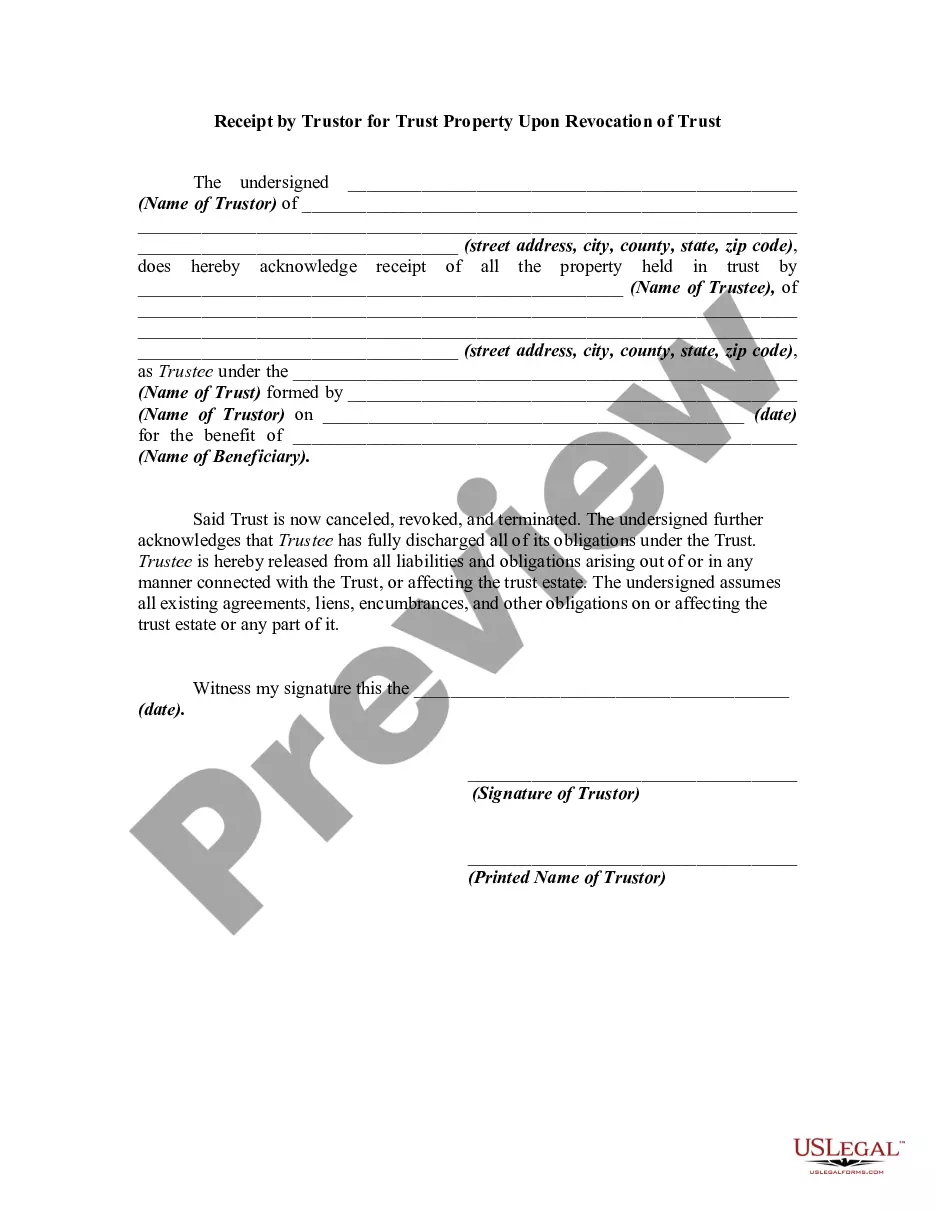
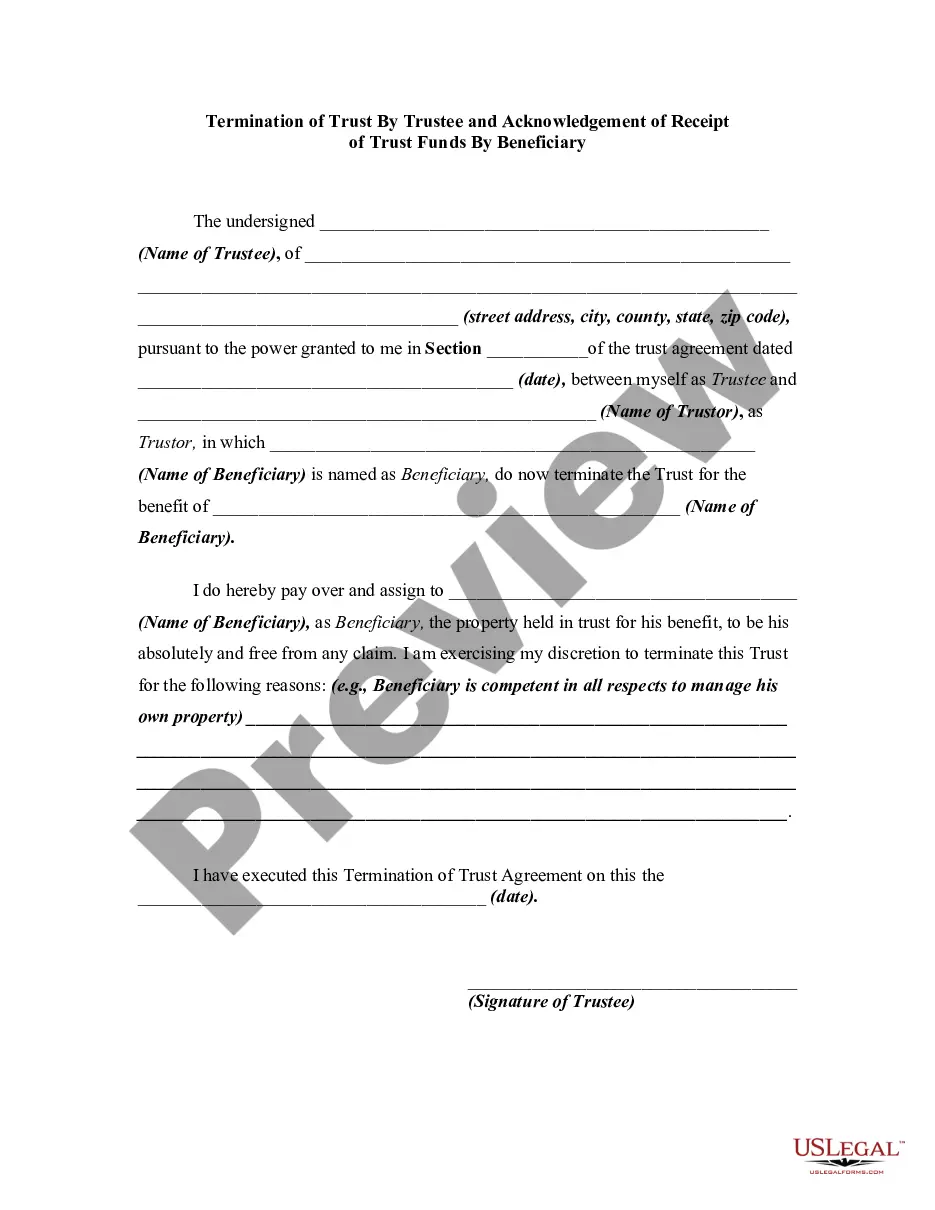
Get your form ready online
Our built-in tools help you complete, sign, share, and store your documents in one place.
Make edits, fill in missing information, and update formatting in US Legal Forms—just like you would in MS Word.
Download a copy, print it, send it by email, or mail it via USPS—whatever works best for your next step.
Sign and collect signatures with our SignNow integration. Send to multiple recipients, set reminders, and more. Go Premium to unlock E-Sign.
If this form requires notarization, complete it online through a secure video call—no need to meet a notary in person or wait for an appointment.
We protect your documents and personal data by following strict security and privacy standards.

Make edits, fill in missing information, and update formatting in US Legal Forms—just like you would in MS Word.

Download a copy, print it, send it by email, or mail it via USPS—whatever works best for your next step.

Sign and collect signatures with our SignNow integration. Send to multiple recipients, set reminders, and more. Go Premium to unlock E-Sign.

If this form requires notarization, complete it online through a secure video call—no need to meet a notary in person or wait for an appointment.

We protect your documents and personal data by following strict security and privacy standards.
Looking for another form?
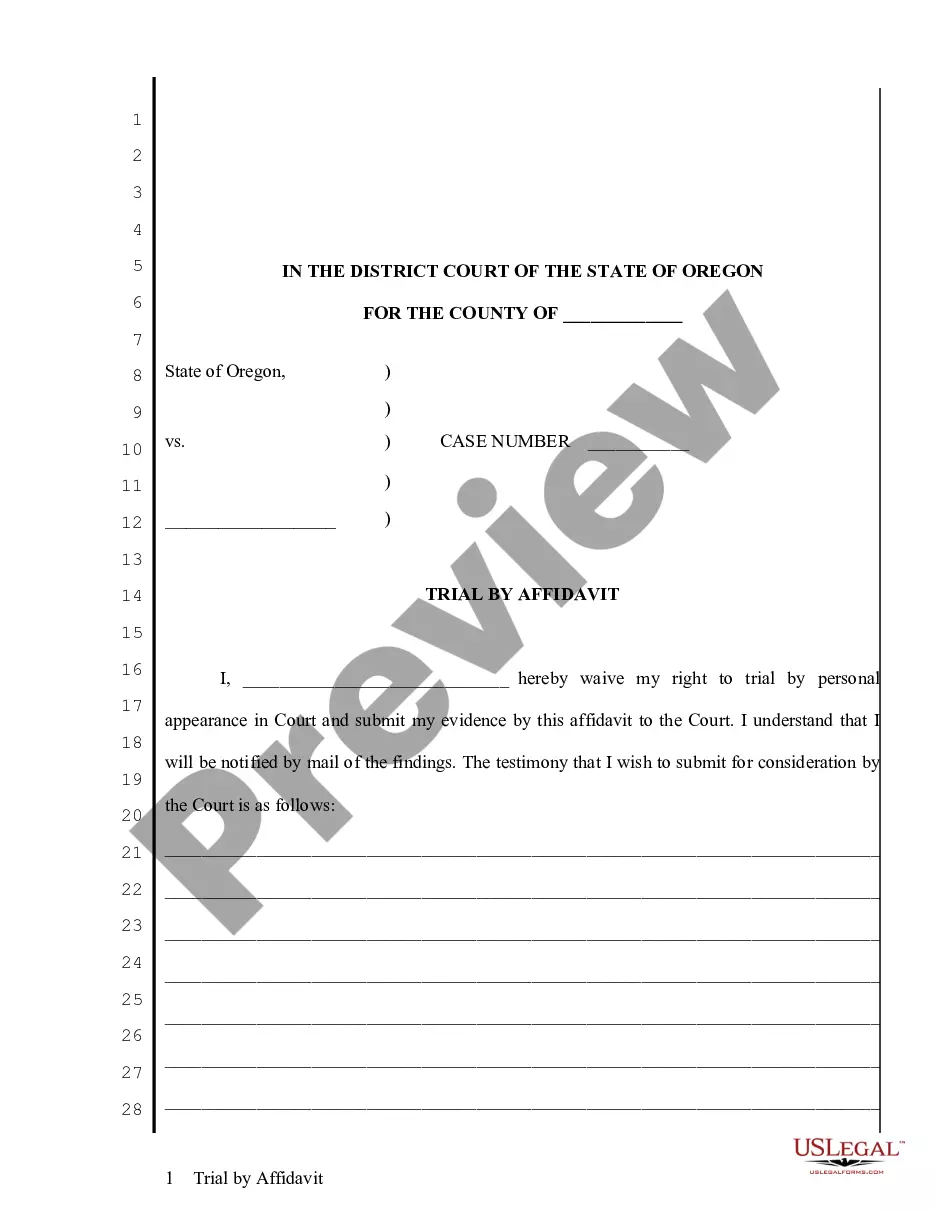
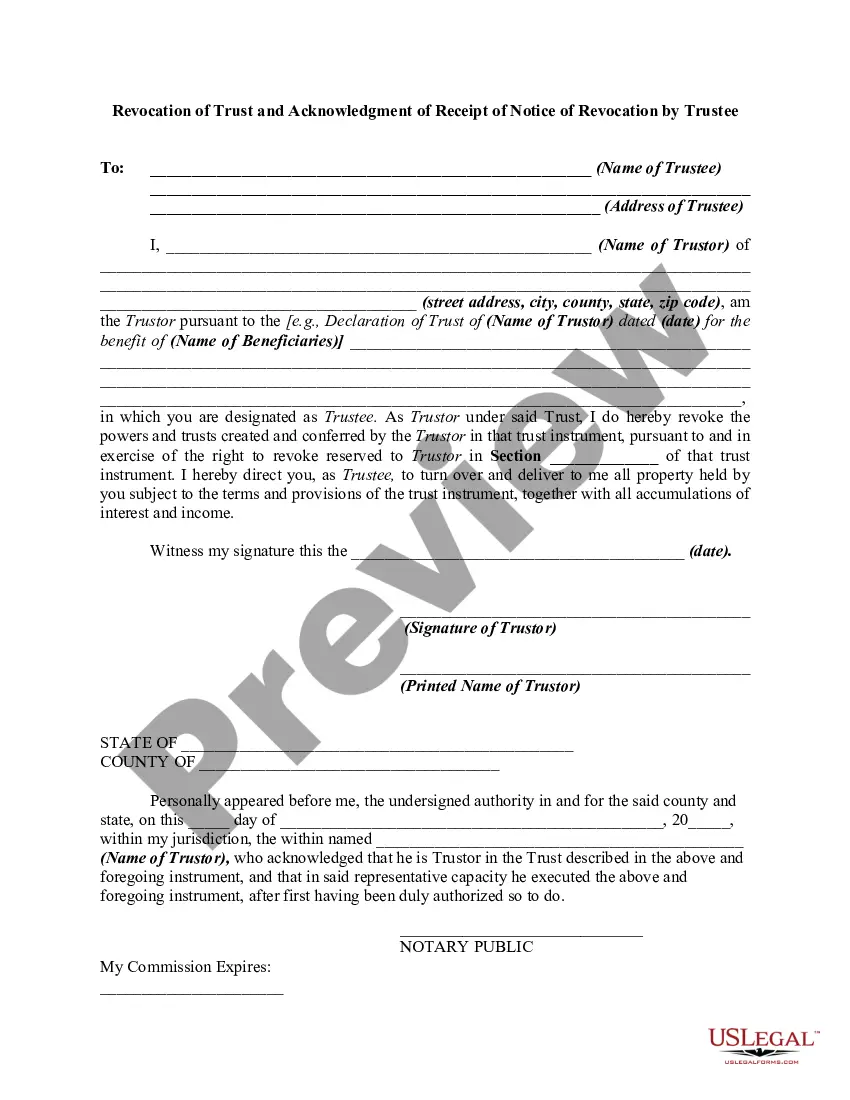
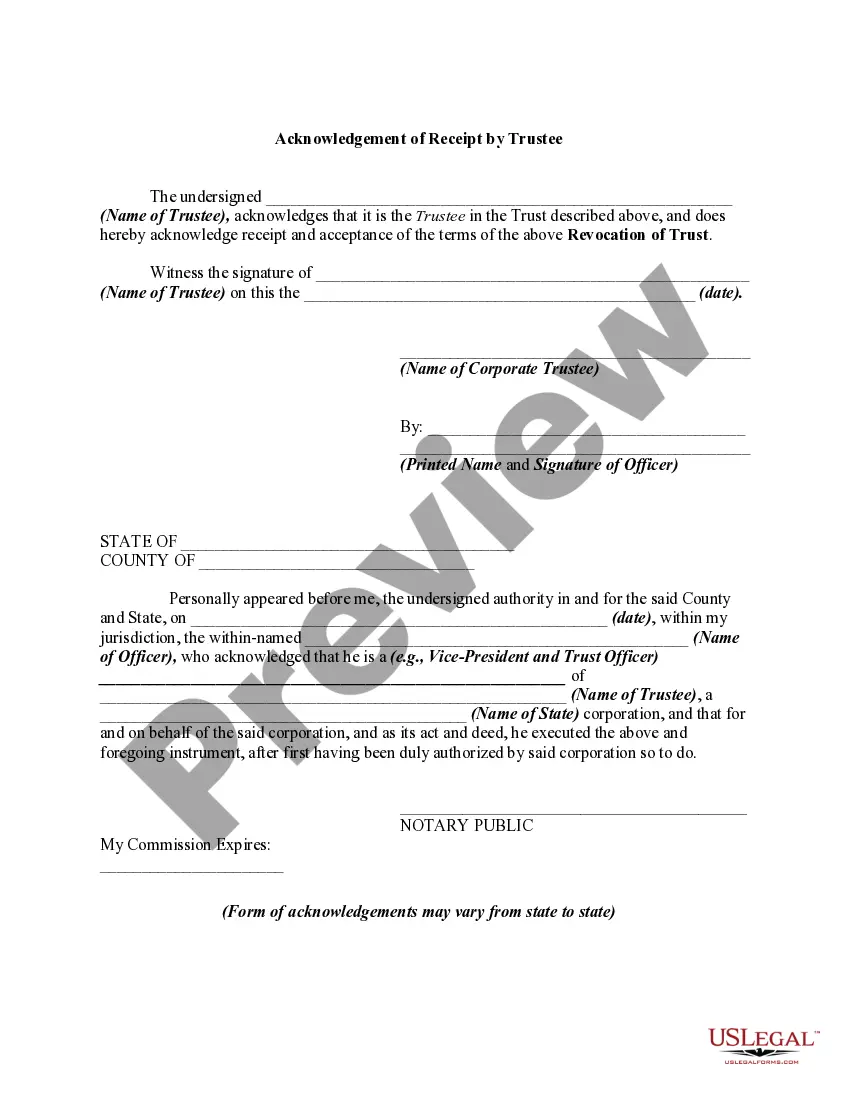
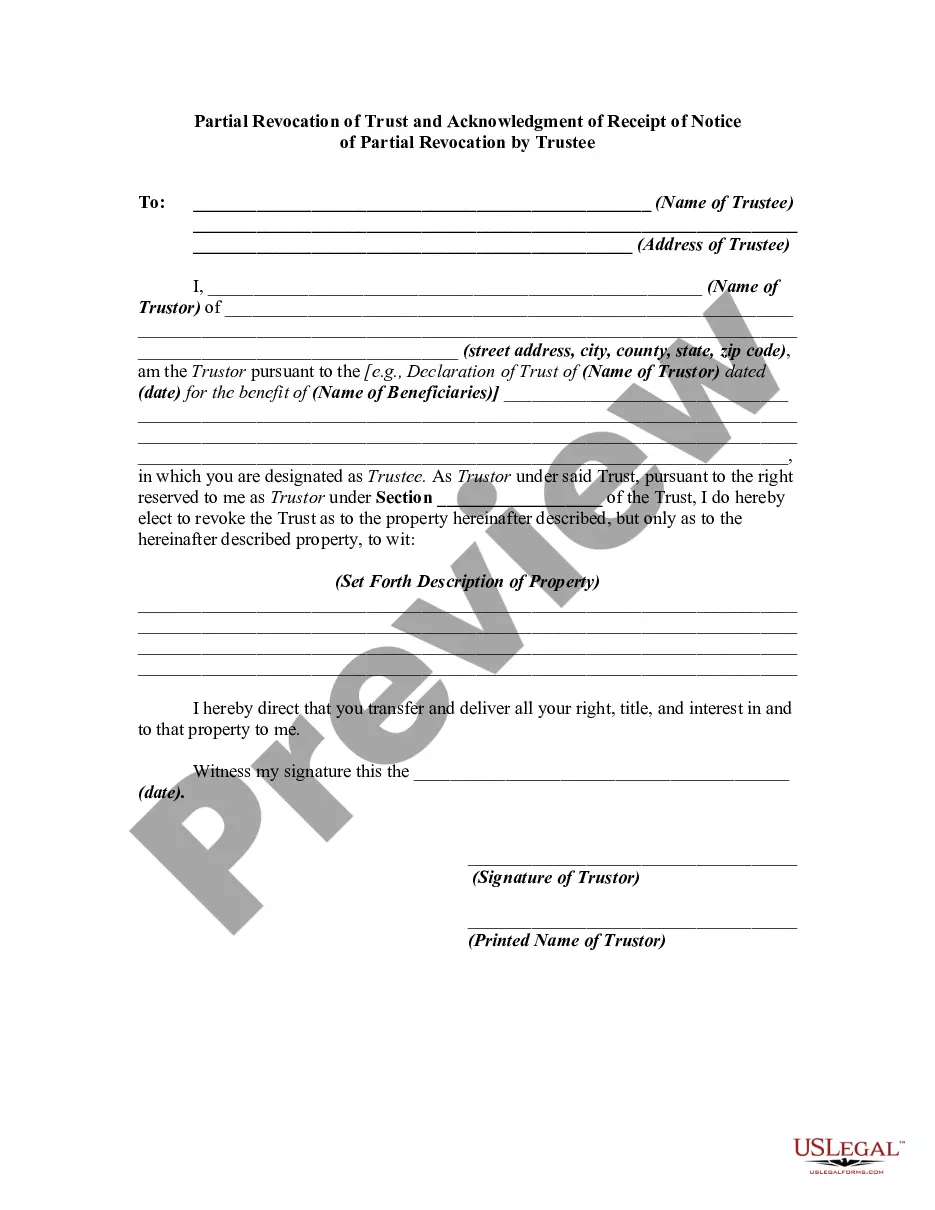
How to fill out Revocation Of Trust And Acknowledgment Of Receipt Of Notice Of Revocation By Trustee?
Legal management can be perplexing, even for experienced experts.
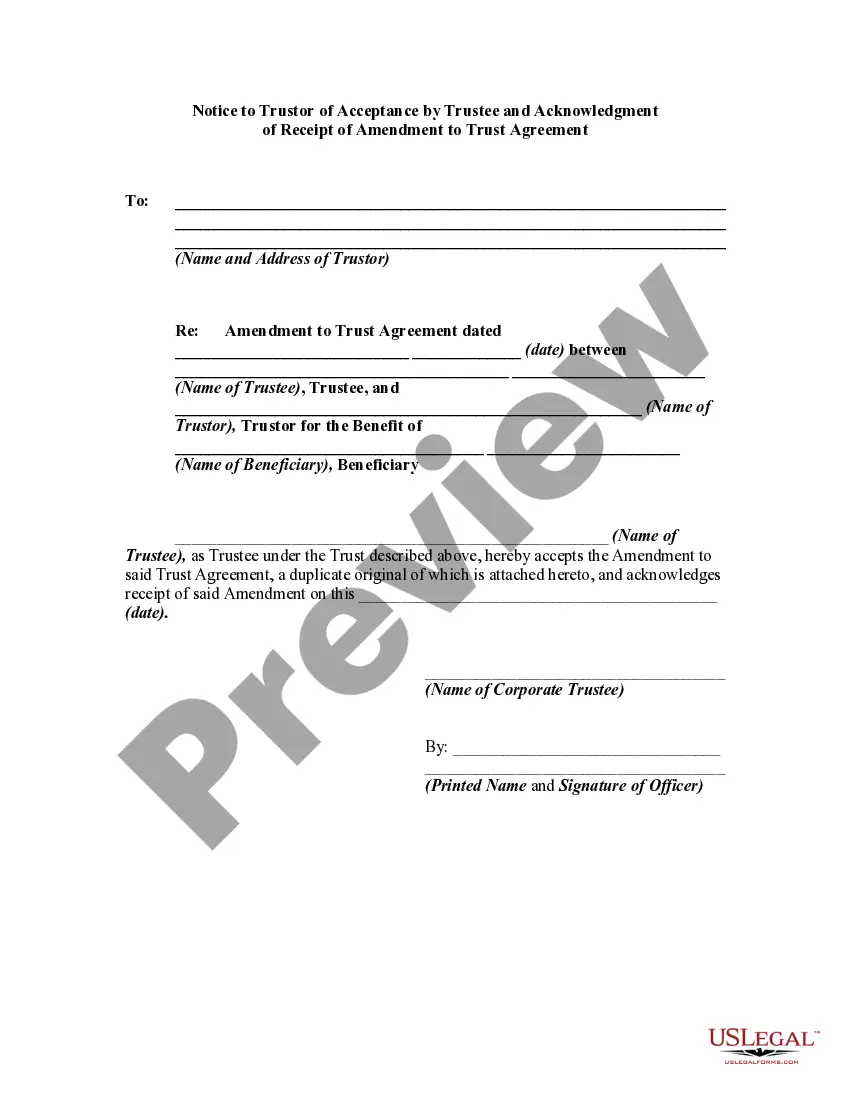
When seeking a Revocable Trust and Trustee and lacking the time to spend searching for the appropriate and current version, the process can be challenging.
US Legal Forms addresses any needs you may have, ranging from personal to business documentation, all in a single location.
Utilize cutting-edge tools to complete and manage your Revocable Trust and Trustee.
Here are the steps to follow after acquiring the form you desire: Verify that it is the correct form by previewing it and examining its description. Ensure that the sample is recognized in your state or county. Click Buy Now when you are prepared. Choose a monthly subscription plan. Select the file format you prefer, and Download, complete, eSign, print, and send your document. Experience the US Legal Forms online library, backed by 25 years of expertise and trustworthiness. Improve your daily document management in a simple and user-friendly manner today.
- Gain access to a valuable repository of articles, tutorials, and resources pertinent to your circumstances and requirements.
- Conserve time and effort searching for the documents you need, and utilize US Legal Forms' sophisticated search and Review tool to locate Revocable Trust and Trustee and obtain it.
- If you possess a monthly subscription, Log In to your US Legal Forms account, look for the form, and download it.
- Check your My documents tab to review the documents you have previously saved and manage your folders as you wish.
- If this is your first encounter with US Legal Forms, create an account and enjoy unlimited access to all the benefits of the library.
- A comprehensive online form library can significantly benefit anyone aiming to navigate these circumstances effectively.
- US Legal Forms stands as a frontrunner in digital legal documents, offering over 85,000 state-specific legal forms accessible at any moment.
- With US Legal Forms, you can access state- or county-specific legal and business documents.
Form popularity
FAQ
Difference between trustee and beneficiary What's the distinction between a trustee and a beneficiary in a trust? A beneficiary stands to benefit from the trust's assets, while a trustee is responsible for managing those assets in line with the trust creator's intentions.
Assets that should not be used to fund your living trust include: Qualified retirement accounts ? 401ks, IRAs, 403(b)s, qualified annuities. Health saving accounts (HSAs) Medical saving accounts (MSAs) Uniform Transfers to Minors (UTMAs) Uniform Gifts to Minors (UGMAs) Life insurance. Motor vehicles.
In most cases, the settlor, trustee, and beneficiary are the same person (at least until that person dies or becomes incompetent). In other words, if you set up a Living Trust, you can be the settlor, the trustee and the beneficiary of the trust.
The simple answer is yes, a Trustee can also be a Trust beneficiary. In fact, a majority of Trusts have a Trustee who is also a Trust beneficiary. Being a Trustee and beneficiary can be problematic, however, because the Trustee should still comply with the duties and responsibilities of a Trustee.
The short answer is yes, a beneficiary can also be a trustee of the same trust?but it may not always be wise, and certain guidelines must be followed. Is it a good idea for a beneficiary to be a trustee? There are good reasons for naming a trust beneficiary as trustee. For one, it is convenient.