Real Property Possession With Intent To Sell
Description
Get your form ready online
Our built-in tools help you complete, sign, share, and store your documents in one place.
Make edits, fill in missing information, and update formatting in US Legal Forms—just like you would in MS Word.
Download a copy, print it, send it by email, or mail it via USPS—whatever works best for your next step.
Sign and collect signatures with our SignNow integration. Send to multiple recipients, set reminders, and more. Go Premium to unlock E-Sign.
If this form requires notarization, complete it online through a secure video call—no need to meet a notary in person or wait for an appointment.
We protect your documents and personal data by following strict security and privacy standards.

Make edits, fill in missing information, and update formatting in US Legal Forms—just like you would in MS Word.

Download a copy, print it, send it by email, or mail it via USPS—whatever works best for your next step.

Sign and collect signatures with our SignNow integration. Send to multiple recipients, set reminders, and more. Go Premium to unlock E-Sign.

If this form requires notarization, complete it online through a secure video call—no need to meet a notary in person or wait for an appointment.

We protect your documents and personal data by following strict security and privacy standards.
Looking for another form?


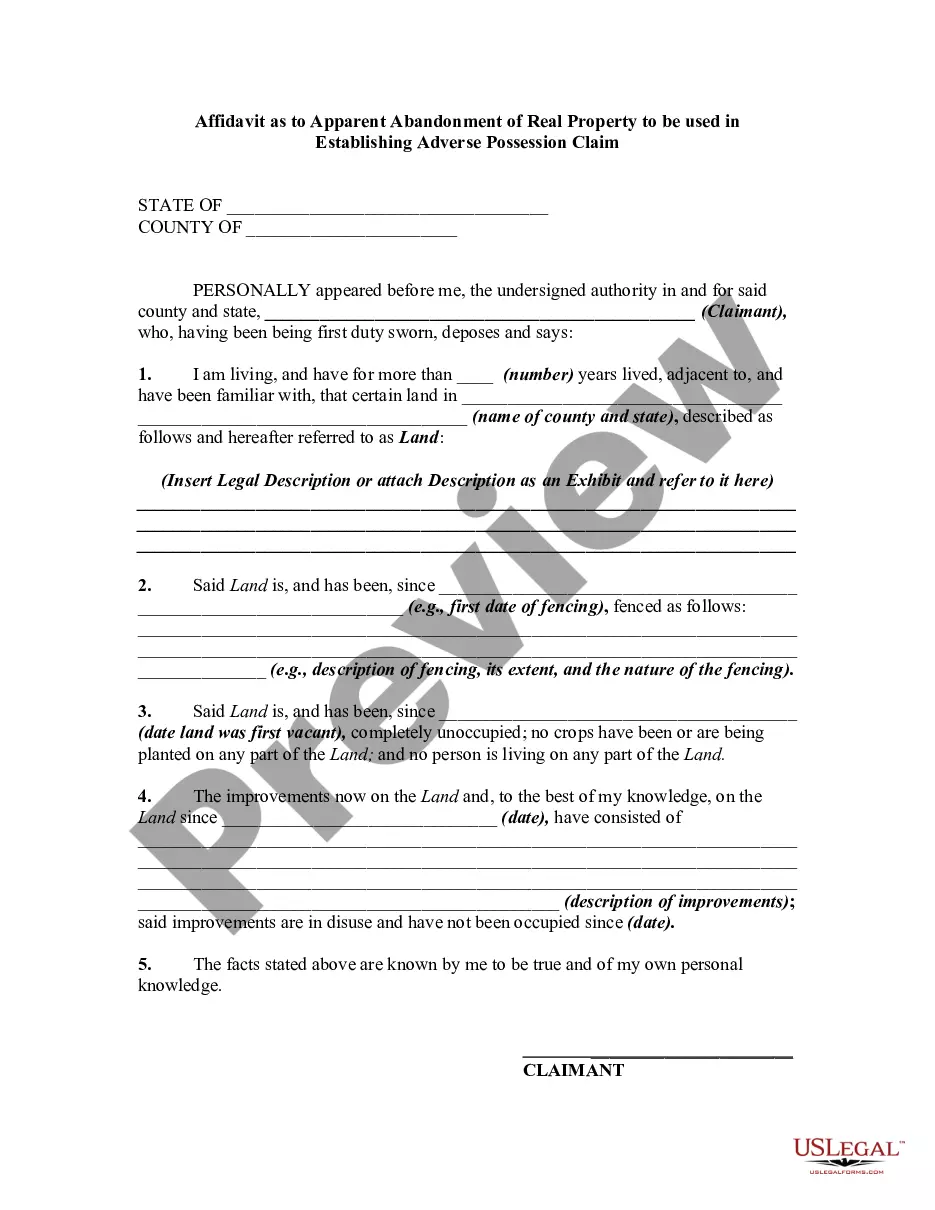
How to fill out Affidavit As To Apparent Abandonment Of Real Property To Be Used In Establishing Adverse Possession Claim - Squatters Rights?
It’s well-known that you cannot transform into a legal expert in a short period, nor can you swiftly learn how to adeptly prepare Real Property Possession With Intent To Sell without possessing a unique skill set.
Assembling legal documents is an arduous task that necessitates specific training and expertise. So why not entrust the creation of the Real Property Possession With Intent To Sell to the professionals.
With US Legal Forms, one of the most extensive legal document repositories, you can access everything from court documents to templates for internal communications. We recognize the significance of compliance with federal and local statutes and regulations.
Select Buy now. Once the purchase is finalized, you can obtain the Real Property Possession With Intent To Sell, fill it out, print it, and send or mail it to the relevant individuals or organizations.
You can access your documents again from the My documents section at any time. If you’re an existing client, you can simply Log In and find and download the template from the same section. Regardless of the purpose of your documents—be it legal, financial, or personal—our website has you covered. Try US Legal Forms today!
- Here’s how to start on our website and acquire the form you need in just a few minutes.
- Locate the document you require using the search bar at the top of the page.
- Preview it (if this option is available) and review the accompanying description to ascertain if Real Property Possession With Intent To Sell is what you seek.
- If you need a different form, begin your search anew.
- Establish a free account and select a subscription plan to buy the form.
Form popularity
FAQ
When a title is in possession, it indicates that the individual holds the legal title to the property and is exercising control over it. This status is essential in real property possession with intent to sell, as it establishes the legal rights necessary for completing a sale. If you have questions about titles and possession, consider using resources from US Legal Forms to clarify your situation.
To succeed in an adverse possession claim, four essential elements must be met: actual possession, exclusive possession, open and notorious use, and continuous use for a statutory period. Each of these elements demonstrates that the possessor treats the property as their own, which can be vital in cases of real property possession with intent to sell. Understanding these criteria helps in navigating property disputes effectively.
Possession in real estate signifies that a person has taken control of a property, regardless of whether they hold legal title. This control grants the possessor certain rights to use or benefit from the property. For those interested in real property possession with intent to sell, knowing how possession works can impact the sale terms and provide assurance to buyers.
In real estate, possession refers to the physical control or occupancy of a property. This means the individual or entity has the right to use the property as their own. Understanding real property possession with intent to sell is crucial, as it often influences the sale process and property rights.
Generally, any form of land can be subject to adverse possession, including residential, commercial, and agricultural properties. However, public lands and government-owned properties are typically exempt from adverse possession claims. When considering real property possession with intent to sell, keep in mind that the type of property can influence the complexities of an adverse possession case. Utilizing platforms like US Legal Forms can help clarify your rights and streamline the process.
In real life, a homeowner might unknowingly maintain a garden that intrudes on their neighbor's land. If they consistently tend to this garden for several years, they may acquire legal rights to that portion of land. This real-life example underscores the implications of real property possession with intent to sell, demonstrating how misunderstandings about property lines can lead to ownership disputes. It emphasizes the need to seek guidance when property ownership issues arise.
A common example of adverse possession occurs when a person builds a fence on what they believe is their land, but the fence encroaches on their neighbor's property. If they maintain that fence openly and exclusively for the required period, they may eventually claim that piece of land as their own. This scenario highlights the principle of real property possession with intent to sell, as the person may one day sell the expanded property. Understanding these examples can clarify how adverse possession works in practice.
Yes, adverse possession can transfer to a new owner. When a property is successfully claimed through adverse possession, the new owner obtains the same legal rights as the original possessor. This means they can sell or otherwise transfer the property without needing approval from the former legal owner. As someone interested in real property possession with intent to sell, it's vital to understand how these rights can impact future transactions.
In Pennsylvania, to succeed in a claim for adverse possession, you must meet five key requirements. First, your possession must be actual, meaning you physically occupy the land. Second, your possession must be open and notorious, which means it is visible and obvious to others. Third, it must be exclusive, as you cannot share the property with others. Fourth, the possession must be hostile, indicating that you occupy the land without the permission of the true owner. Finally, your possession must be continuous for a statutory period, typically 21 years. Understanding these basics is important, especially when considering real property possession with intent to sell.
Indeed, the sale of land must be reported to the IRS, especially if you've had real property possession with intent to sell. You should report this sale on your income tax return, which impacts your overall tax obligation. Neglecting to report it can result in complications or audits down the line. For assistance and clarity in this process, USLegalForms can be a helpful tool.