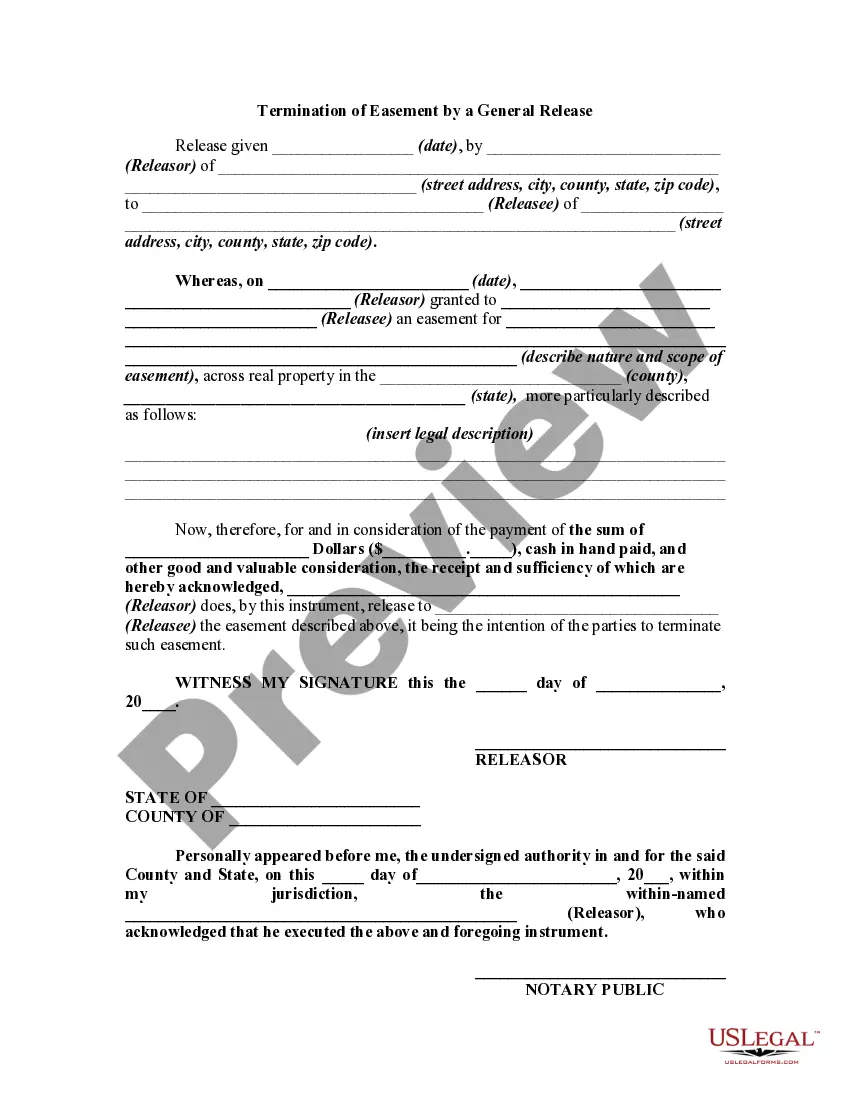
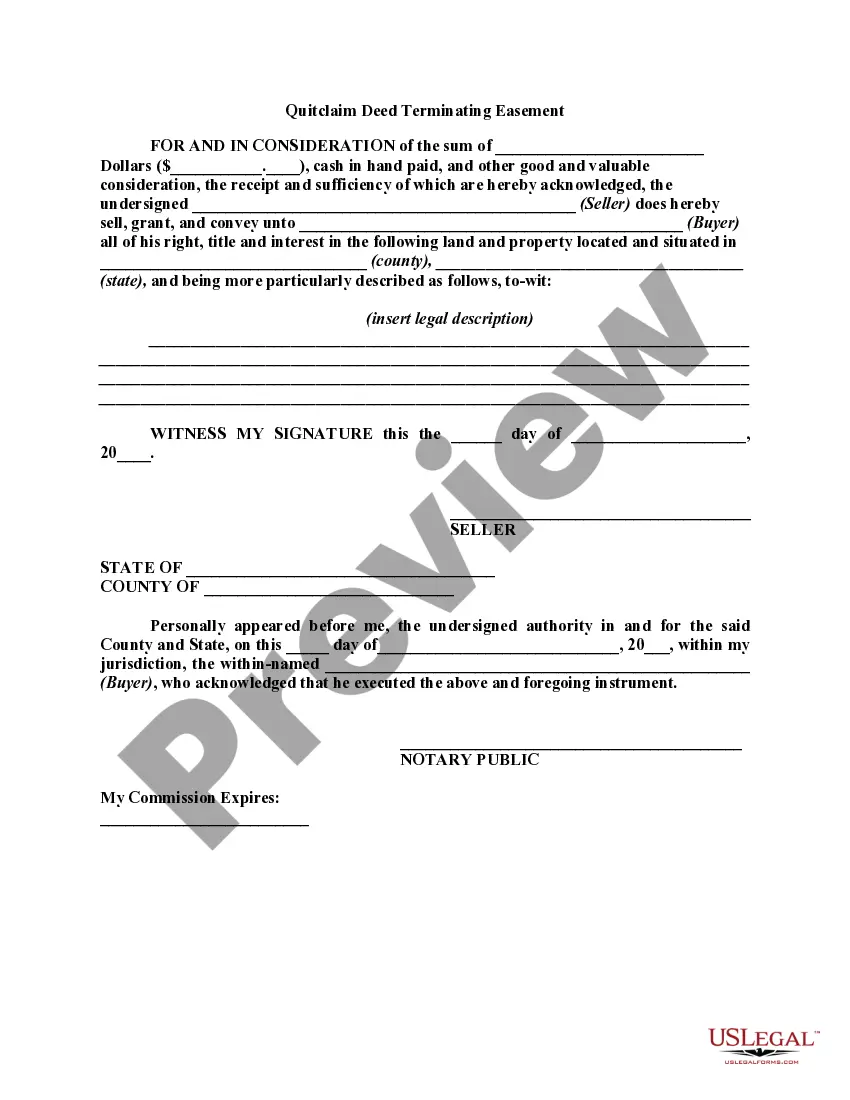
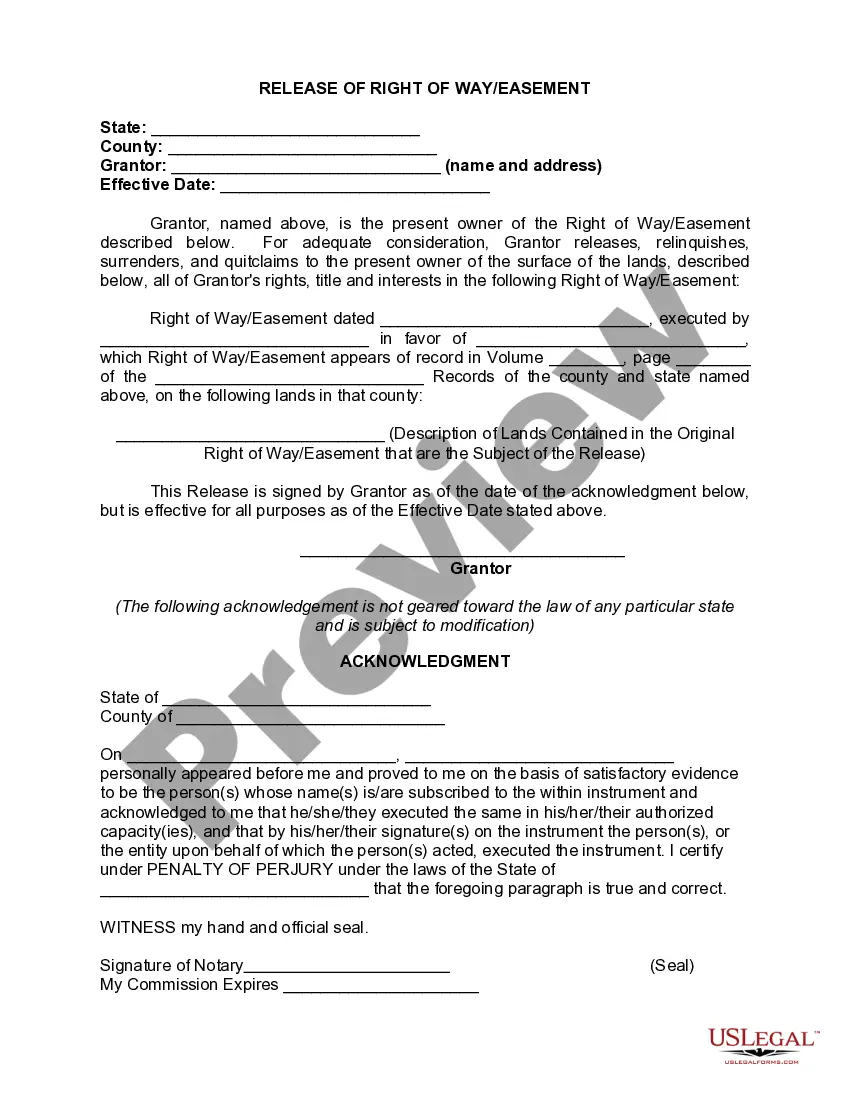
Termination Easement Form For Land
Description

Get your form ready online
Our built-in tools help you complete, sign, share, and store your documents in one place.
Make edits, fill in missing information, and update formatting in US Legal Forms—just like you would in MS Word.
Download a copy, print it, send it by email, or mail it via USPS—whatever works best for your next step.
Sign and collect signatures with our SignNow integration. Send to multiple recipients, set reminders, and more. Go Premium to unlock E-Sign.
If this form requires notarization, complete it online through a secure video call—no need to meet a notary in person or wait for an appointment.
We protect your documents and personal data by following strict security and privacy standards.

Make edits, fill in missing information, and update formatting in US Legal Forms—just like you would in MS Word.

Download a copy, print it, send it by email, or mail it via USPS—whatever works best for your next step.

Sign and collect signatures with our SignNow integration. Send to multiple recipients, set reminders, and more. Go Premium to unlock E-Sign.

If this form requires notarization, complete it online through a secure video call—no need to meet a notary in person or wait for an appointment.

We protect your documents and personal data by following strict security and privacy standards.
Looking for another form?

How to fill out Terminating Or Termination Of Easement By A General Release?
Locating a primary source to obtain the most up-to-date and pertinent legal documents is part of the challenge of navigating bureaucracy.
Identifying the appropriate legal forms requires precision and meticulousness, which is why it's essential to source Termination Easement Form For Land exclusively from trustworthy providers, such as US Legal Forms.
Proceed to the registration to complete your transaction. Finalize your purchase by selecting a payment method (credit card or PayPal). Choose the document format for downloading the Termination Easement Form For Land. After obtaining the form on your device, you can modify it with the editor or print it and fill it out manually. Eliminate the complications associated with your legal paperwork. Explore the vast US Legal Forms collection to find legal templates, verify their relevance to your situation, and download them instantly.
- An incorrect template will consume your time and delay your situation.
- With US Legal Forms, you have minimal concerns.
- You can examine and view all the specifics regarding the document’s applicability and significance for your situation in your state or county.
- Follow these outlined steps to accomplish your Termination Easement Form For Land.
- Use the catalog navigation or search bar to locate your template.
- Check the form’s description to verify if it meets the standards of your state and locality.
- Review the form preview, if available, to confirm the template is the one you seek.
- Return to the search to find the correct document if the Termination Easement Form For Land does not fulfill your criteria.
- Once you are certain about the form’s applicability, download it.
- If you are a registered user, click Log in to verify and access your selected templates in My documents.
- If you do not possess an account yet, click Buy now to acquire the template.
- Select the pricing option that suits your needs.
Form popularity
FAQ
An easement may terminate for numerous reasons. The most common include: impossibility of purpose, merger, elimination of necessity, abandonment, adverse possession, eminent domain, and the express terms of the easement itself.
It will depend on the nature of the easement. Owning a property which does not have the benefit of adequate easements could affect its value. For example, a property which does not have a right of access over a private road where it does not about public highway would have a reduced value.
Easements are usually permanent unless terminated by one of the ways recognized under Washington law. For example, an easement can be terminated if the property owner benefiting from the easement signs a written document stating that the easement is terminated.
If there is a right of way over your land you must not block or otherwise obstruct it but generally you are not obliged to take positive steps to keep the surface in good repair. The neighbour who has the right of way can repair the surface but does not have to.
If the easement is a problem, it is possible to have them removed in extreme cases. There are eight legal ways to terminate an easement: abandonment, merger, end of necessity, demolition, recording act, condemnation, adverse possession, and release, which a solicitor can give further advice if needed.