Stock Power Vs Assignment Separate From Certificate
Description
Get your form ready online
Our built-in tools help you complete, sign, share, and store your documents in one place.
Make edits, fill in missing information, and update formatting in US Legal Forms—just like you would in MS Word.
Download a copy, print it, send it by email, or mail it via USPS—whatever works best for your next step.
Sign and collect signatures with our SignNow integration. Send to multiple recipients, set reminders, and more. Go Premium to unlock E-Sign.
If this form requires notarization, complete it online through a secure video call—no need to meet a notary in person or wait for an appointment.
We protect your documents and personal data by following strict security and privacy standards.

Make edits, fill in missing information, and update formatting in US Legal Forms—just like you would in MS Word.

Download a copy, print it, send it by email, or mail it via USPS—whatever works best for your next step.

Sign and collect signatures with our SignNow integration. Send to multiple recipients, set reminders, and more. Go Premium to unlock E-Sign.

If this form requires notarization, complete it online through a secure video call—no need to meet a notary in person or wait for an appointment.

We protect your documents and personal data by following strict security and privacy standards.
Looking for another form?



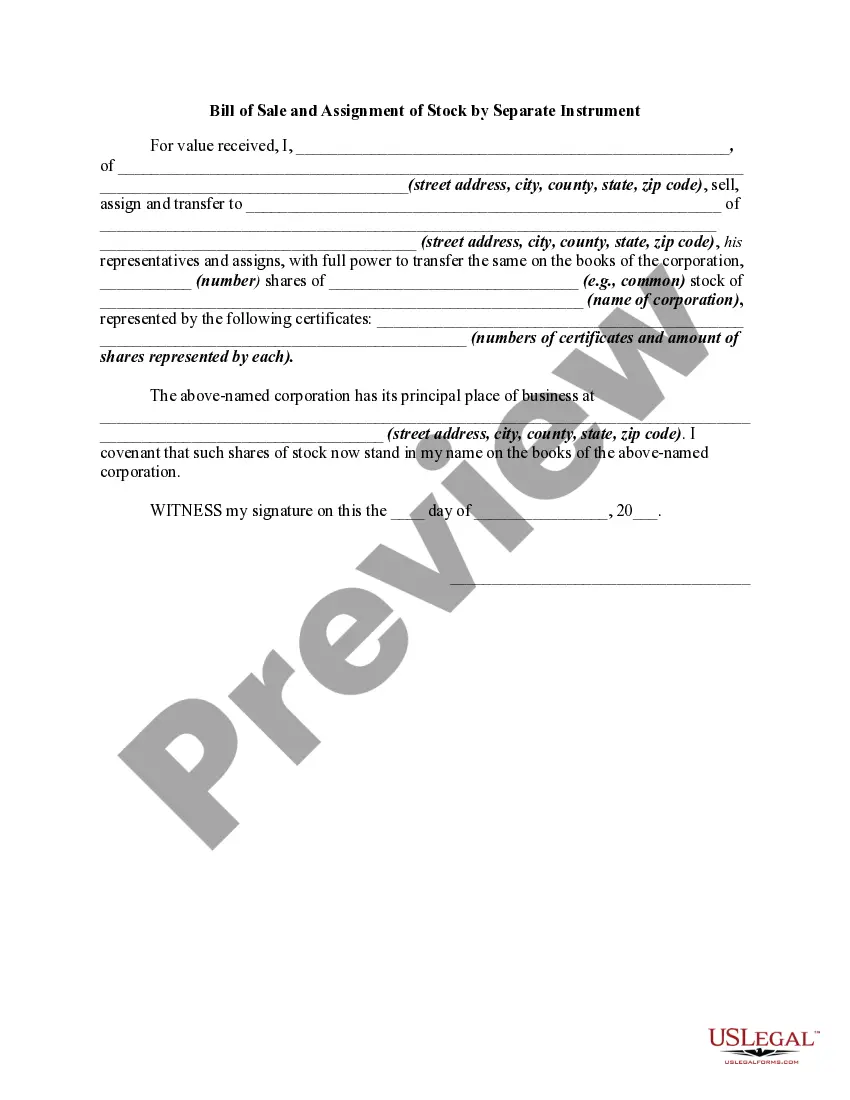
How to fill out Bill Of Sale And Assignment Of Stock By Separate Instrument?
Securing a reliable source for the latest and pertinent legal templates is a significant part of dealing with bureaucracy.
Locating the appropriate legal documents demands accuracy and meticulousness, which is why it's crucial to obtain samples of Stock Power Vs Assignment Separate From Certificate exclusively from trustworthy providers, such as US Legal Forms. An incorrect template can squander your time and hinder your progress.
Eliminate the stress associated with your legal documentation. Explore the vast US Legal Forms catalog, where you can find legal templates, assess their relevance to your situation, and download them instantly.
- Utilize the catalog browsing or search feature to find your template.
- Examine the details of the form to determine if it meets the criteria of your state and county.
- View the form preview, if it's available, to ensure it's precisely what you're looking for.
- Continue searching to locate the suitable document if the Stock Power Vs Assignment Separate From Certificate does not align with your needs.
- Once you are confident of the form’s appropriateness, download it.
- If you're an authorized user, click Log in to verify and access your chosen templates in My documents.
- If you haven't created a profile yet, click Buy now to acquire the form.
- Choose the pricing plan that meets your criteria.
- Proceed with the registration to complete your purchase.
- Finalize your transaction by selecting a payment method (credit card or PayPal).
- Select the document format for downloading Stock Power Vs Assignment Separate From Certificate.
- Once the form is on your device, you can edit it using the editor or print it to fill it out manually.
Form popularity
FAQ
While a stock power and a stock certificate both relate to share ownership, they serve different purposes. A stock certificate represents the actual ownership of shares, providing proof of ownership. Conversely, a stock power facilitates the transfer of those shares. Understanding these nuances is essential when considering stock power vs assignment separate from certificate.
Determining whether stock power is better than assignment separate from certificate hinges on specific circumstances. Stock powers are often simpler for direct transfers, while assignments may offer broader applications for various types of assets. It ultimately depends on your transaction needs and preferences in the context of stock power vs assignment separate from certificate.
A stock power serves to simplify the transfer of stock ownership between parties. It provides a clear, formal way to transfer shares without needing the original stock certificate. As an integral part of discussions on stock power vs assignment separate from certificate, knowing how and when to use a stock power is essential for smooth transactions.
The purpose of an assignment separate from the certificate is to allow for the transfer of shares without physically exchanging the stock certificate. This serves to streamline the process, especially when certificates are lost or unavailable. In discussions of stock power vs assignment separate from certificate, this method facilitates efficient stock transfers.
To fill out a stock power, start by entering the name of the current shareholder and the stock's details. You will include the number of shares being transferred and the recipient's name. After completing these sections, the document must be signed and dated by the seller. This process is crucial for anyone navigating stock power vs assignment separate from certificate.
The difference between stock power and assignment lies in their use and format. A stock power transfers shares using a specific form focused on the stock being transferred. On the other hand, an assignment is a broader document that conveys ownership and can apply to various assets. Understanding these distinctions helps clarify the landscape of stock power vs assignment separate from certificate.
Yes, a Stock Transfer Form is typically required to transfer shares legally. This form provides a clear record of the transfer and helps protect the interests of both the buyer and seller. Understanding stock power vs assignment separate from certificate will aid you in selecting the right forms for your situation. Utilizing US Legal Forms can streamline the process by providing easy access to necessary documentation.
The rules for transferring shares vary by state and by company regulations. Generally, the transfer must be documented with the appropriate forms, and the current shareholder must sign off on the transfer. Familiarizing yourself with stock power vs assignment separate from certificate ensures you select the right paperwork for your shares. Platforms like US Legal Forms can provide the essential templates for a smooth transfer.
Converting shares to a different class usually requires following your company's specific procedures outlined in its bylaws. This process may involve submitting a conversion request alongside relevant documentation, clearly detailing why the shares are being converted. Understanding stock power vs assignment separate from certificate can clarify what forms are necessary for this process. Resources from US Legal Forms can guide you through the steps needed to complete the conversion.
Indeed, you can have different classes of common shares. Companies often create distinct classes to offer varied voting rights or dividend preferences. Knowing the differences between stock power vs assignment separate from certificate is essential when dealing with multiple share classes and their respective transfers. US Legal Forms provides resources to help you navigate these complexities.