Unmarried Wife
Description

Get your form ready online
Our built-in tools help you complete, sign, share, and store your documents in one place.
Make edits, fill in missing information, and update formatting in US Legal Forms—just like you would in MS Word.
Download a copy, print it, send it by email, or mail it via USPS—whatever works best for your next step.
Sign and collect signatures with our SignNow integration. Send to multiple recipients, set reminders, and more. Go Premium to unlock E-Sign.
If this form requires notarization, complete it online through a secure video call—no need to meet a notary in person or wait for an appointment.
We protect your documents and personal data by following strict security and privacy standards.

Make edits, fill in missing information, and update formatting in US Legal Forms—just like you would in MS Word.

Download a copy, print it, send it by email, or mail it via USPS—whatever works best for your next step.

Sign and collect signatures with our SignNow integration. Send to multiple recipients, set reminders, and more. Go Premium to unlock E-Sign.

If this form requires notarization, complete it online through a secure video call—no need to meet a notary in person or wait for an appointment.

We protect your documents and personal data by following strict security and privacy standards.
Looking for another form?

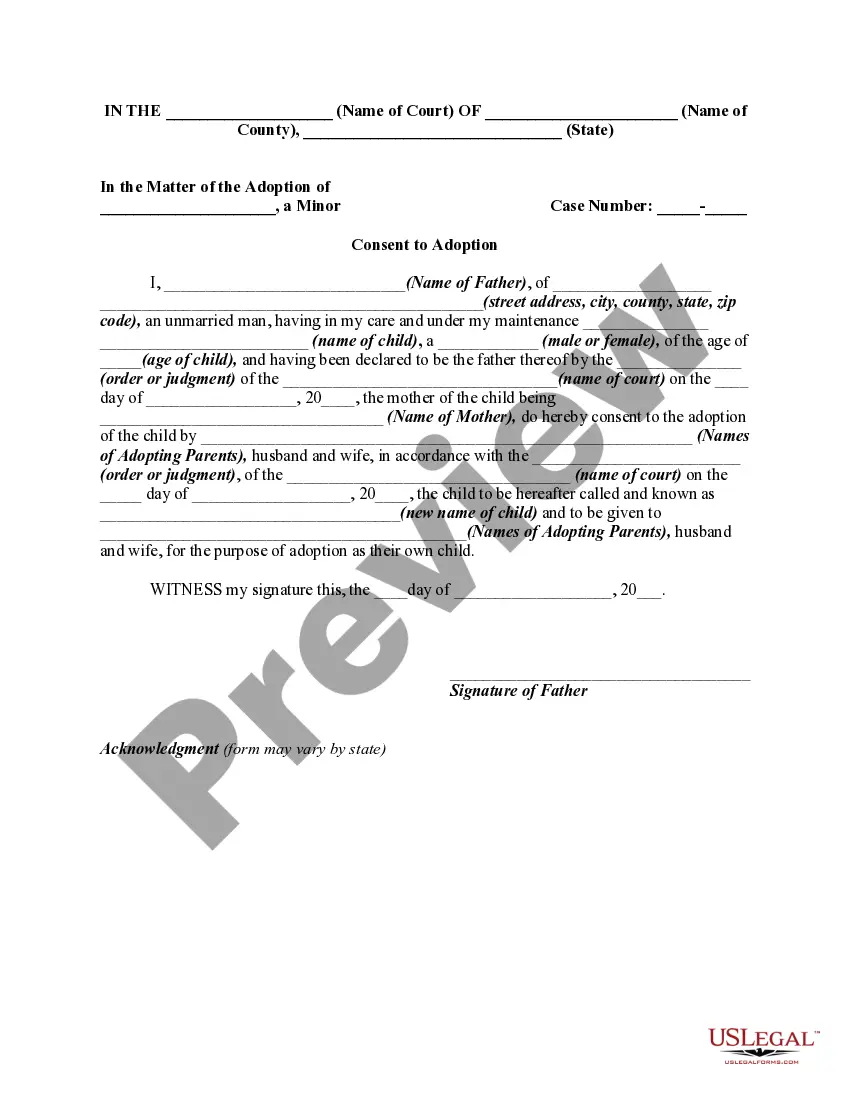
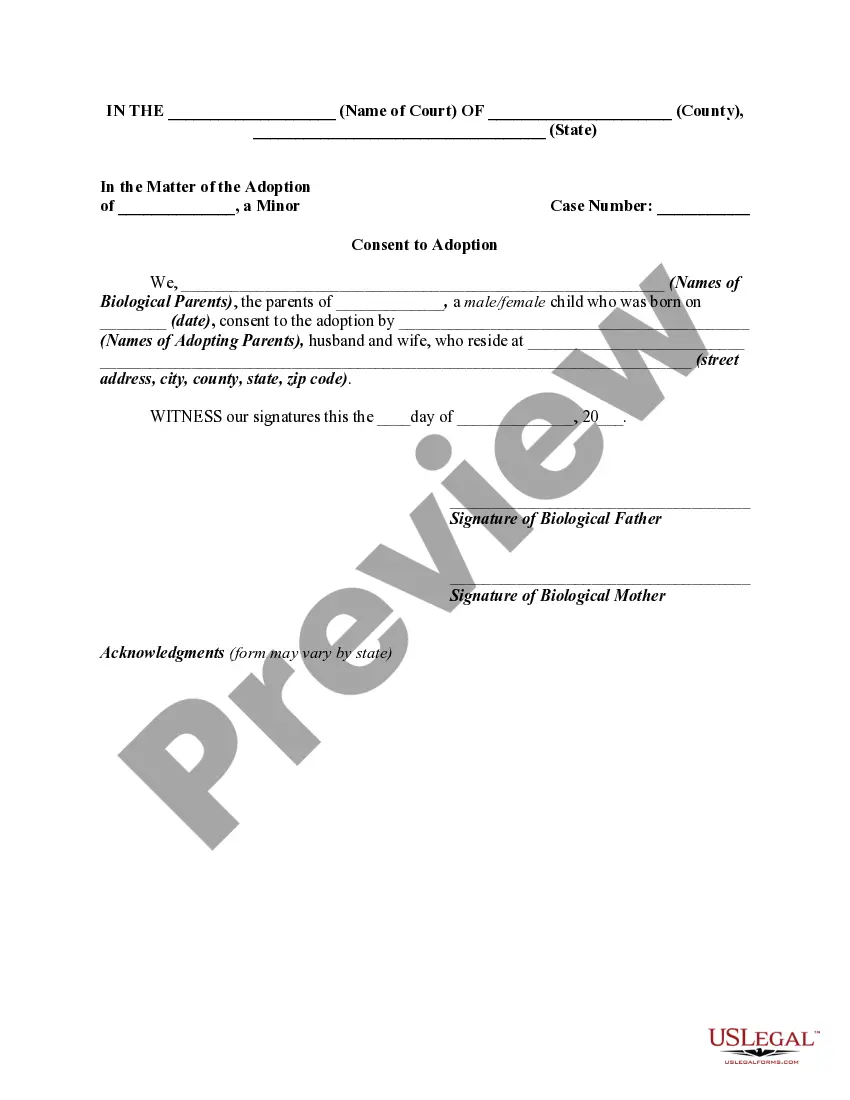
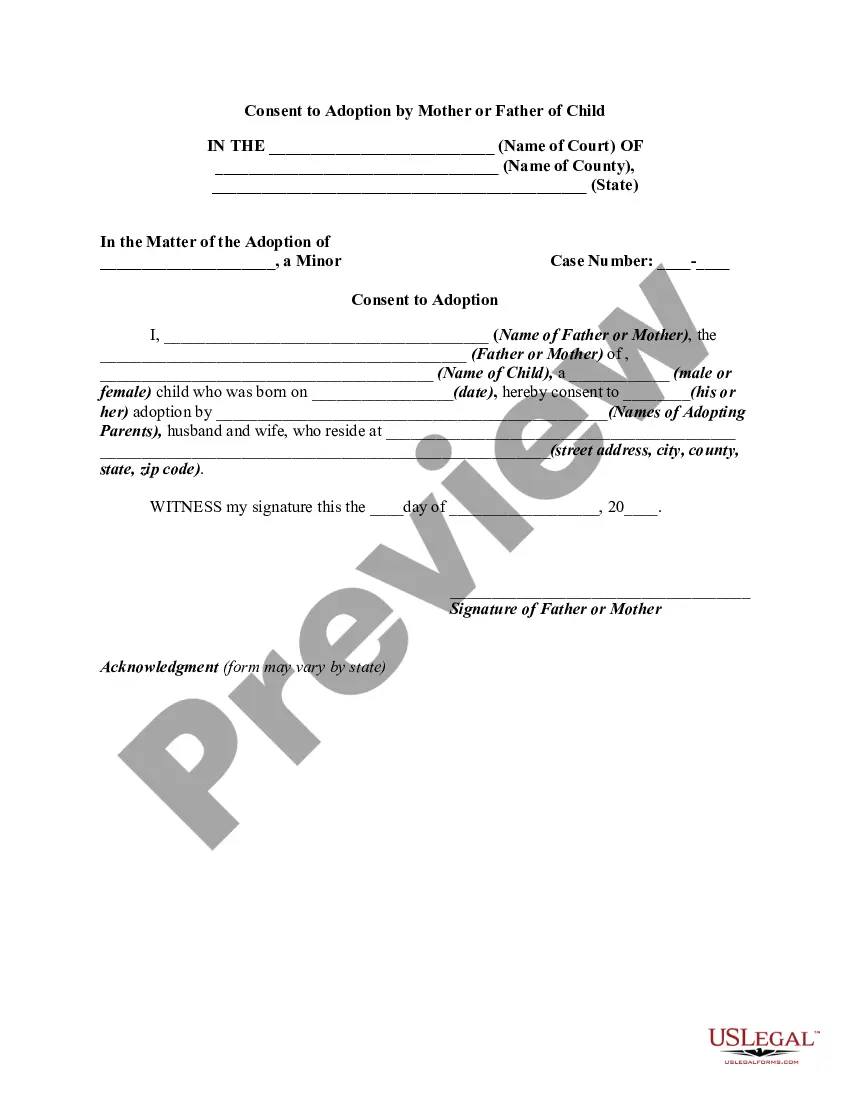
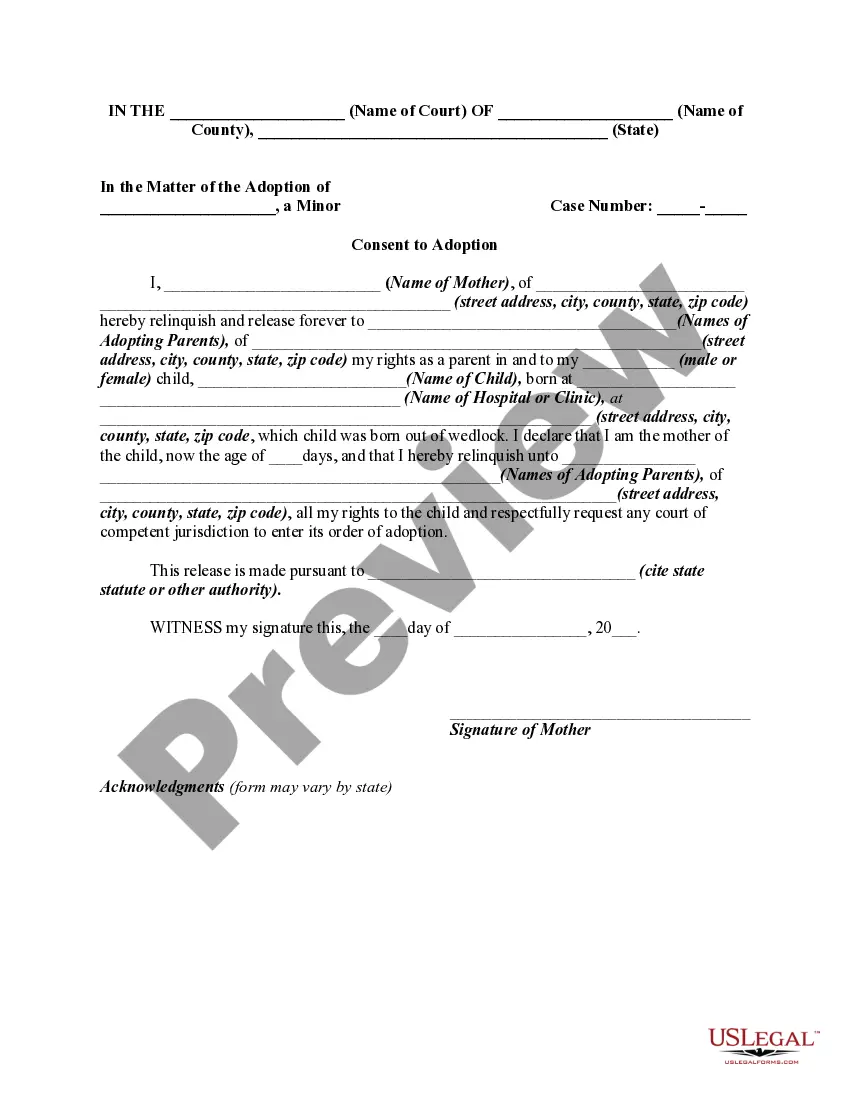
How to fill out Consent To Adoption By Unmarried Father Of Child?
- Begin by checking out the Preview mode and form description to confirm you've selected the correct unmarried wife form that aligns with your jurisdiction's requirements.
- If necessary, utilize the Search tab to explore additional templates until you find one that fits your exact needs.
- Select the 'Buy Now' option for the document you wish to acquire, then choose a subscription plan that works for you. You'll need to create an account for full access to their extensive library.
- Proceed to checkout by entering your credit card details or using your PayPal account for a secure transaction.
- Finally, download the form to your device, allowing you to fill it out at your convenience. Access this document anytime via the 'My Forms' section in your profile.
With US Legal Forms, you're not just getting a document; you're ensuring that it's accurate and compliant with your state laws. Their robust collection of over 85,000 editable legal forms, combined with access to expert assistance, sets them apart from competitors.
Get started today and simplify your legal processes with US Legal Forms for all your unmarried wife documentation needs!
Form popularity
FAQ
An unmarried spouse can often be referred to as a 'partner' or 'significant other.' While these terms capture the essence of your relationship, the designation 'Unmarried Wife' is specific and reflects your commitment. Regardless of the terminology, understanding your role is crucial in discussions about rights and responsibilities.
For an unmarried wife, the appropriate title is 'Ms.' This title is neutral and does not specify marital status, making it suitable for various situations. Using 'Ms.' can help you navigate social and professional interactions comfortably.
When you live together but are not legally married, your status is commonly referred to as 'Cohabitating' or 'Unmarried.' This classification applies to couples who share a life together without formal marriage. As an unmarried wife, you may want to know your rights and obligations in this context.
To express your marital status when not married, simply write 'Unmarried' or 'Single' on the form. This designation is appropriate in both official documents and casual settings. By identifying as an unmarried wife, you maintain your individuality while acknowledging your relationship.
When filling out forms, clearly indicate your marital status as 'Unmarried' if applicable. Use this term in any legal or financial contexts. Properly stating your unmarried status supports accuracy in documentation and protects your rights as an unmarried wife.
If you are not married, your filing status will typically be 'Single' or 'Head of Household' if you qualify. These choices affect your tax rate and deductions. Understanding your position as an unmarried wife can help you maximize available benefits during tax season.
When you encounter a section asking for marital status, indicate your situation clearly. If you are in a relationship but not legally married, select 'Unmarried' or 'Single.' This designation accurately reflects your status as an unmarried wife, ensuring clarity in legal and financial documents.
Yes, filing as single while being married can trigger legal issues with the IRS. This misrepresentation can lead to audits and potential penalties. Always ensure that your tax filings accurately reflect your marital status, and use the guidance available on USLegalForms to avoid pitfalls.
Filing as married filing separately can lead to higher tax rates and limited access to certain deductions or credits. Additionally, if the IRS finds discrepancies, you may face fines and interest on unpaid taxes. To navigate this complexity, it is beneficial to use resources like USLegalForms to understand your obligations fully.
Yes, you can face complications when filing separately while married. The IRS may question your intention and distribute liabilities differently. Therefore, it is essential to ensure that your filing status accurately reflects your situation, and using USLegalForms can help clarify the rules and guide you through the process.