Custody With Visitation
Description

Get your form ready online
Our built-in tools help you complete, sign, share, and store your documents in one place.
Make edits, fill in missing information, and update formatting in US Legal Forms—just like you would in MS Word.
Download a copy, print it, send it by email, or mail it via USPS—whatever works best for your next step.
Sign and collect signatures with our SignNow integration. Send to multiple recipients, set reminders, and more. Go Premium to unlock E-Sign.
If this form requires notarization, complete it online through a secure video call—no need to meet a notary in person or wait for an appointment.
We protect your documents and personal data by following strict security and privacy standards.

Make edits, fill in missing information, and update formatting in US Legal Forms—just like you would in MS Word.

Download a copy, print it, send it by email, or mail it via USPS—whatever works best for your next step.

Sign and collect signatures with our SignNow integration. Send to multiple recipients, set reminders, and more. Go Premium to unlock E-Sign.

If this form requires notarization, complete it online through a secure video call—no need to meet a notary in person or wait for an appointment.

We protect your documents and personal data by following strict security and privacy standards.
Looking for another form?






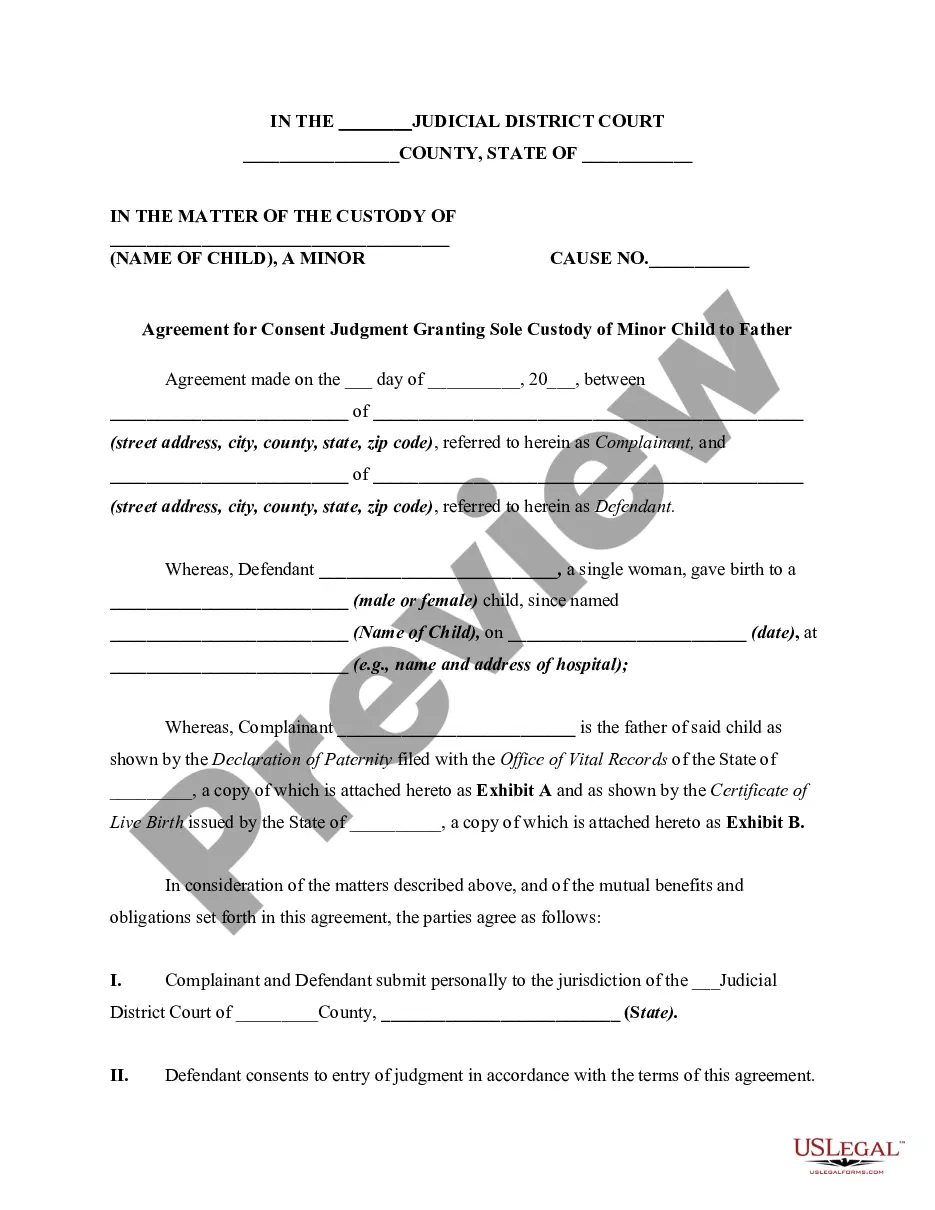
How to fill out Agreement For Consent Judgment Granting Sole Custody Of Minor Child To Father?
- If you're a returning user, log into your account and ensure your subscription is active. If it needs renewal, follow your payment plan to update it.
- For first-time users, start by previewing the form descriptions to find the appropriate custody with visitation template for your jurisdiction.
- If you encounter any issues with the form, utilize the Search feature to locate a different template that meets your specific needs.
- Select your required form, click on the Buy Now button, and choose a subscription plan that suits you. You'll need to create an account to gain full access to all resources.
- Complete your purchase by entering your payment details, whether through credit card or PayPal.
- Once your transaction is confirmed, download the form directly to your device and find it later in the My Forms section of your profile.
In conclusion, US Legal Forms equips you with robust resources for handling custody with visitation documents effortlessly. With access to expert assistance and a vast collection of forms, you can ensure that your legal needs are addressed accurately and thoroughly.
Start now by visiting US Legal Forms and streamline your legal document process today!
Form popularity
FAQ
The new child custody law in Utah focuses on ensuring that both parents remain actively involved in their child's life. It emphasizes the importance of custody with visitation, allowing for shared parenting time that benefits the child's emotional and relational development. This law aims to create a cooperative environment between parents, promoting more balanced and fair arrangements. To navigate these changes effectively, consider using US Legal Forms to access the necessary documentation and resources.
When one parent has full custody, the other parent may still receive visitation rights. These rights are typically outlined in a court order, detailing when and how the non-custodial parent can spend time with the child. Consistency and open communication between parents are essential for a successful visitation arrangement. US Legal Forms offers templates and resources to help facilitate these agreements and ensure that all parties understand their rights and responsibilities.
Shared custody typically means that both parents have legal and physical responsibility for the child, allowing them to make important decisions together. In contrast, visitation refers to the scheduled time a non-custodial parent spends with the child, which usually occurs when one parent has primary physical custody. Understanding these differences is vital when negotiating your custody arrangement. Leveraging resources from US Legal Forms can guide you through these definitions and applications effectively.
Behaviors like frequent arguments, inappropriate comments about the other parent, or instances of neglect can negatively impact your position in a custody battle. Additionally, any actions that suggest you are unfit as a parent, such as substance abuse or criminal activity, will also be viewed unfavorably. It’s crucial to present your best self during this process. US Legal Forms can help you understand what to avoid and how to safeguard your interests.
In a custody battle, it's important to avoid speaking negatively about your co-parent in front of your child. Such comments can undermine your credibility and harm your case. Additionally, statements that question your child's safety or well-being without evidence can also be detrimental. Always remember to highlight your commitment to a peaceful and constructive co-parenting relationship for the best outcome in custody with visitation.
The biggest mistake in a custody battle often involves failing to prioritize the child's best interests. It’s crucial to avoid using children as bargaining chips or making them part of the conflict. Instead, focusing on maintaining a healthy relationship with your children can present you positively in the eyes of the court. US Legal Forms can guide you through this challenging process and help avoid common pitfalls.
When it comes to custody with visitation, the best evidence usually includes documentation of your involvement in your child's life. This can include school records, medical records, or communication logs that show your commitment to your child’s well-being. Demonstrating a stable environment and a loving relationship can significantly influence custody decisions. Utilizing a platform like US Legal Forms can help you organize and present your evidence effectively.
In Delaware, several factors influence child custody decisions, including the child's relationship with each parent, the child's needs, and the parents' ability to provide for those needs. The court prioritizes the child's best interests, focusing on stability and emotional support. If you're unsure about your rights, consider using US Legal Forms to access helpful guides on custody with visitation.
No, you do not need full custody to establish visitation rights. Even if you share custody, you can have a structured visitation schedule that allows you to spend quality time with your child. It's important to have clear agreements that define visitation hours and responsibilities. If you need assistance, US Legal Forms offers resources to help you navigate custody with visitation issues.
During a custody battle, avoid making negative comments about your child's other parent. This can reflect poorly on you and may affect the judge's view of your parenting abilities. Focus instead on demonstrating your dedication to your child's well-being and stability. Remember, the goal is to secure custody with visitation rights that are in the best interest of your child.