Theft Law In The Philippines
Description
Get your form ready online
Our built-in tools help you complete, sign, share, and store your documents in one place.
Make edits, fill in missing information, and update formatting in US Legal Forms—just like you would in MS Word.
Download a copy, print it, send it by email, or mail it via USPS—whatever works best for your next step.
Sign and collect signatures with our SignNow integration. Send to multiple recipients, set reminders, and more. Go Premium to unlock E-Sign.
If this form requires notarization, complete it online through a secure video call—no need to meet a notary in person or wait for an appointment.
We protect your documents and personal data by following strict security and privacy standards.

Make edits, fill in missing information, and update formatting in US Legal Forms—just like you would in MS Word.

Download a copy, print it, send it by email, or mail it via USPS—whatever works best for your next step.

Sign and collect signatures with our SignNow integration. Send to multiple recipients, set reminders, and more. Go Premium to unlock E-Sign.

If this form requires notarization, complete it online through a secure video call—no need to meet a notary in person or wait for an appointment.

We protect your documents and personal data by following strict security and privacy standards.
Looking for another form?
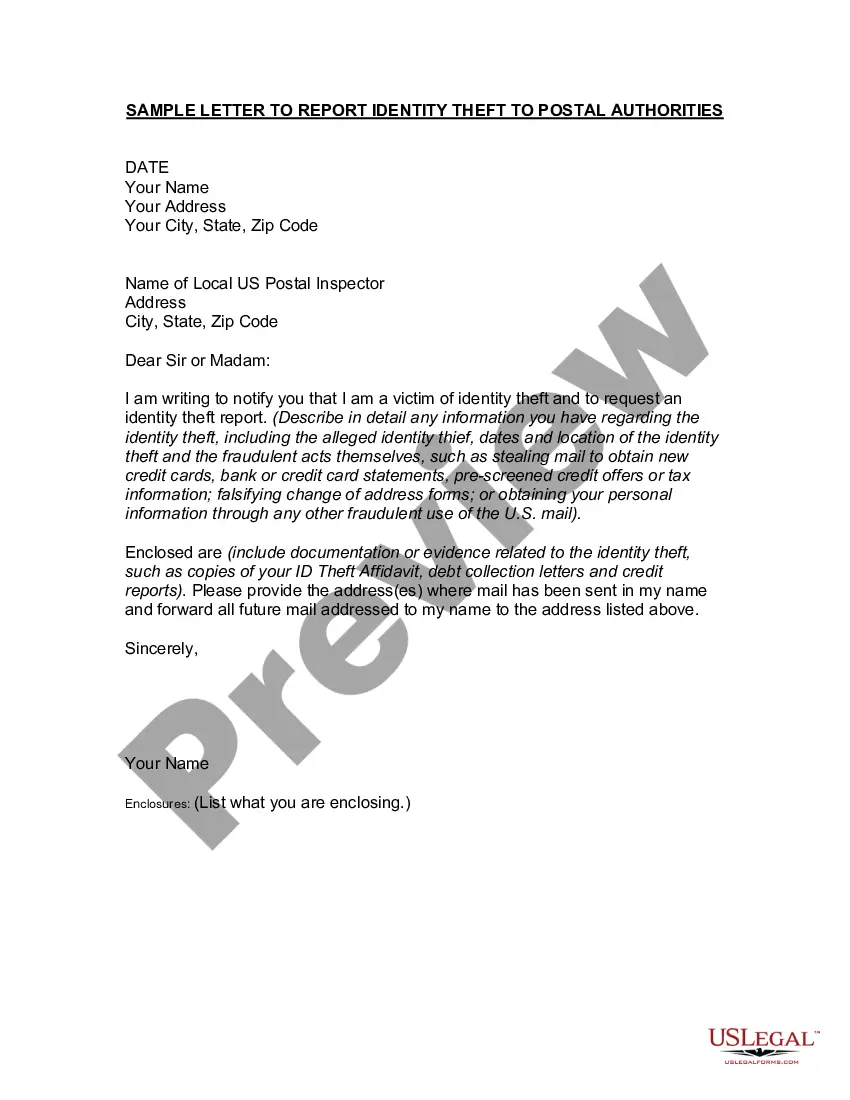
How to fill out Letter Notifying Law Enforcement Of Identity Theft?
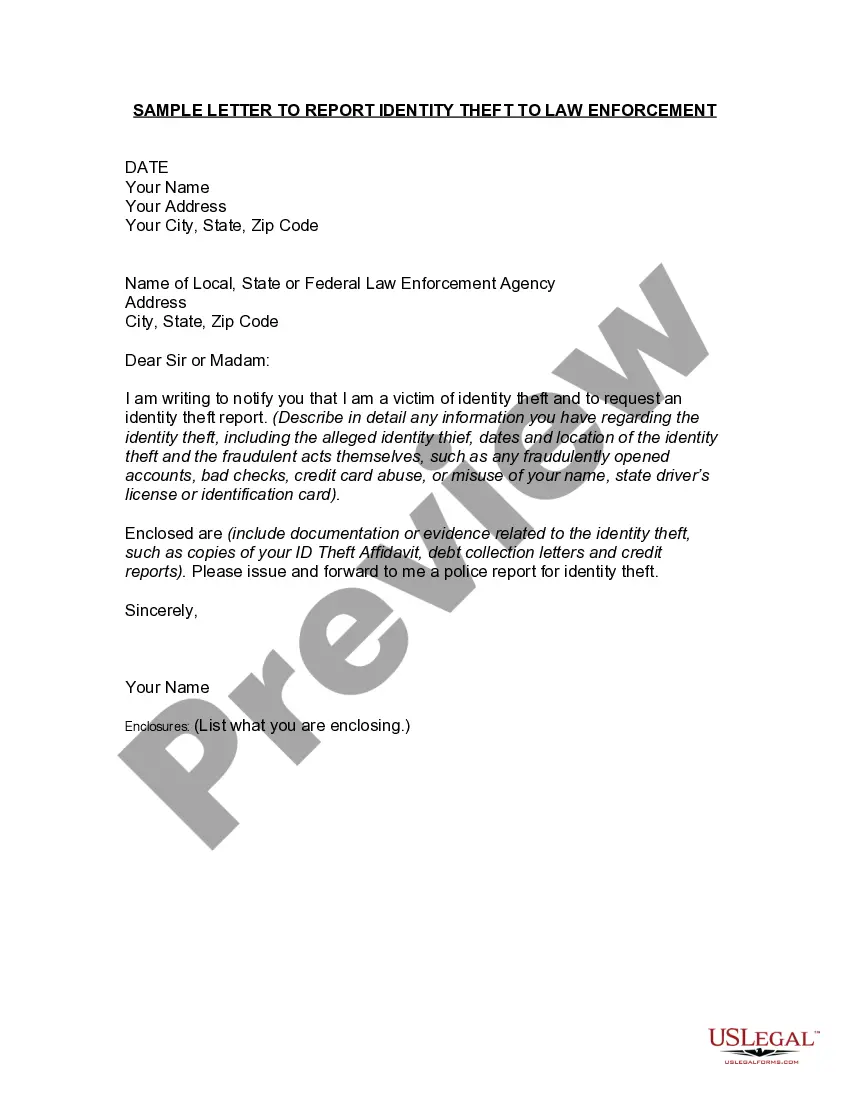
The Theft Legislation In The Philippines presented on this page is a reusable official template crafted by expert attorneys in accordance with federal and state statutes and regulations.
For over 25 years, US Legal Forms has supplied individuals, companies, and legal practitioners with over 85,000 validated, state-specific documents for any business and personal situation. It’s the fastest, easiest, and most reliable method to acquire the documents you require, as the service ensures bank-level data security and anti-malware safeguards.
Select the format you desire for your Theft Legislation In The Philippines (PDF, DOCX, RTF) and save the sample onto your device.
- Search for the document you require and review it.
- Browse through the sample you searched and preview it or examine the form description to ensure it meets your requirements. If it doesn't, use the search bar to locate the suitable one. Click Buy Now once you have found the template you need.
- Subscribe and Log In.
- Select the pricing plan that fits you and create an account. Use PayPal or a credit card to make a swift payment. If you already possess an account, Log In and verify your subscription to continue.
- Obtain the editable template.
Form popularity
FAQ
For small amounts like 750 pesos, the crime may be considered as "petty theft," but it is still a criminal offense that carries legal consequences. Penalties may range from arresto menor (imprisonment for 1 to 30 days) to prision mayor (imprisonment for 6 years and 1 day to 12 years), depending on various factors.
Hear this out loud PauseArticle 308 of the RPC defines theft as that which is committed by any person, who with intent to gain but without violence, against or intimidation of persons nor force upon things, shall take the personal property of another without the latter's consent.
Hear this out loud Pauseimposable penalty for simple theft should not exceed a total of 20 years. correct imposable penalty is reclusion perpetua for each count. Qualified Theft with corresponding four penalties of reclusion perpetua, Art. imprisonment for a period not exceeding 40 years.
Hear this out loud PauseThe complaint is typically lodged with the law enforcement agency or directly to the Prosecutor's Office. It must detail the facts surrounding the incident and the alleged crime. Upon receipt of the complaint, a preliminary investigation is carried out by the Prosecutor's Office.
Hear this out loud PauseIn the Philippines, theft is defined under Article 308 of the Revised Penal Code. Theft is committed by any person who, with intent to gain, takes personal property of another without the latter's consent. The law does not specify a minimum amount that must be stolen for the act to qualify as theft.