Sole Proprietor With Llc
Description
Get your form ready online
Our built-in tools help you complete, sign, share, and store your documents in one place.
Make edits, fill in missing information, and update formatting in US Legal Forms—just like you would in MS Word.
Download a copy, print it, send it by email, or mail it via USPS—whatever works best for your next step.
Sign and collect signatures with our SignNow integration. Send to multiple recipients, set reminders, and more. Go Premium to unlock E-Sign.
If this form requires notarization, complete it online through a secure video call—no need to meet a notary in person or wait for an appointment.
We protect your documents and personal data by following strict security and privacy standards.

Make edits, fill in missing information, and update formatting in US Legal Forms—just like you would in MS Word.

Download a copy, print it, send it by email, or mail it via USPS—whatever works best for your next step.

Sign and collect signatures with our SignNow integration. Send to multiple recipients, set reminders, and more. Go Premium to unlock E-Sign.

If this form requires notarization, complete it online through a secure video call—no need to meet a notary in person or wait for an appointment.

We protect your documents and personal data by following strict security and privacy standards.
Looking for another form?




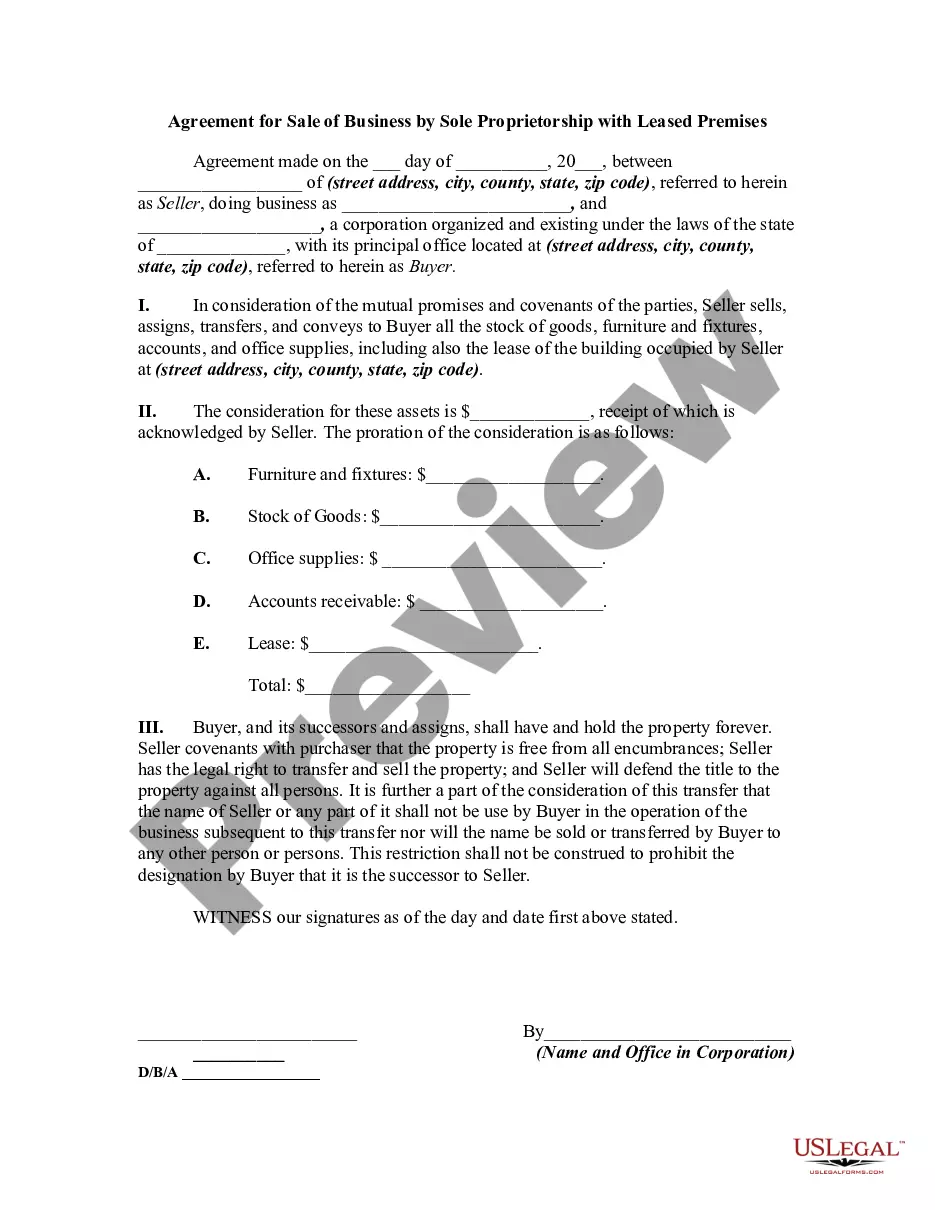
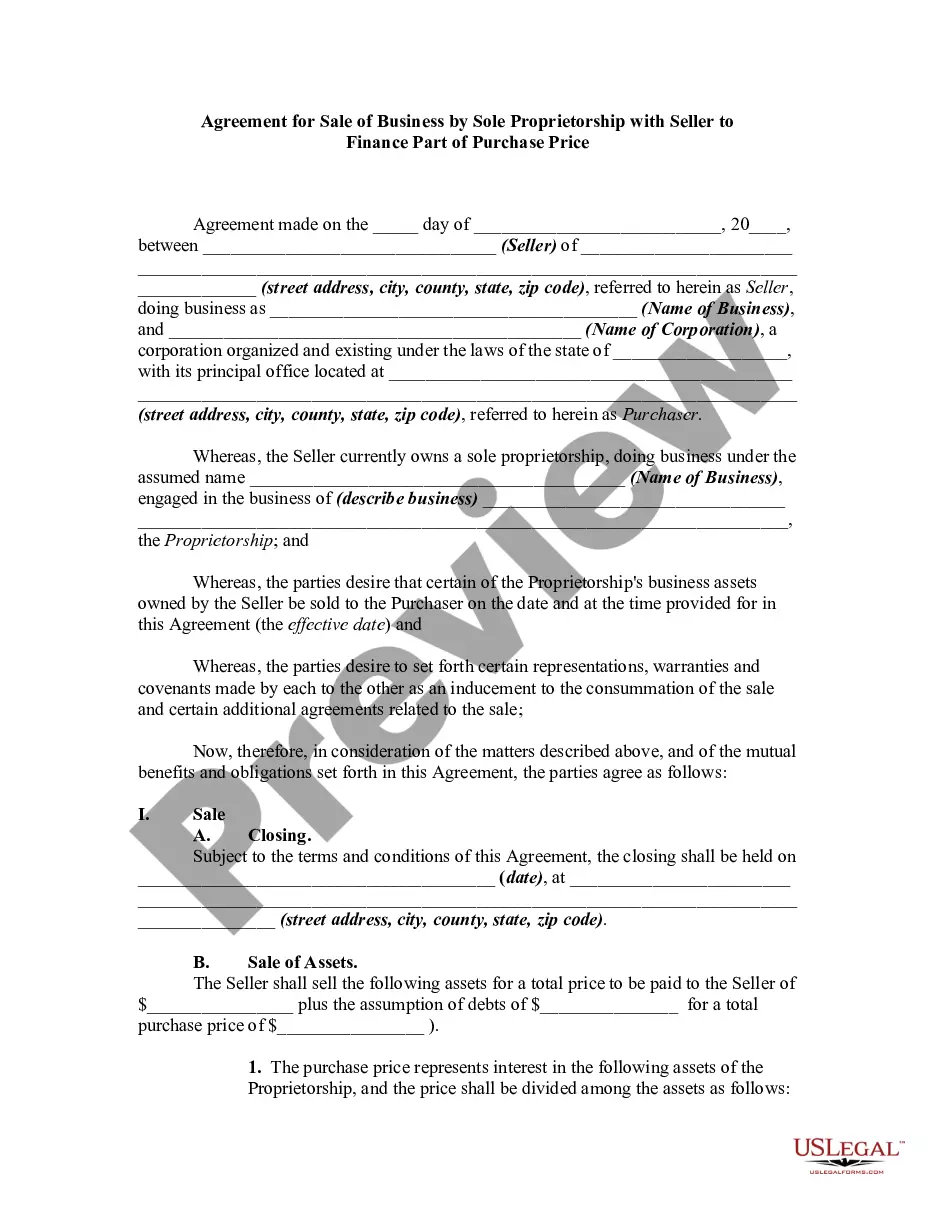
How to fill out Agreement For Sale Of Business By Sole Proprietorship With Leased Premises?
- Log in to your US Legal Forms account if you're a returning user. Ensure your subscription is active for access to the needed documents.
- Preview the available forms. Check the details and confirm that the selected form meets your local jurisdiction's requirements.
- Search for alternative templates if necessary. If there are inconsistencies or if you're unsure, use the search feature to find the right document.
- Make your purchase by selecting 'Buy Now' and choosing your desired subscription plan. You'll need to create an account if you're a new user.
- Complete your payment securely by entering your credit card information or using your PayPal account.
- Download your legal form to your device. You can always access it later through the 'My Forms' section in your profile.
With US Legal Forms, you're not just getting access to an array of documents; you're also benefiting from expert assistance to ensure your form is completed accurately and legally sound.
Start today to take the hassle out of your legal paperwork and ensure your sole proprietor LLC is set up for success!
Form popularity
FAQ
When you change your business structure from a sole proprietor to an LLC, you typically need a new Employer Identification Number (EIN). This is because an LLC is considered a separate legal entity, distinct from a sole proprietorship. Having a new EIN simplifies tax filing processes and clearly differentiates your business types. If you're looking for guidance through this transition, US Legal Forms offers resources and tools to assist you in establishing your LLC correctly.
Converting your sole proprietorship to an LLC involves several steps, starting with choosing a name that complies with state regulations. You also need to file Articles of Organization with your state and obtain a new EIN. The US Legal Forms platform can guide you through the process, ensuring you complete each requirement efficiently and correctly.
When evaluating tax implications, a sole proprietor with LLC might enjoy some advantages. LLCs can choose how they want to be taxed, either as a sole proprietorship or a corporation, potentially achieving better tax outcomes. Although a sole proprietorship generally faces simpler taxation, an LLC offers the flexibility to adapt to your specific financial situation.
Yes, converting your sole proprietorship to an LLC necessitates obtaining a new EIN. This change is important because the IRS views an LLC as a distinct legal entity. By securing your new EIN, you ensure that your business operations align with the law and maintain clarity in your financial activities.
As a sole proprietor with LLC, you typically need to use a different Employer Identification Number (EIN) when you convert your business to an LLC. While a sole proprietorship can often operate under your Social Security number, an LLC requires its own EIN for tax and legal purposes. Thus, it is essential to obtain a new EIN to comply with requirements.
You cannot have a sole proprietorship under an LLC since they are distinct business entities. An LLC provides limited liability protection, while a sole proprietorship does not. If you seek the benefits of both, you might consider remaining as an LLC while operating with sole proprietorship characteristics, but this may have its own implications.
Establishing yourself as a sole proprietorship is straightforward. You typically need to register your business name and obtain any necessary local licenses or permits. If you were previously operating under an LLC, ensure all previous obligations are settled before making the transition to avoid confusion and maintain compliance.
Determining whether an LLC or a sole proprietorship is better for taxes depends on your specific situation. Generally, a sole proprietor with an LLC may have simpler tax obligations because income passes directly to the owner. However, an LLC can offer liability protection for personal assets. Analyze your needs and consult with a tax professional to find the best solution.
To change your LLC to a sole proprietorship, you must first dissolve your LLC legally. This typically involves filing paperwork with your state and paying any required fees. Once you dissolve your LLC, you can begin operating as a sole proprietor without additional registration, but ensure to comply with any local licensing or permits needed.
In most cases, you will need to obtain a new Employer Identification Number (EIN) when changing from an LLC to a sole proprietorship. The IRS considers these structures distinct, which necessitates a new EIN for tax purposes. This means you should take the time to complete this step to avoid complications in your business tax filings.