Sample Letter for Dating Between Co-Workers - Not Allowed
About this form
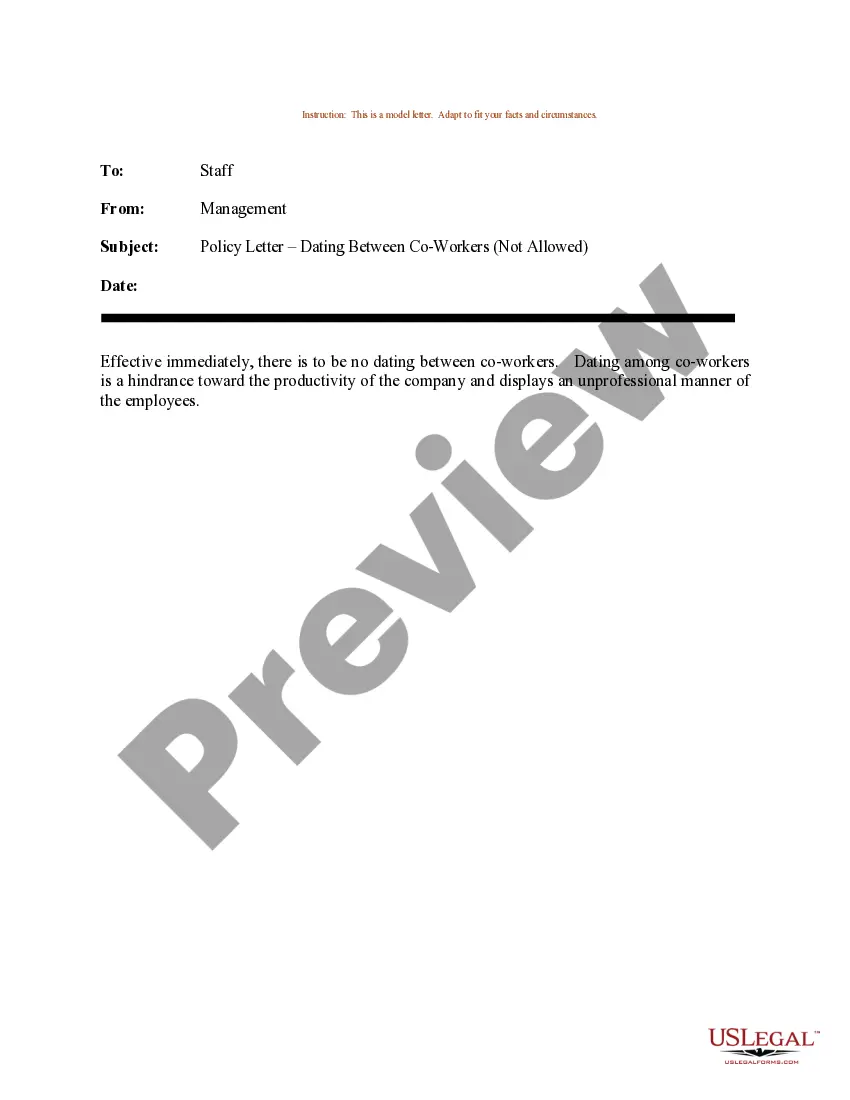
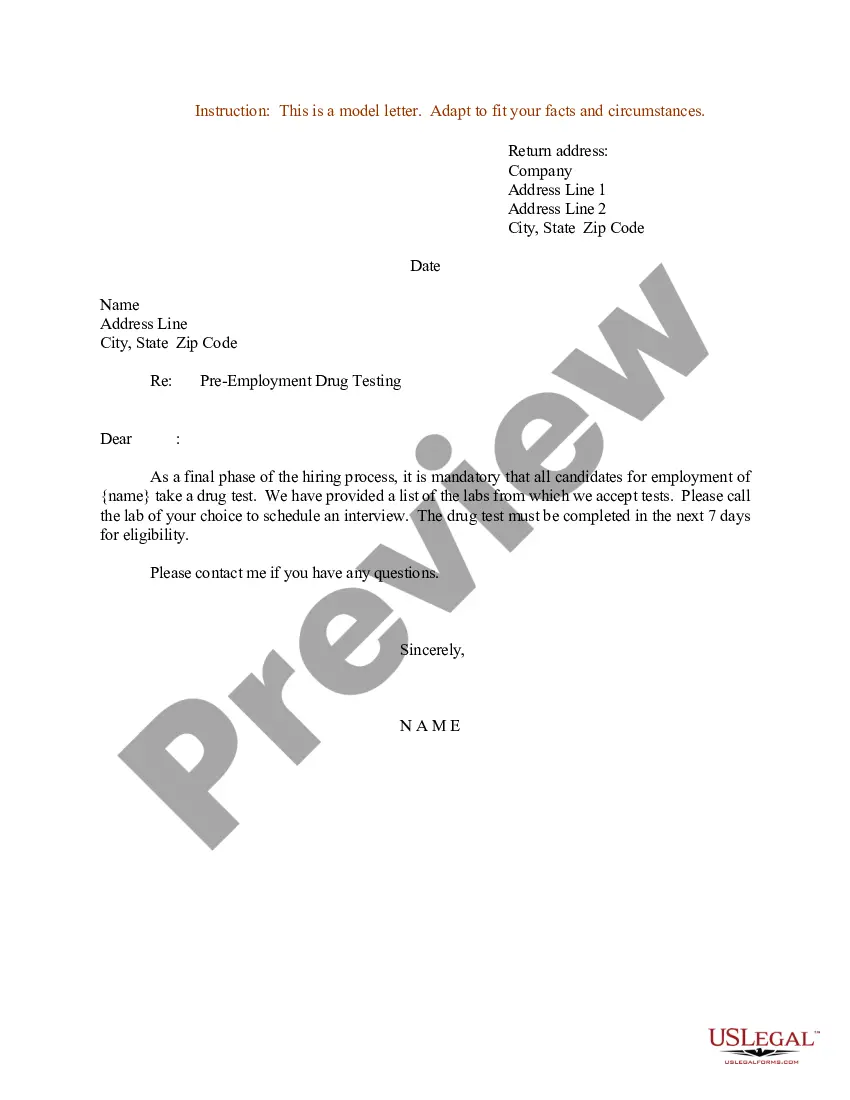
The Sample Letter for Dating Between Co-Workers - Not Allowed is a formal document that addresses workplace policies regarding romantic relationships among employees. This letter serves as a guideline or notification for situations where such relationships are deemed inappropriate or against company policy, distinguishing it from other types of letters that may promote or encourage dating in the workplace.
Main sections of this form
- Addressing the letter to the employee involved.
- Stating the company's policy on workplace dating.
- Clarifying consequences of non-compliance.
- Providing a signature line for the management or HR representative.
- Including a date for the issuance of the letter.
When this form is needed
This form is used when an employer wants to inform an employee that dating between co-workers is not permitted in the workplace. It may be necessary when an employee has expressed romantic interest in a colleague or when an existing relationship has come to the employer's attention, potentially impacting workplace dynamics and professionalism.
Intended users of this form
This letter is ideal for:
- Human resources departments addressing dating policies.
- Managers who need to enforce workplace conduct standards.
- Employers who wish to maintain a professional work environment.
- Companies aiming to prevent potential conflicts of interest or harassment claims.
Steps to complete this form
- Identify the employee who will receive the letter.
- Specify the company's dating policy clearly.
- State the potential consequences if the policy is violated.
- Provide a date to indicate when the letter was issued.
- Sign the letter to authenticate it as an official communication.
Notarization guidance
Notarization is generally not required for this form. However, certain states or situations might demand it. You can complete notarization online through US Legal Forms, powered by Notarize, using a verified video call available anytime.
Get your form ready online
Our built-in tools help you complete, sign, share, and store your documents in one place.
Make edits, fill in missing information, and update formatting in US Legal Forms—just like you would in MS Word.
Download a copy, print it, send it by email, or mail it via USPS—whatever works best for your next step.
Sign and collect signatures with our SignNow integration. Send to multiple recipients, set reminders, and more. Go Premium to unlock E-Sign.
If this form requires notarization, complete it online through a secure video call—no need to meet a notary in person or wait for an appointment.
We protect your documents and personal data by following strict security and privacy standards.

Make edits, fill in missing information, and update formatting in US Legal Forms—just like you would in MS Word.

Download a copy, print it, send it by email, or mail it via USPS—whatever works best for your next step.

Sign and collect signatures with our SignNow integration. Send to multiple recipients, set reminders, and more. Go Premium to unlock E-Sign.

If this form requires notarization, complete it online through a secure video call—no need to meet a notary in person or wait for an appointment.

We protect your documents and personal data by following strict security and privacy standards.
Avoid these common issues
- Failing to clearly state the dating policy.
- Not providing specific consequences for violations.
- Addressing the letter in a casual tone instead of maintaining professionalism.
- Omitting the date or signature, which makes the letter less formal.
Why use this form online
- Easy to download and customize according to specific company policies.
- Accessible format that allows for quick edits and updates.
- Reliable source of professionally drafted legal forms.
- Convenient access anytime, ensuring timely communication when necessary.
Legal use & context
- Helps prevent workplace harassment claims related to workplace relationships.
- Ensures compliance with company policies to maintain workplace professionalism.
- Provides a clear framework for addressing and resolving conflicts of interest.
Summary of main points
- This form is essential for communicating workplace dating policies.
- It helps prevent conflicts of interest and maintain professionalism.
- Proper completion and issuance can protect the organization legally and ethically.
Looking for another form?
Form popularity
FAQ
The policies most often used are: Complete Ban: A complete ban on workplace relationships prohibits dating between any two employees.Discrimination and Harassment Policy Only: Employers also have the option to ignore workplace relationships altogether, as long as they do not interfere with work.
What Is Fraternization in the Workplace? Fraternization is the interaction between co-workers that extends beyond business relationships. Your employees probably spend as much time with each other as they do with their family, if not more.
While being friends with a coworker doesn't mean you can be fired from your job, you could get fired if your relationship causes a disruption at work. Rather than risk losing a job for your relationship, keep all of your personal relationships out of the workplace, even if they are with coworkers.
Can I Be Fired For Dating A Coworker?That said, in California, state-level legislation designed to protect employees' rights to privacy and a private life outside of work mandates that employers cannot forbid coworkers from dating, or fire you for dating a colleague.
Legally speaking, in most states an employer can enact a policy that prohibits employees from dating one another.Prohibiting it could decrease morale and could even result in losing employees who wish to date coworkers but cannot.
This has made both workers and employers more cautious about romance on the job. In fact, when it comes to love at work, most dating experts are clear about what they recommend: Don't do it. But, of course, people ignore relationship advice all the time.
Is Firing for Office Dating Legal?The California state laws have established that an employee's personal life outside of work is protected and employers are not allowed to make disciplinary decisions based on off-hours activities including who you date.