Employee Handbook For Contractors
Description


Get your form ready online
Our built-in tools help you complete, sign, share, and store your documents in one place.
Make edits, fill in missing information, and update formatting in US Legal Forms—just like you would in MS Word.
Download a copy, print it, send it by email, or mail it via USPS—whatever works best for your next step.
Sign and collect signatures with our SignNow integration. Send to multiple recipients, set reminders, and more. Go Premium to unlock E-Sign.
If this form requires notarization, complete it online through a secure video call—no need to meet a notary in person or wait for an appointment.
We protect your documents and personal data by following strict security and privacy standards.

Make edits, fill in missing information, and update formatting in US Legal Forms—just like you would in MS Word.

Download a copy, print it, send it by email, or mail it via USPS—whatever works best for your next step.

Sign and collect signatures with our SignNow integration. Send to multiple recipients, set reminders, and more. Go Premium to unlock E-Sign.

If this form requires notarization, complete it online through a secure video call—no need to meet a notary in person or wait for an appointment.

We protect your documents and personal data by following strict security and privacy standards.
Looking for another form?








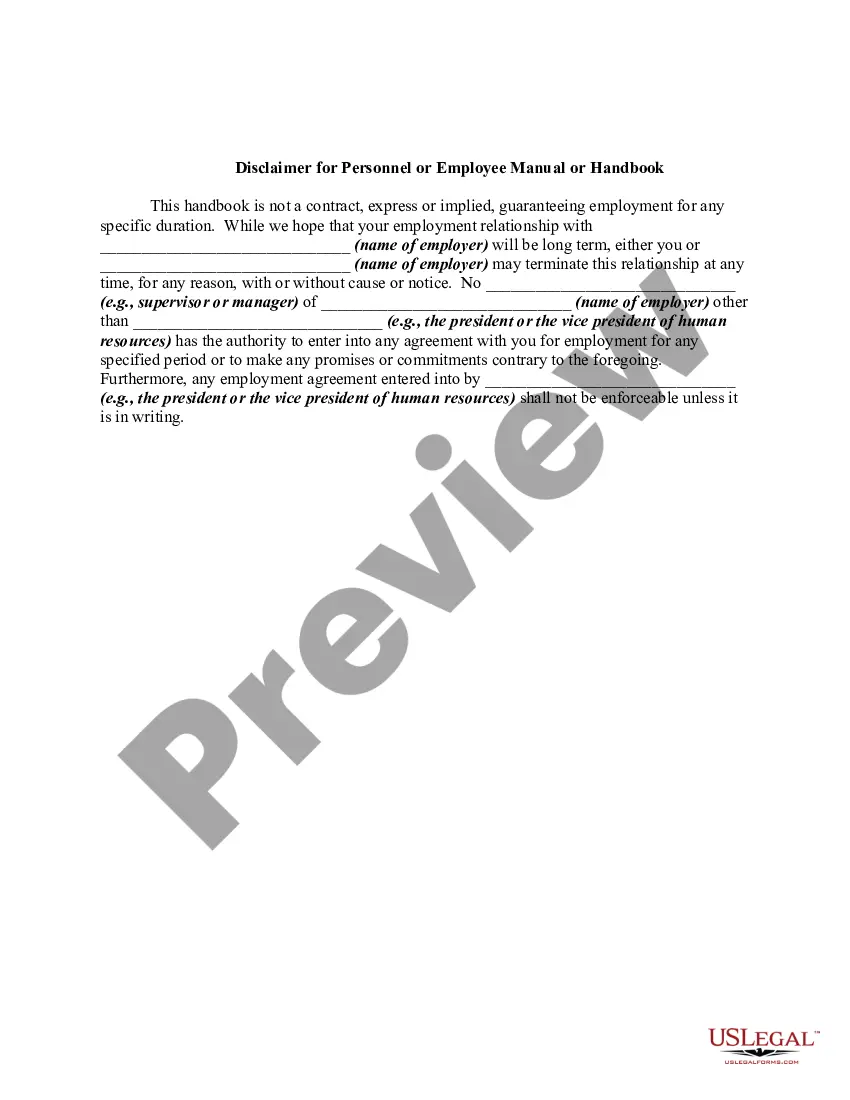
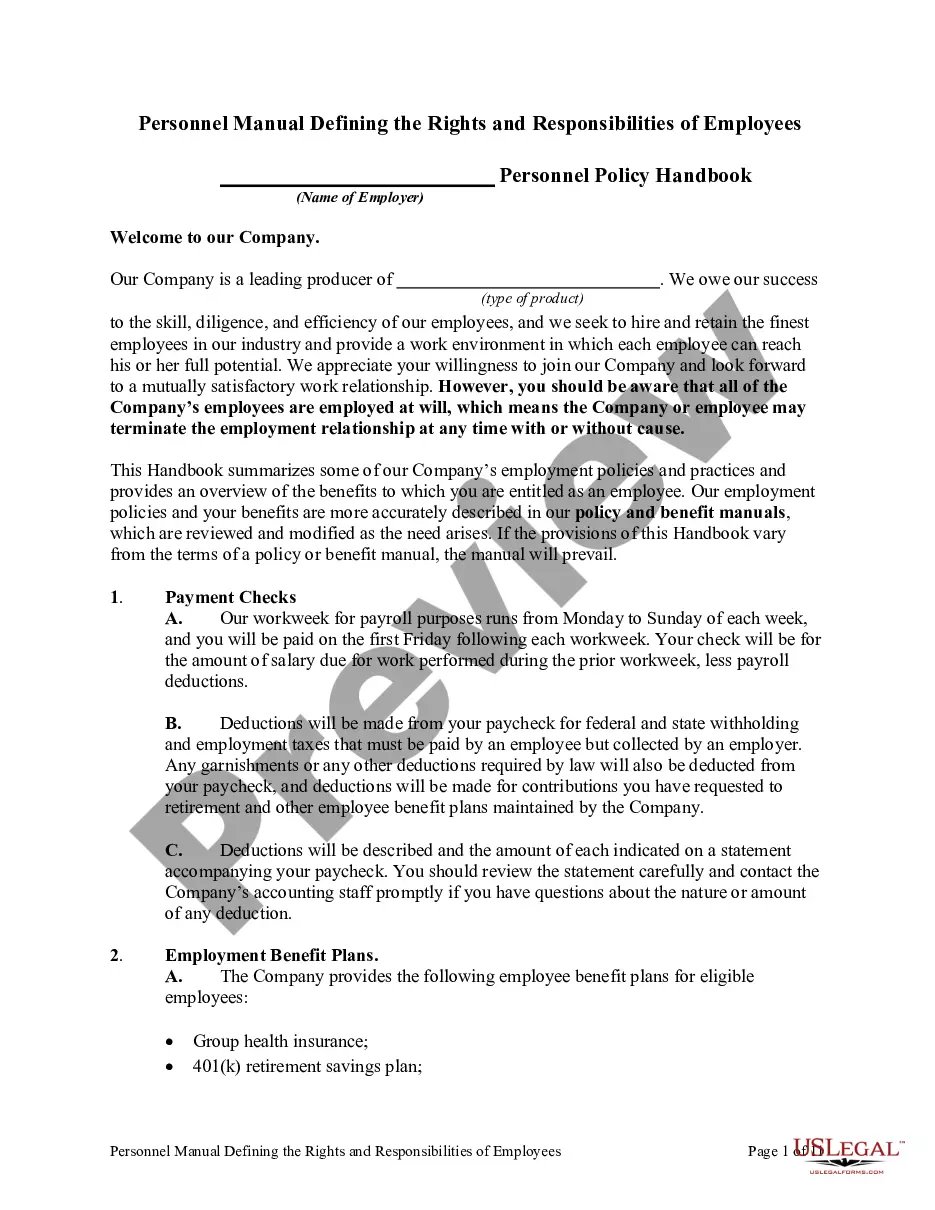
How to fill out Disclaimer For Personnel Or Employee Manual Or Handbook?
Individuals often link legal documents with something complex that only an expert can handle.
In a certain sense, this is accurate, as preparing the Employee Handbook For Contractors necessitates a comprehensive grasp of subject criteria, including both state and local laws.
Nevertheless, with US Legal Forms, the situation has improved: pre-prepared legal documents for various life and business situations tailored to state regulations are gathered in a single online repository and are now accessible to all.
All templates within our collection are reusable: once acquired, they remain stored in your account. You can access them at any time through the My documents tab. Discover all the advantages of utilizing the US Legal Forms platform. Subscribe today!
- Carefully review the page content to ensure it fulfills your requirements.
- Examine the form description or view it through the Preview feature.
- If the previous one is not suitable, search for another sample using the Search field located in the header.
- Once the appropriate Employee Handbook For Contractors is found, click Buy Now.
- Choose a pricing plan that aligns with your needs and financial constraints.
- Create an account or Log In to continue to the payment page.
- Complete the payment for your subscription using PayPal or a credit card.
- Select your sample's format and click Download.
- Print your document or upload it to an online editor for quicker completion.
Form popularity
FAQ
Whatever you call yourself, if you are self-employed, an independent contractor, or a sole proprietor, a partner in a partnership, or an LLC member, you must pay self-employment taxes (Social Security and Medicare). Since you are not an employee, no Social Security/Medicare taxes are withheld from your wages.
If you are an independent contractor, then you are self-employed. The earnings of a person who is working as an independent contractor are subject to self-employment tax. To find out what your tax obligations are, visit the Self-Employed Individuals Tax Center.
Your mission, vision, values, and guiding principles. Details about your company culture and practices. Company specific information like where to park, how and when they can gain access to the building, and when certain events usually occur. Any rules or regulations (policies) that also apply to the contractors.
If you're unsure, refer to the IRS definition of a contractor. Independent contractor relationships are best managed with a contract. Additionally, don't give your 1099 contractors a copy of your employee handbook, because you never want to muddy the line between contract and employee labor.
Nine Tips for Writing an Employee HandbookKeep It Simple & Engaging.Use Your Handbook As A Communication Tool.Pay Attention to Format and Visuals.Clearly Mention Work Hours, Compensations, and Benefits.Mention Your Company Culture & How Employees Can Maintain The Same.Mention Legal Issues.Mention Employee Appreciation.More items...?