Construction Contracts Oregon Withholding In Michigan
Description

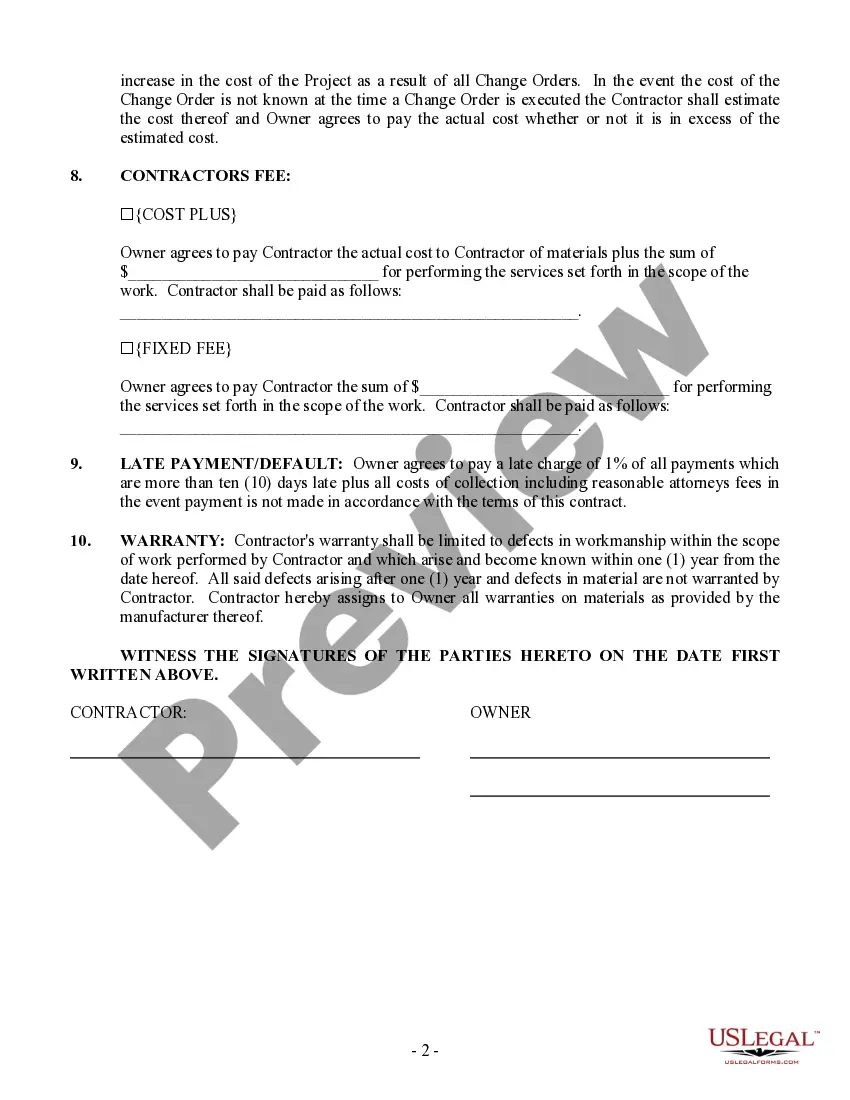
Get your form ready online
Our built-in tools help you complete, sign, share, and store your documents in one place.
Make edits, fill in missing information, and update formatting in US Legal Forms—just like you would in MS Word.
Download a copy, print it, send it by email, or mail it via USPS—whatever works best for your next step.
Sign and collect signatures with our SignNow integration. Send to multiple recipients, set reminders, and more. Go Premium to unlock E-Sign.
If this form requires notarization, complete it online through a secure video call—no need to meet a notary in person or wait for an appointment.
We protect your documents and personal data by following strict security and privacy standards.

Make edits, fill in missing information, and update formatting in US Legal Forms—just like you would in MS Word.

Download a copy, print it, send it by email, or mail it via USPS—whatever works best for your next step.

Sign and collect signatures with our SignNow integration. Send to multiple recipients, set reminders, and more. Go Premium to unlock E-Sign.

If this form requires notarization, complete it online through a secure video call—no need to meet a notary in person or wait for an appointment.

We protect your documents and personal data by following strict security and privacy standards.
Looking for another form?









Form popularity
FAQ
If it's for the employee's convenience, generally tax withholding should be for the state where the business is located. If it's a necessity, then tax withholding should be for the employee's state of residence.
MSU participates in the State Authorization Reciprocity Agreement (SARA), which is an agreement among states that establishes national standards for the interstate offering of postsecondary distance-education courses and programs.
To claim exemption due to no tax liability, you must meet both of the following conditions: Last year you had the right to a refund of all Oregon tax withheld because you had no tax liability, and • This year you expect a refund of all Oregon income tax withheld because you expect to have no tax liability.
A reciprocal agreement, also called reciprocity, is an agreement between two states that allows residents of one state to request exemption from tax withholding in the other (reciprocal) state. This can save you the trouble of having to file multiple state returns.
Michigan has reciprocal agreements with Illinois, Indiana, Kentucky, Minnesota, Ohio, and Wisconsin. If any of these states withheld taxes for a Michigan full-year resident, you'll need to file a nonresident return with that state indicating the full-year residency in Michigan.
Kentucky participates in the most agreements with seven, followed by Michigan and Pennsylvania at six apiece. At the other end of the spectrum, Iowa, Montana, and New Jersey offer reciprocity with only one state each, while 25 states with wage income taxes do not offer such reciprocity to multistate taxpayers.
What is Form OR-24 used for? Form OR-24 is used to report like-kind exchanges and involuntary conversions related to property in Oregon. How do I fill out Form OR-24? Collect your property details, enter the required dates and financial information, and submit it with your tax return.
All persons ("withholding agents") making US-source fixed, determinable, annual, or periodical (FDAP) payments to foreign persons generally must report and withhold 30% of the gross US-source FDAP payments, such as dividends, interest, royalties, etc.
Instructions: Use this schedule to report additions, subtractions, tax recaptures, standard credits, carryforward credits, and refundable credits that aren't included on Form OR-40. File an additional Schedule OR-ASC if you are claiming more than what will fit on one schedule.
Delivery or installation charges can now be exempt from Michigan sales and use tax. Michigan's legislature changed the Michigan sales and use tax treatment of most delivery and installation charges effective April 26, 2023. When a seller follows two simple steps, the fees are now exempt from the sales tax calculation.
