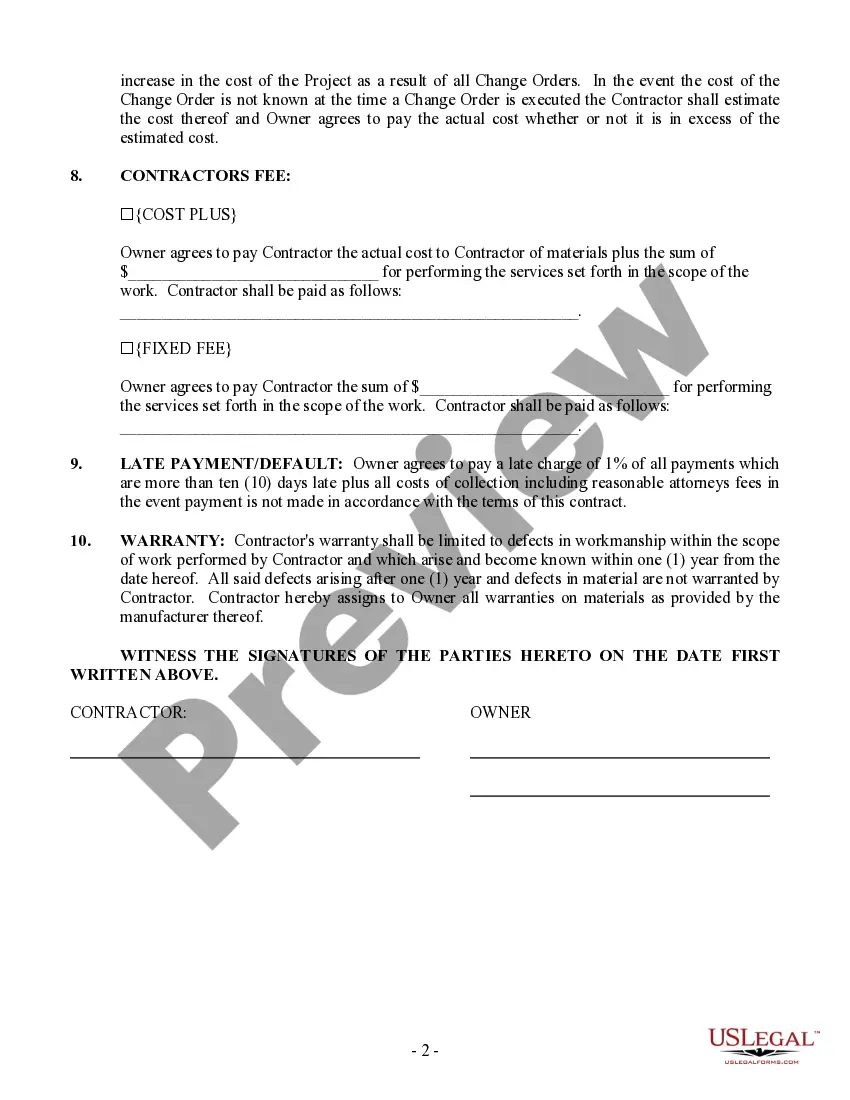
Construction Contract Cost Plus Withholding In Contra Costa
Description

Get your form ready online
Our built-in tools help you complete, sign, share, and store your documents in one place.
Make edits, fill in missing information, and update formatting in US Legal Forms—just like you would in MS Word.
Download a copy, print it, send it by email, or mail it via USPS—whatever works best for your next step.
Sign and collect signatures with our SignNow integration. Send to multiple recipients, set reminders, and more. Go Premium to unlock E-Sign.
If this form requires notarization, complete it online through a secure video call—no need to meet a notary in person or wait for an appointment.
We protect your documents and personal data by following strict security and privacy standards.

Make edits, fill in missing information, and update formatting in US Legal Forms—just like you would in MS Word.

Download a copy, print it, send it by email, or mail it via USPS—whatever works best for your next step.

Sign and collect signatures with our SignNow integration. Send to multiple recipients, set reminders, and more. Go Premium to unlock E-Sign.

If this form requires notarization, complete it online through a secure video call—no need to meet a notary in person or wait for an appointment.

We protect your documents and personal data by following strict security and privacy standards.
Looking for another form?








Form popularity
FAQ
5 Percent. Prior to completion and acceptance of the project, retainage may not exceed 5%. After 95% of the work is complete, withheld funds may be reduced to 125% of the estimated value of the unfinished work.
For example, in California, the statute of repose is four years for most problems, but 10 years for latent defects or problems that aren't readily apparent.
Payment Deadlines for Private Projects Final payments from the owner to the prime contractor become due within 45 days after the completion of the entire project. Upon receipt of payment from the owner, the prime contractor needs to make payment to their subs and suppliers within 10 days.
For example, ing to retainage rules in California, state law caps retainage at 5% prior to completion and acceptance of the project. On private construction projects in Taxes, the property owner must retain 10%. You need to consult to see what the rules are in your state.
Finally, retaining walls are addressed by CIV §832, which makes it the responsibility of the excavated property to provide adequate support to neighboring landowners. Not sure, but that sounds like you as the excavated property owner have a duty to your neighbor to maintain the retaining wall.
(b)(1) The retention proceeds withheld from any payment by a public entity from the original contractor, by the original contractor from any subcontractor, and by a subcontractor from any subcontractor thereunder shall not exceed 5 percent of the payment.
Laws set a limit and deadline for retainage For example, ing to retainage rules in California, state law caps retainage at 5% prior to completion and acceptance of the project. On private construction projects in Taxes, the property owner must retain 10%.
In general, construction labor is not taxable. Installation labor of a fixture in most cases is also exempt from taxation, but the fabrication labor involved in the creation of a fixture is taxable.
