3-Point Cost Estimate Comparisons
What is this form?
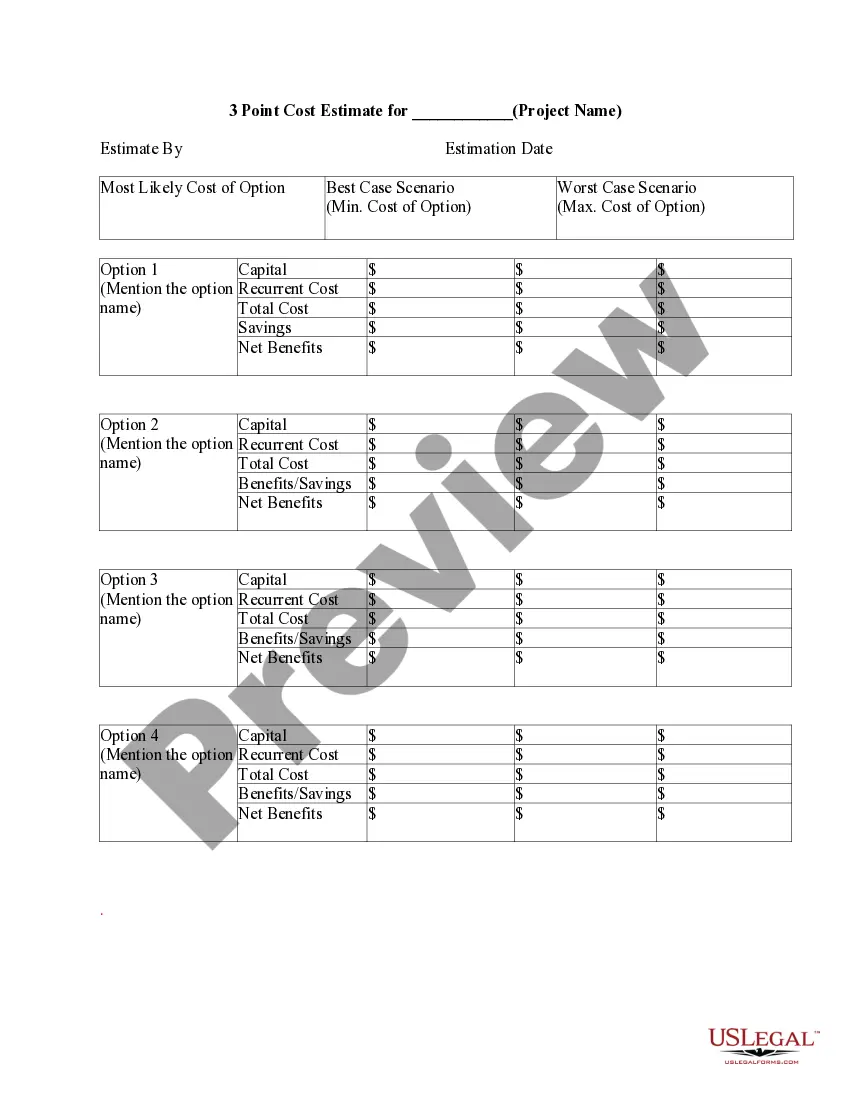
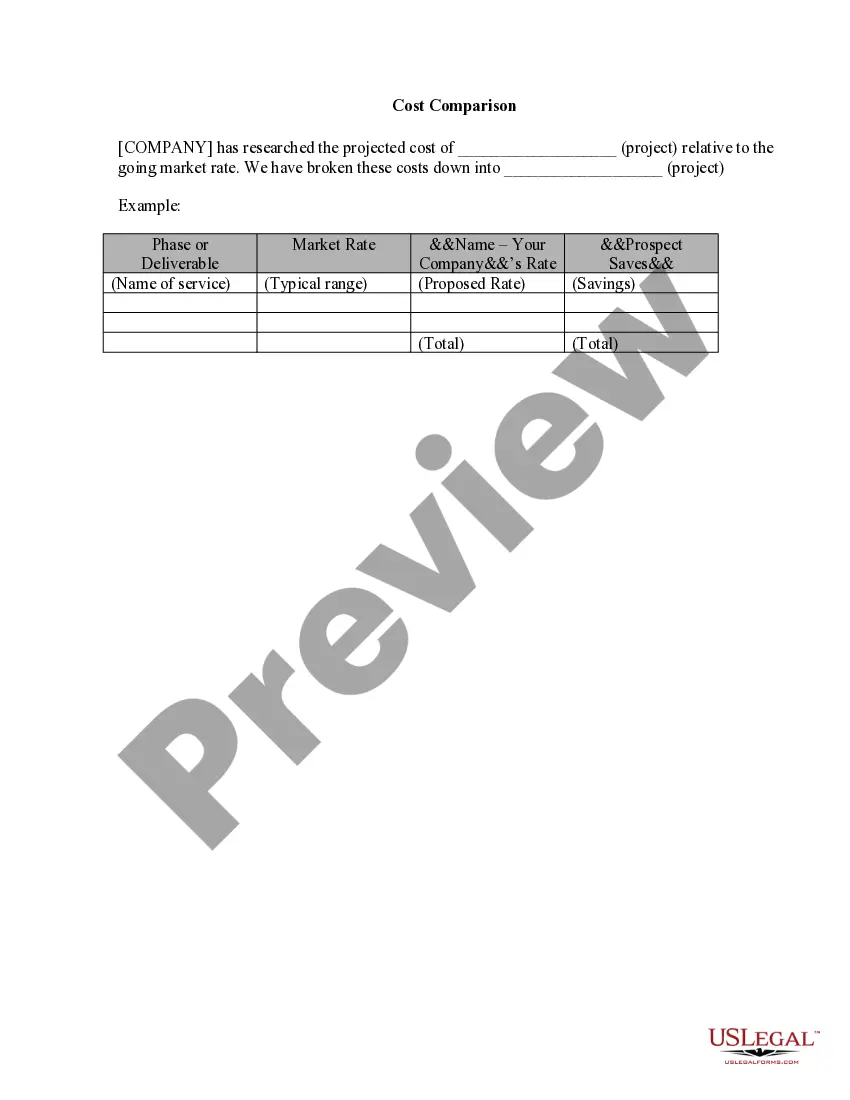
The 3-Point Cost Estimate Comparisons form is designed to facilitate project budgeting by providing a framework for estimating costs using three different scenarios: the most likely cost, best case, and worst case. This form is commonly used in management and information systems to help decision-makers understand potential outcomes for budgeting purposes. Unlike traditional cost estimation methods, this approach offers a more rounded view of potential financial commitments, allowing for comprehensive planning and risk assessment.
Key components of this form
- Estimation date: The date when the estimate is created.
- Cost options: Fields for up to four different options, each requiring input for capital costs, recurrent costs, total costs, and net benefits.
- Most likely cost: The expected outcome based on available data.
- Best case scenario: The minimum cost anticipated for a particular option.
- Worst case scenario: The maximum cost that could occur.
When to use this form
This form is useful in various scenarios, including when planning a new project, making budget forecasts, or assessing the financial feasibility of multiple options. It is particularly beneficial when limited information is available, allowing stakeholders to make informed decisions based on different potential outcomes.
Who this form is for
- Project managers evaluating multiple financial scenarios.
- Business analysts preparing budgets for projects.
- Finance professionals assessing the viability of investment options.
- Decision-makers in organizations aiming to minimize financial risk.
How to prepare this document
- Identify and clearly state the estimation date at the top of the form.
- For each cost option, specify the option name and fill in the capital costs and recurrent costs.
- Assign the most likely, best case, and worst-case scenarios for each option.
- Calculate and enter the total costs and net benefits for each option.
- Review all provided information for accuracy before finalizing the estimates.
Does this form need to be notarized?
Notarization is not commonly needed for this form. However, certain documents or local rules may make it necessary. Our notarization service, powered by Notarize, allows you to finalize it securely online anytime, day or night.
Get your form ready online
Our built-in tools help you complete, sign, share, and store your documents in one place.
Make edits, fill in missing information, and update formatting in US Legal Forms—just like you would in MS Word.
Download a copy, print it, send it by email, or mail it via USPS—whatever works best for your next step.
Sign and collect signatures with our SignNow integration. Send to multiple recipients, set reminders, and more. Go Premium to unlock E-Sign.
If this form requires notarization, complete it online through a secure video call—no need to meet a notary in person or wait for an appointment.
We protect your documents and personal data by following strict security and privacy standards.

Make edits, fill in missing information, and update formatting in US Legal Forms—just like you would in MS Word.

Download a copy, print it, send it by email, or mail it via USPS—whatever works best for your next step.

Sign and collect signatures with our SignNow integration. Send to multiple recipients, set reminders, and more. Go Premium to unlock E-Sign.

If this form requires notarization, complete it online through a secure video call—no need to meet a notary in person or wait for an appointment.

We protect your documents and personal data by following strict security and privacy standards.
Avoid these common issues
- Failing to accurately estimate costs due to lack of sufficient data.
- Neglecting to update the form with the correct estimation date.
- Overlooking potential savings and net benefits, which skew overall assessments.
- Using unrealistic scenarios for best case or worst case estimates.
Why complete this form online
- Easy access to downloadable formats that can be saved and edited as needed.
- Structured layout simplifies the estimation process and improves accuracy.
- Provides a clear comparison between different cost scenarios, aiding decision-making.
- Convenient use that can be tailored to various projects or budgeting needs.
Looking for another form?





Form popularity
FAQ
Pros: it is considered to be one of the most accurate estimation techniques in project management; it reduces the scenario with too optimistic and too inflated estimates. Cons: it requires more time to provide three estimates for each task. Accuracy: close to the highest value.
Pros: it is considered to be one of the most accurate estimation techniques in project management; it reduces the scenario with too optimistic and too inflated estimates. Cons: it requires more time to provide three estimates for each task. Accuracy: close to the highest value.
Because three-point estimation offers a more accurate estimate, it helps to mitigate the risk of failure and reduces the likelihood of an overly optimistic or over-inflated estimate. Once you've identified the risks, you can analyze and prioritize them by applying the three-point estimation technique.
Three-point estimating is a management technique to determine the probable outcomes of future events based on available information. The term refers to the three-points it measures: the best-case estimate, the most likely estimate, and the worst-case estimate.
Estimation Techniques - Three Point the most optimistic estimate (O), a most likely estimate (M), and. a pessimistic estimate (least likely estimate (L)).
Pessimistic time estimation Three-point estimating method is so accurate because it also takes into consideration the pessimistic scenario. Just like I mentioned before there are variables that influence the time of the implementation.
Pessimistic time estimation Three-point estimating method is so accurate because it also takes into consideration the pessimistic scenario. Just like I mentioned before there are variables that influence the time of the implementation.
The difference between 3 point estimate and PERT is that the 3 point considers only three estimated points and PERT allows to convert the 3 points estimate to nearly normally distributed bell shaped curve which can be used for probabilities calculation of ranges of expected duration.