Construction Cost Plus Contract With Guaranteed Maximum Price
Description

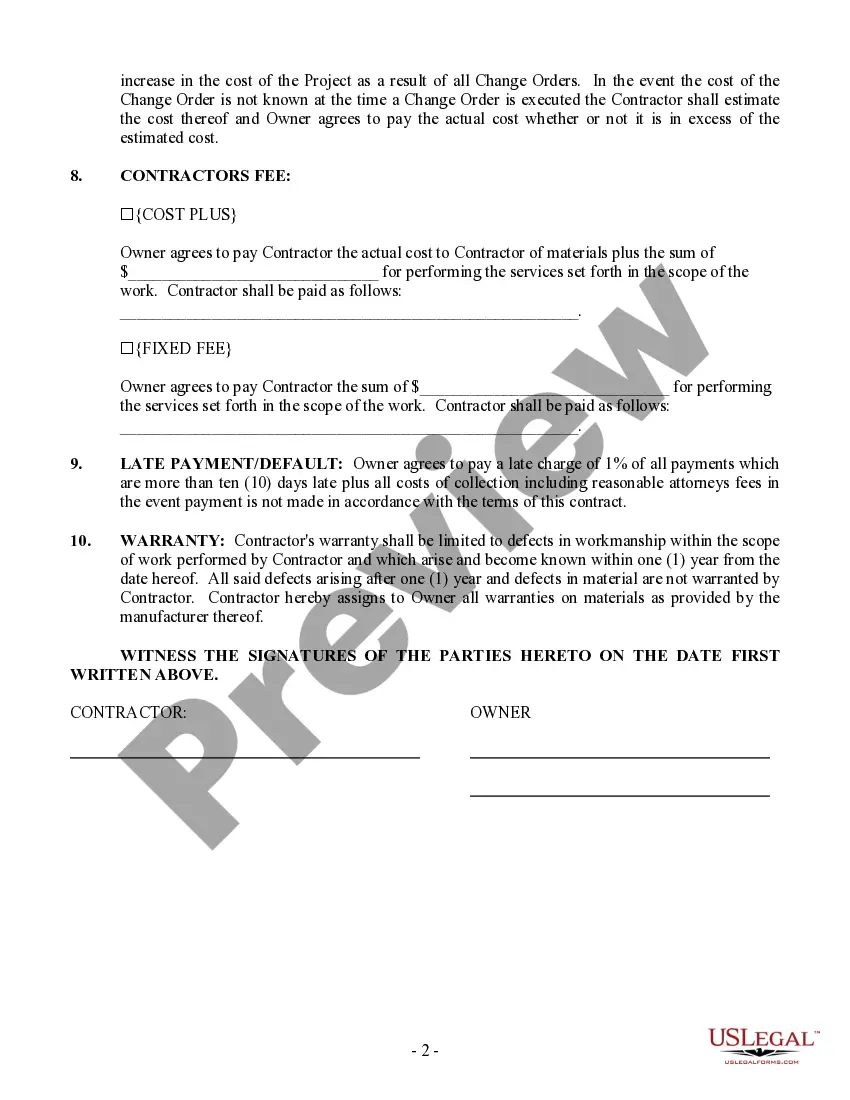
How to fill out Construction Contract For Home - Fixed Fee Or Cost Plus?
Regardless of whether it is for corporate activities or personal issues, everyone eventually must navigate legal scenarios in their lives.
Finalizing legal documents requires meticulous attention, starting from selecting the correct form template.
With a vast US Legal Forms database available, you no longer need to waste time searching for the appropriate sample on the internet. Utilize the library’s straightforward navigation to find the correct template for any circumstance.
- Obtain the document you require through the search box or directory browsing.
- Review the form’s details to confirm it aligns with your situation, jurisdiction, and area.
- Select the form’s preview to examine it.
- If it is not the right form, return to the search tool to locate the Construction Cost Plus Contract With Guaranteed Maximum Price sample you require.
- Download the form if it fulfills your specifications.
- If you already possess a US Legal Forms account, simply click Log in to access previously stored documents in My documents.
- If you don’t have an account yet, you can access the form by clicking Buy now.
- Select the suitable pricing option.
- Fill out the account registration form.
- Pick your payment method: either a credit card or a PayPal account.
- Choose the file format you desire and download the Construction Cost Plus Contract With Guaranteed Maximum Price.
- Once downloaded, you can complete the form using editing software or print it out and fill it manually.
Form popularity
FAQ
Gmax, or guaranteed maximum price, is a critical element in a construction cost plus contract with guaranteed maximum price. It represents the highest amount the project will cost, thus protecting the client from unexpected expenses. This price cap allows project stakeholders to plan effectively and minimizes financial risks. Using Gmax helps ensure that the project remains within budget while encouraging efficient management of resources.
The guaranteed construction sum refers to the total amount agreed upon in a construction cost plus contract with guaranteed maximum price. This sum ensures that the project does not exceed the specified budget, providing security for both the client and the contractor. With this arrangement, clients can confidently manage their expenditures while enjoying the flexibility that a cost-plus contract offers. Ultimately, this approach fosters transparency and collaboration throughout the construction process.
While a construction cost plus contract with a guaranteed maximum price offers many advantages, it can also have drawbacks. One significant issue may arise from the contention over what costs are allowable under the contract, possibly leading to disputes between you and the contractor. Additionally, this type of contract may result in less incentive for contractors to minimize costs, as they might aim for the maximum allowed. Understanding these potential pitfalls can help you make informed decisions when selecting contract types for your projects.
You should consider a construction cost plus contract with a guaranteed maximum price when you want to control costs while maintaining flexibility in project design. This contract type protects you from unexpected cost overruns, as the contractor agrees to complete the project within a specified budget. It's particularly beneficial in projects where scope or design might change, allowing for adaptability without sacrificing cost control. By using this model, you can effectively manage your budget while encouraging collaboration and innovation.
Writing a cost-plus construction contract involves several key steps. First, clearly outline the scope of work and specify all allowable costs, including labor and materials. Then, establish the guaranteed maximum price, ensuring both parties understand their roles and responsibilities. Using uslegalforms can simplify this process, providing templates that help you create an effective construction cost plus contract with guaranteed maximum price tailored to your project needs.
The maximum contract value in a construction cost plus contract with guaranteed maximum price refers to the highest amount that can be charged under the contract. This value limits the overall expenses and provides financial security to all parties involved. By establishing a guaranteed maximum price, you ensure that your project remains within budget, preventing unforeseen costs from derailing your plans. Choosing the right contract structure is essential, and uslegalforms can assist you in drafting contracts that reflect these important terms.
A guaranteed maximum price (GMP) contract sets a maximum price for a construction project, beyond which the contractor absorbs additional costs. Sometimes called a construction manager at risk contract, this type of construction agreement minimizes financial risk for the owner because it sets a project cost limit.
Unlike a lump sum contract wherein a contractor is paid a flat fee for the work, the guaranteed maximum price contract allows the owner to potentially save money if the project ends up costing less than estimated.
Cost-plus fixed-fee: The contractor's profit is a base fee that doesn't depend on the project cost. Cost-plus fixed fee with a guaranteed maximum price: The contractor's profit is a base fee that does not exceed a specified amount.
3322(b) and 41 U.S.C. 3905 : (A) For experimental, developmental, or research work performed under a cost-plus-fixed-fee contract, the fee shall not exceed 15 percent of the contract's estimated cost, excluding fee.