S Corporation Without Payroll In Washington
Description


Get your form ready online
Our built-in tools help you complete, sign, share, and store your documents in one place.
Make edits, fill in missing information, and update formatting in US Legal Forms—just like you would in MS Word.
Download a copy, print it, send it by email, or mail it via USPS—whatever works best for your next step.
Sign and collect signatures with our SignNow integration. Send to multiple recipients, set reminders, and more. Go Premium to unlock E-Sign.
If this form requires notarization, complete it online through a secure video call—no need to meet a notary in person or wait for an appointment.
We protect your documents and personal data by following strict security and privacy standards.

Make edits, fill in missing information, and update formatting in US Legal Forms—just like you would in MS Word.

Download a copy, print it, send it by email, or mail it via USPS—whatever works best for your next step.

Sign and collect signatures with our SignNow integration. Send to multiple recipients, set reminders, and more. Go Premium to unlock E-Sign.

If this form requires notarization, complete it online through a secure video call—no need to meet a notary in person or wait for an appointment.

We protect your documents and personal data by following strict security and privacy standards.
Looking for another form?






Form popularity
FAQ
S Corp owners must file Form 1120-S, U.S. Income Tax Return for an S Corporation. Both C and S Corps follow the same guidelines for filing taxes with no income. If you had no income, you must file the corporation income tax return, regardless of whether you had expenses or not.
The C corporation is the standard (or default) corporation under IRS rules. The S corporation is a corporation that has elected a special tax status with the IRS and therefore has some tax advantages. Both business structures get their names from the parts of the Internal Revenue Code that they are taxed under.
An S corporation can have only one class of stock, although it can have both voting and non-voting shares. Therefore, there can't be different classes of investors who are entitled to different dividends or distribution rights. Also, there cannot be more than 100 shareholders.
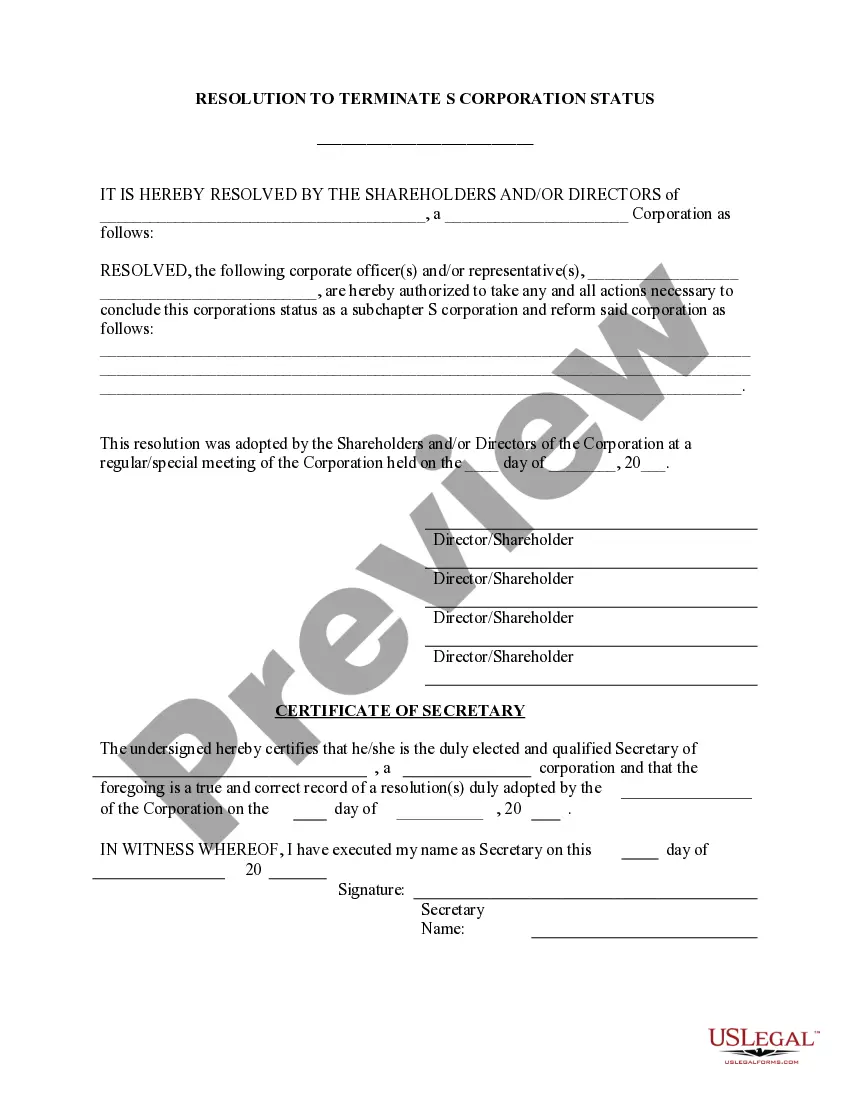
To form a Washington S corp, you'll need to ensure your company has a Washington formal business structure (LLC or corporation), and then you can elect S corp tax designation. If you've already formed an LLC or corporation, file Form 2553 with the Internal Revenue Service (IRS) to designate S corp taxation status.
In Washington, an S corporation is treated as a regular C corporation for state tax purposes because the state does not recognize the federal S corporation election.
LLC members may be any person or organization while S Corporation shareholders must be individual U.S. citizens or U.S. residents, estates or certain trusts (they cannot be other corporations or LLCs). Also, the number of shareholders is limited for an S Corporation while an LLC may have an unlimited number of members.
LLC members may be any person or organization while S Corporation shareholders must be individual U.S. citizens or U.S. residents, estates or certain trusts (they cannot be other corporations or LLCs). Also, the number of shareholders is limited for an S Corporation while an LLC may have an unlimited number of members.
