S Corporation Without Payroll In Dallas
Description


Get your form ready online
Our built-in tools help you complete, sign, share, and store your documents in one place.
Make edits, fill in missing information, and update formatting in US Legal Forms—just like you would in MS Word.
Download a copy, print it, send it by email, or mail it via USPS—whatever works best for your next step.
Sign and collect signatures with our SignNow integration. Send to multiple recipients, set reminders, and more. Go Premium to unlock E-Sign.
If this form requires notarization, complete it online through a secure video call—no need to meet a notary in person or wait for an appointment.
We protect your documents and personal data by following strict security and privacy standards.

Make edits, fill in missing information, and update formatting in US Legal Forms—just like you would in MS Word.

Download a copy, print it, send it by email, or mail it via USPS—whatever works best for your next step.

Sign and collect signatures with our SignNow integration. Send to multiple recipients, set reminders, and more. Go Premium to unlock E-Sign.

If this form requires notarization, complete it online through a secure video call—no need to meet a notary in person or wait for an appointment.

We protect your documents and personal data by following strict security and privacy standards.
Looking for another form?








Form popularity
FAQ
Even if an S Corp has no income, it must file IRS Form 1120S annually to maintain compliance. Filing establishes a tax record, prevents IRS assumptions about tax liability, and avoids penalties. Business expenses can still be deducted, potentially resulting in a loss that carries forward.
Even if an S Corp has no income, it must file IRS Form 1120S annually to maintain compliance. Filing establishes a tax record, prevents IRS assumptions about tax liability, and avoids penalties. Business expenses can still be deducted, potentially resulting in a loss that carries forward.
An S corporation may have no employees in the traditional sense of a person who works for the business but has no ownership stake. However, for tax purposes, any shareholder who performs duties for the business may be treated as a shareholder-employee.
LLCs can have an unlimited number of members; S corps can have no more than 100 shareholders (owners). Non-U.S. citizens/residents can be members of LLCs; S corps may not have non-U.S. citizens/residents as shareholders. S corporations cannot be owned by corporations, LLCs, partnerships or many trusts.
There's no need to convert your LLC to a corporation at the state level. If you'd like to convert your LLC to an S corporation, then you must elect S corporation tax status. To convert to an S corporation, file an IRS Form 2553 at the federal level.
A Texas plan of conversion is a written document authorizing a Texas LLC to take the steps necessary to move the LLC to a new state. An LLC's Texas plan of conversion specifies how an LLC conversion will be carried out and how it will affect the company and authorizes the procedure on behalf of the company.
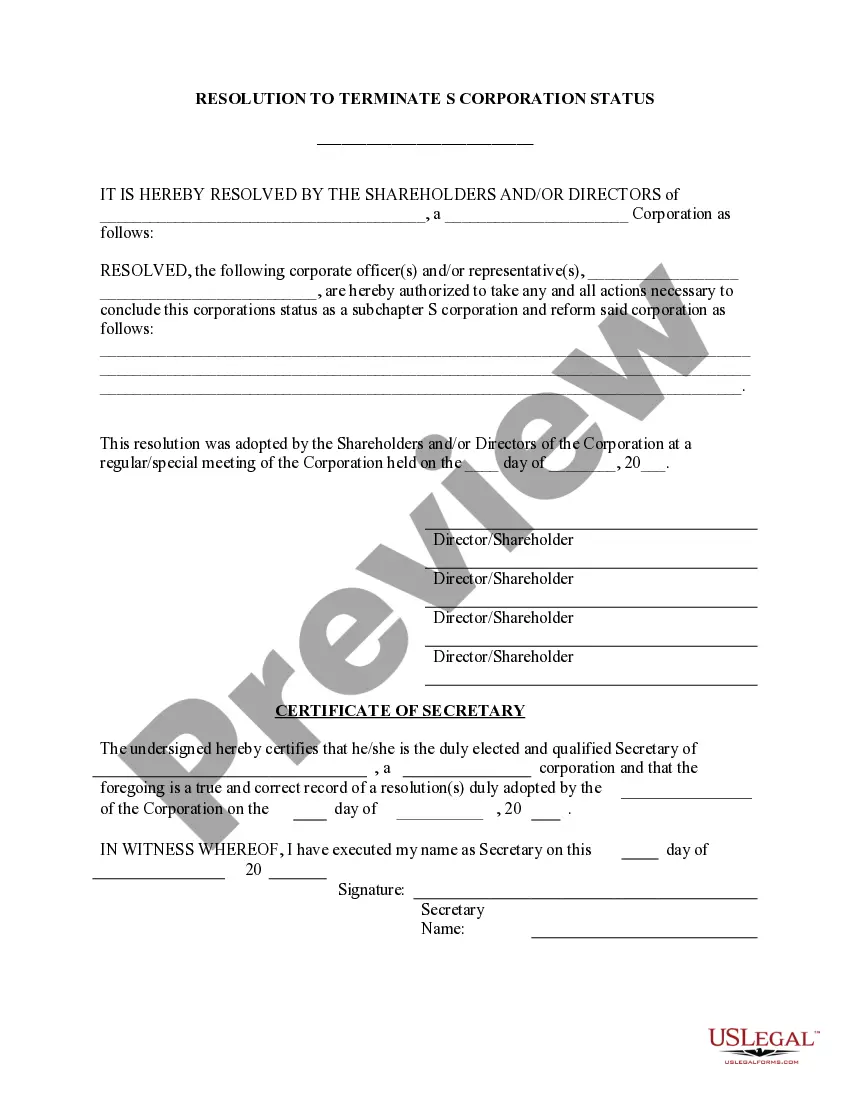
To file an S Corporation in Texas, you'll first form a corporation with the Texas Secretary of State. After forming your corporation, you'll then elect to be taxed as an S Corporation. To become an S Corporation, you won't work with the state of Texas.
To file an S Corporation in Texas, you'll first form a corporation with the Texas Secretary of State. After forming your corporation, you'll then elect to be taxed as an S Corporation. To become an S Corporation, you won't work with the state of Texas.
Texas S-Corp Filing Service is one-time $375 and includes: State filing fees. Processing of your Texas Articles of Incorporation.
