Confidentiality And Nondisclosure Agreement For Consultant In Middlesex
Description

Get your form ready online
Our built-in tools help you complete, sign, share, and store your documents in one place.
Make edits, fill in missing information, and update formatting in US Legal Forms—just like you would in MS Word.
Download a copy, print it, send it by email, or mail it via USPS—whatever works best for your next step.
Sign and collect signatures with our SignNow integration. Send to multiple recipients, set reminders, and more. Go Premium to unlock E-Sign.
If this form requires notarization, complete it online through a secure video call—no need to meet a notary in person or wait for an appointment.
We protect your documents and personal data by following strict security and privacy standards.

Make edits, fill in missing information, and update formatting in US Legal Forms—just like you would in MS Word.

Download a copy, print it, send it by email, or mail it via USPS—whatever works best for your next step.

Sign and collect signatures with our SignNow integration. Send to multiple recipients, set reminders, and more. Go Premium to unlock E-Sign.

If this form requires notarization, complete it online through a secure video call—no need to meet a notary in person or wait for an appointment.

We protect your documents and personal data by following strict security and privacy standards.
Looking for another form?









Form popularity
FAQ
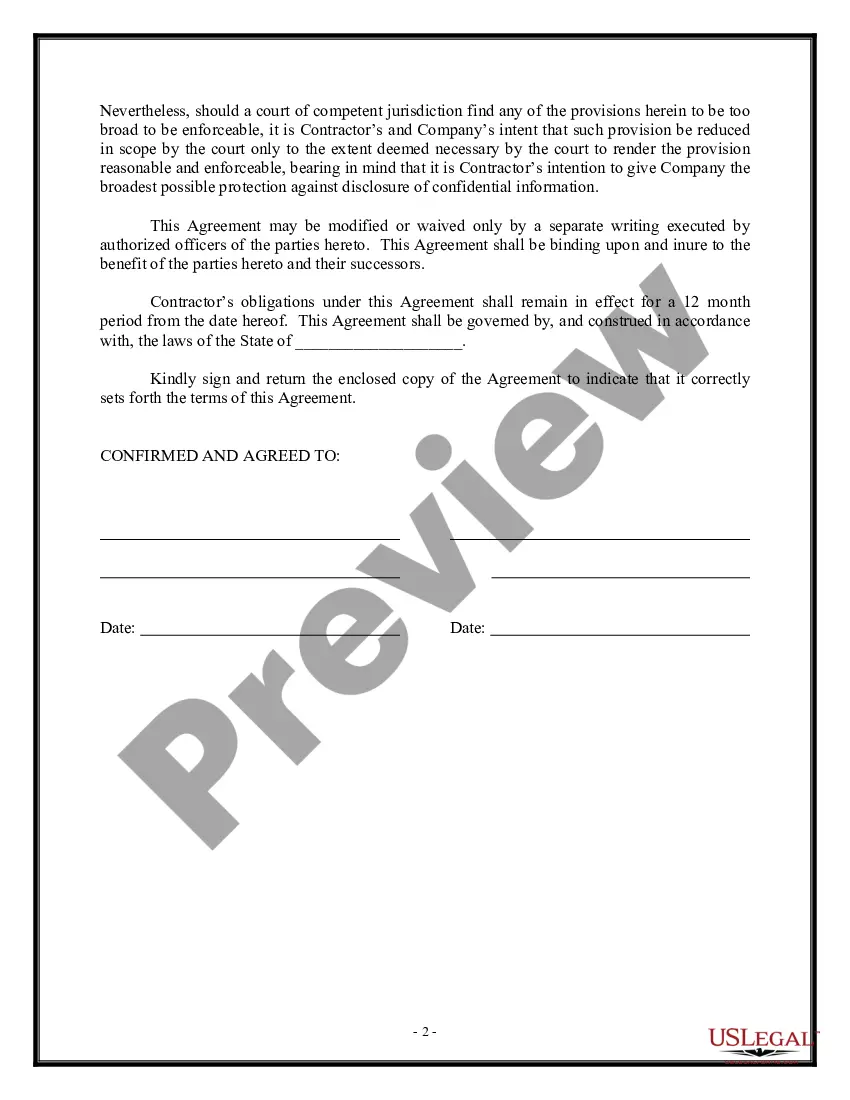
Is a 12-month restrictive covenant enforceable? Each case turns on its own facts, but a court is generally reluctant to enforce restrictive covenants longer than 12 months. Market practice dictates a period of between 3 and 6 months is appropriate for more junior employees.
Completing the Confidentiality Agreement The "Receiving Party" is the person or company who receives the confidential information and is obligated to keep it secret. You'll need to fill in information specific to your circumstances in the spaces provided, such as the parties' names and addresses.
A confidentiality agreement should include the names and addresses of the parties to the contract. Consider also including: Reason for the agreement: Explain why you're sharing this information. The information disclosed: Be specific about the subject matter and what exactly is included in the agreement.
Harshdeep Rapalon June 14, 2024. A Consultant Non-Disclosure Agreement (NDA) is a legal contract that establishes a confidential relationship between a company and a consultant. The agreement outlines the information that must remain confidential and details the obligations of both parties regarding that information.
Non-disclosure agreements are a legal contract. If broken, the aggrieved party can take legal action; they should spell out what will happen if breached.
NDAs are enforceable once signed, provided they have been drafted and executed properly. Unilateral NDAs need only the signature of the receiving party, whereas mutual non-disclosure agreements need the signatures of both parties.
For consultants, maintaining confidentiality is both a professional obligation and a matter of legal compliance. In many cases, contracts include non-disclosure agreements (NDAs) that explicitly prohibit sharing sensitive information.
Completing the Confidentiality Agreement The "Receiving Party" is the person or company who receives the confidential information and is obligated to keep it secret. You'll need to fill in information specific to your circumstances in the spaces provided, such as the parties' names and addresses.
It is important that you don't assume conversations with advisors are automatically confidential. An NDA is a legal contract. It sets out how you share information or ideas in confidence.
Many contracts contain a confidentiality clause - by which I mean a provision which prevents the parties to the contract from publicising, or otherwise disclosing to others, certain information.
