Roommate Agreement For Couples Form Big Bang Theory In Dallas
Description


Get your form ready online
Our built-in tools help you complete, sign, share, and store your documents in one place.
Make edits, fill in missing information, and update formatting in US Legal Forms—just like you would in MS Word.
Download a copy, print it, send it by email, or mail it via USPS—whatever works best for your next step.
Sign and collect signatures with our SignNow integration. Send to multiple recipients, set reminders, and more. Go Premium to unlock E-Sign.
If this form requires notarization, complete it online through a secure video call—no need to meet a notary in person or wait for an appointment.
We protect your documents and personal data by following strict security and privacy standards.

Make edits, fill in missing information, and update formatting in US Legal Forms—just like you would in MS Word.

Download a copy, print it, send it by email, or mail it via USPS—whatever works best for your next step.

Sign and collect signatures with our SignNow integration. Send to multiple recipients, set reminders, and more. Go Premium to unlock E-Sign.

If this form requires notarization, complete it online through a secure video call—no need to meet a notary in person or wait for an appointment.

We protect your documents and personal data by following strict security and privacy standards.
Looking for another form?





Form popularity
FAQ
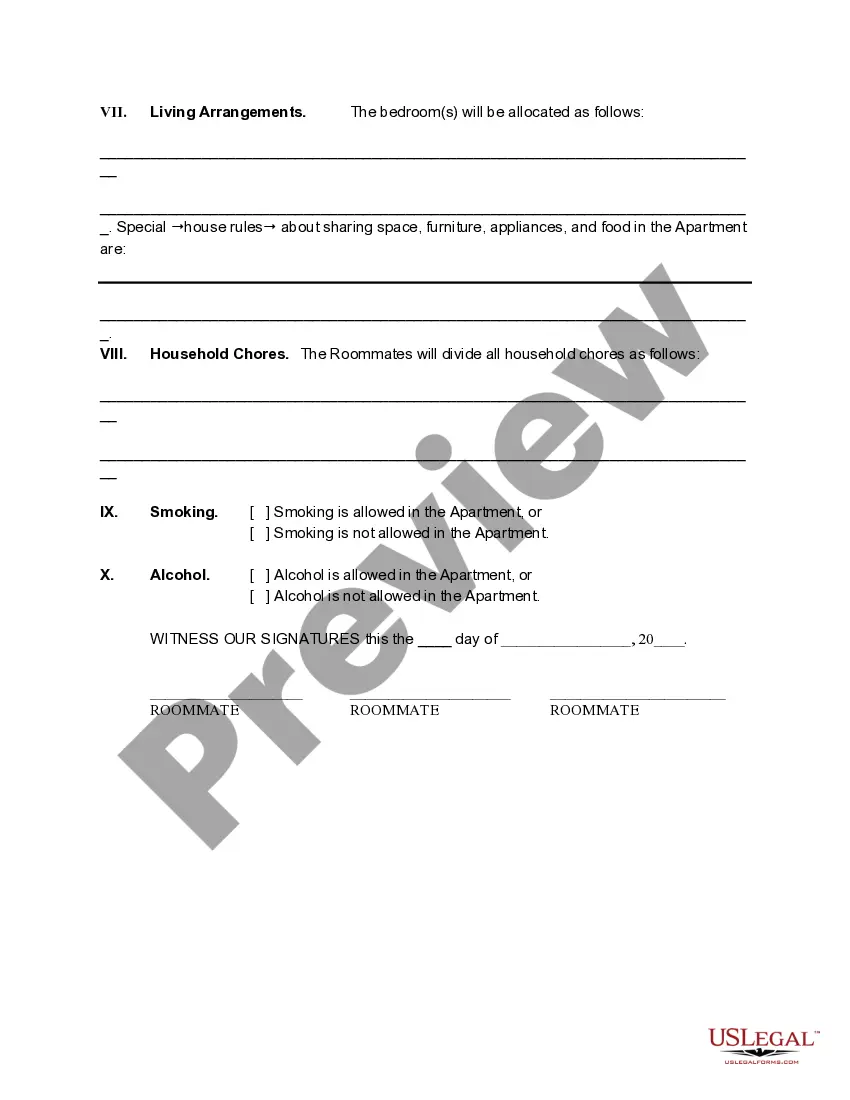
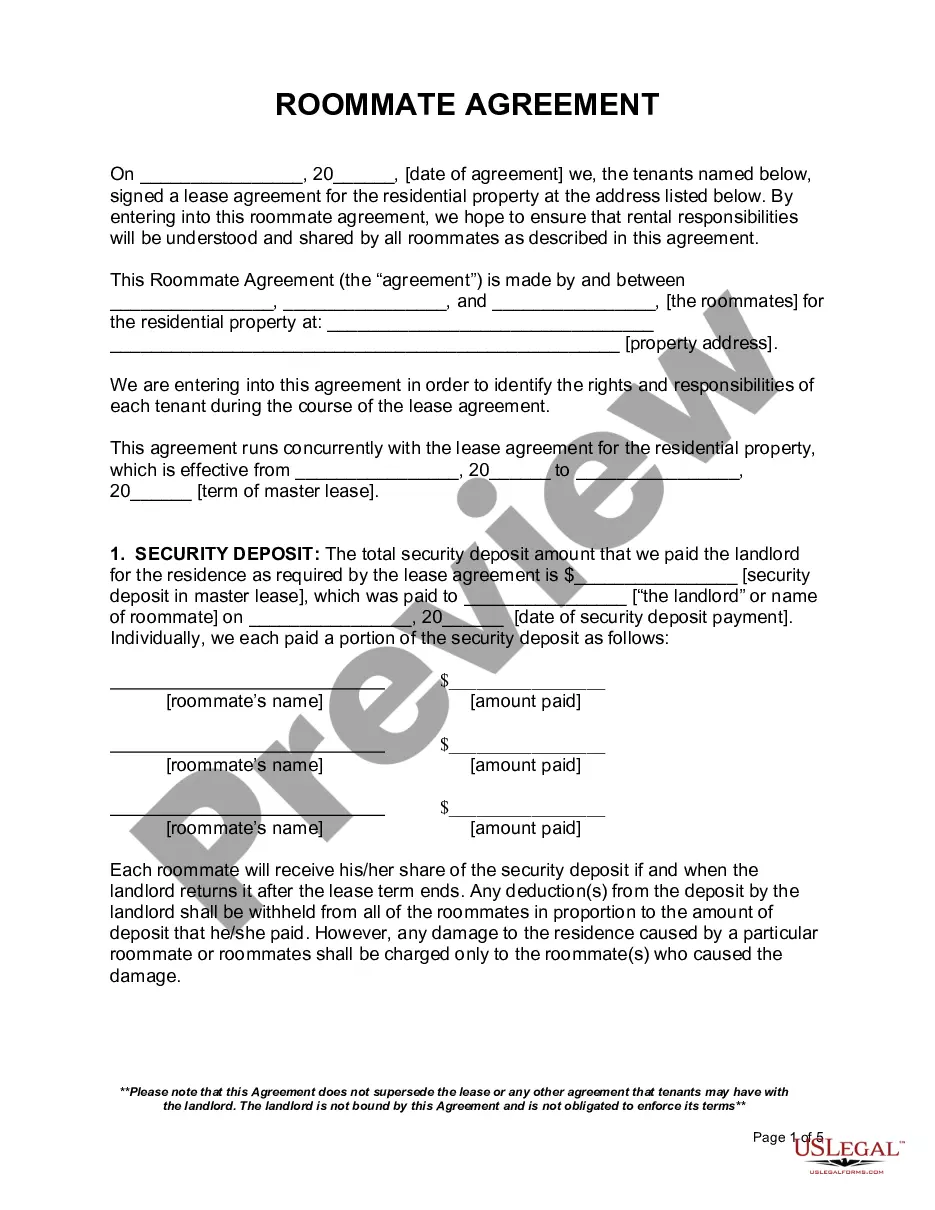
A legally binding agreement with your roommate, which is carefully drawn out to eliminate problems in the future, is signed between the tenants and has nothing to do with the property owner. An agreement should include your basic details. For example, your name, permanent address, and workplace details.
Clause 209 suspends our friendship, and strips down the roommate agreement to its bare essentials. Our responsibilities toward each other would only be rent, utilities and a perfunctory chin jut of recognition as we pass in the hall.
The basic answer to that question is that a written agreement is valid and does not need to be notarized to be enforceable.
Roommate agreements are typically considered legally binding when both a valid offer and acceptance exist, and there's a clear intention to enter into the contract from all parties.
Depending on what you and your roommate decide, your agreement will include some of the following information. Information about the property, roommates, and original lease. Term or length of the agreement. Rent responsibilities. Security deposit details. Responsibilities for utilities and household costs.
Roommate agreements are typically considered legally binding when both a valid offer and acceptance exist, and there's a clear intention to enter into the contract from all parties.
All parties agree to discuss frankly and unemotionally all concerns with their roommates before problems occur. All parties agree to negotiate in good faith, should the need arise. All parties will respect one another's privacy, sleep schedules, and other requests that are not unreasonably burdensome.
The Staircase Implementation - The Big Theory (Season 3, Episode 22) - Apple TV.
Penny was the same age as Kaley was at the start of the show - 21 - while both Leonard and Sheldon are between 5/6 years older than Penny though their real life counterparts Johnny and Jim are both 10 years older than Kaley.
Sheldon never met Leonard, Howard, and Raj until they were all around 24. Penny didn't move into the building until Sheldon and Leonard were both 27 and have been living there as roommates and best friends for three years; Penny was only 21 then.