Condominium Bylaws Condo Format In Houston
Description















Get your form ready online
Our built-in tools help you complete, sign, share, and store your documents in one place.
Make edits, fill in missing information, and update formatting in US Legal Forms—just like you would in MS Word.
Download a copy, print it, send it by email, or mail it via USPS—whatever works best for your next step.
Sign and collect signatures with our SignNow integration. Send to multiple recipients, set reminders, and more. Go Premium to unlock E-Sign.
If this form requires notarization, complete it online through a secure video call—no need to meet a notary in person or wait for an appointment.
We protect your documents and personal data by following strict security and privacy standards.
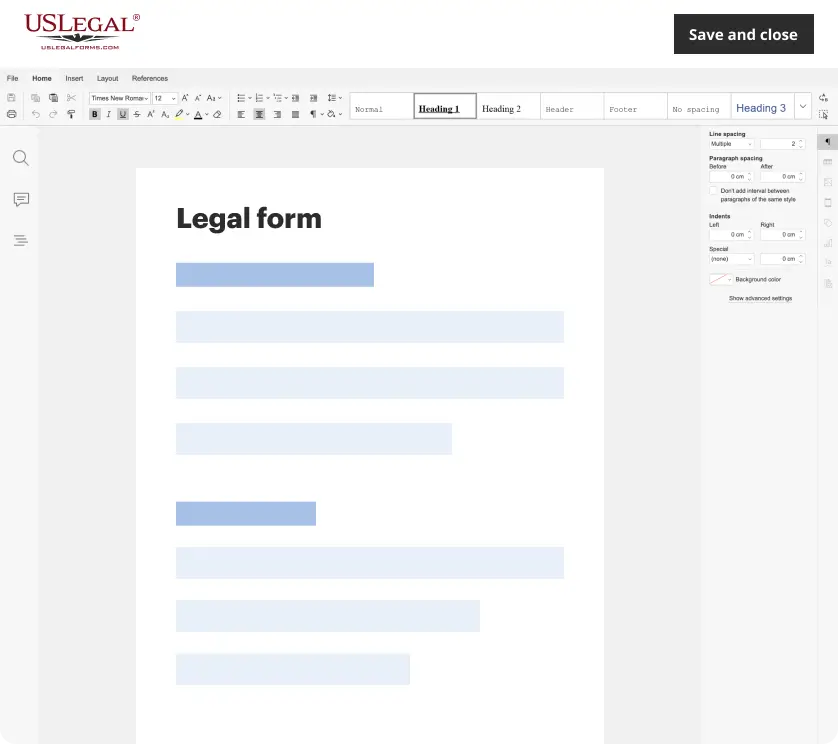
Make edits, fill in missing information, and update formatting in US Legal Forms—just like you would in MS Word.
Download a copy, print it, send it by email, or mail it via USPS—whatever works best for your next step.
Sign and collect signatures with our SignNow integration. Send to multiple recipients, set reminders, and more. Go Premium to unlock E-Sign.
If this form requires notarization, complete it online through a secure video call—no need to meet a notary in person or wait for an appointment.
We protect your documents and personal data by following strict security and privacy standards.
Looking for another form?









Form popularity
FAQ
Voting to amend the CC&Rs must be done by secret ballot pursuant to written election rules established by the association. (Civ. Code §§ 5100, 5105(a); See also “Balloting Requirements & Procedures.”) The text of the proposed CC&R amendment must be delivered to the members with the ballot. (Civ.
The new law will require that homeowners association policies must include general categories of restrictive covenants for which the association may assess fines, a schedule of fines for each category of violation, and information on hearings.
(a) A property owners' association by a two-thirds vote of the association's governing body may submit a procedure for amending restrictions to a vote of the property owners in the subdivision or in the unit or parcel of the subdivision governed by restrictions.
There must be at least three people on the Board of Directors. If an association's governing documents do not state how many people must serve on the Board of Directors, Texas law says that the number will be equal to the initial number of directors listed in the Articles of Incorporation.
House Bill 614 guarantees your right to a hearing before the HOA board to contest the violation or the proposed fine. This ensures a fair and transparent process where you can voice your concerns and advocate for your interests.
Declaration of Covenants, Conditions, and Restrictions. This is the main document that defines the rights and responsibilities of the homeowners. Declaration will have the rules related to property use, upkeep and appearance, rule violations, fines and fees, and judicial enforcement.
The Texas Constitution provides that the legislature, by a two-thirds vote of all members of each house, may propose amendments revising the constitution and that proposed amendments must then be submitted for approval to the qualified voters of the state.
Disclosure Requirements Disclosure is mandated by law, often through public records and real property records. Before purchasing a home, buyers must receive a set of documents detailing the HOA's health, such as its covenants, conditions, restrictions, bylaws, rules, and financial statements.
Texas law places limits on HOA power, including restrictions on their ability to prohibit certain types of construction like solar panels and rules against unreasonable fines or foreclosure practices. The exact limitations are outlined in state statutes, which are intended to protect homeowners' rights.
Notably, Texas HOA's with 60 or more lots are legally required to have an HOA Website, ensuring transparency and accessibility for all members. The HOA Website Law in Texas is designed to facilitate better communication and provide a centralized location for important association information.
