Educational Assistance Employees Without Money In Maryland
Description

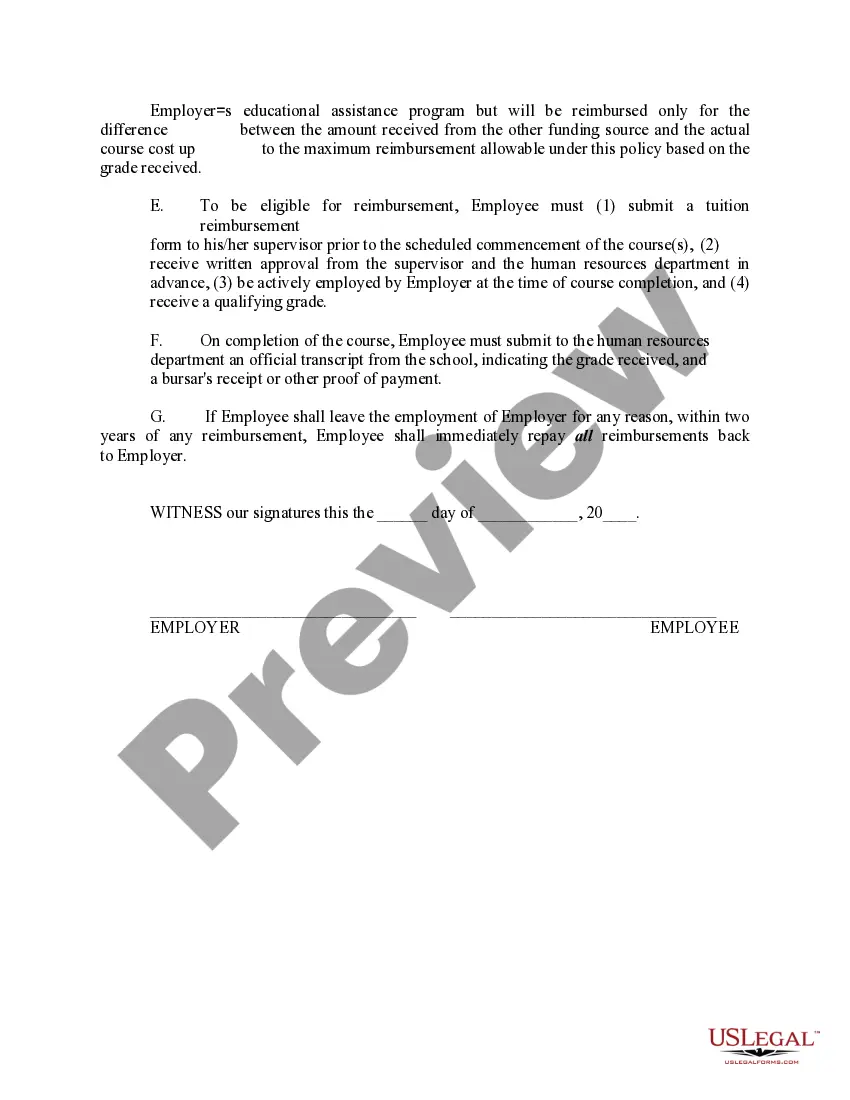
Get your form ready online
Our built-in tools help you complete, sign, share, and store your documents in one place.
Make edits, fill in missing information, and update formatting in US Legal Forms—just like you would in MS Word.
Download a copy, print it, send it by email, or mail it via USPS—whatever works best for your next step.
Sign and collect signatures with our SignNow integration. Send to multiple recipients, set reminders, and more. Go Premium to unlock E-Sign.
If this form requires notarization, complete it online through a secure video call—no need to meet a notary in person or wait for an appointment.
We protect your documents and personal data by following strict security and privacy standards.

Make edits, fill in missing information, and update formatting in US Legal Forms—just like you would in MS Word.

Download a copy, print it, send it by email, or mail it via USPS—whatever works best for your next step.

Sign and collect signatures with our SignNow integration. Send to multiple recipients, set reminders, and more. Go Premium to unlock E-Sign.

If this form requires notarization, complete it online through a secure video call—no need to meet a notary in person or wait for an appointment.

We protect your documents and personal data by following strict security and privacy standards.
Looking for another form?









Form popularity
FAQ
Who is eligible for special education? Under federal and state law, children with disabilities from birth through the end of the school year in which they turn age 21 may be eligible for special education and related services.
The UMD grant is offered to full-time undergraduate students who are State of Maryland residents demonstrating financial need. To qualify for consideration, students must submit their completed 2024-25 FAFSA by the April 1 priority deadline.
Be a Maryland resident (If you are a dependent student, your parent(s) must also have Maryland residency.) Enroll at a two-year or four-year Maryland college or university as a full-time, degree-seeking, undergraduate student. Demonstrate financial need as determined by the FAFSA/MSFAA and MHEC.
The Delegate Howard P. Rawlings Guaranteed Access (GA) Grant is a need-based grant thatprovides financial assistance to eligible applicants enrolled at postsecondary institutions for educational expenses. The Guaranteed Access Grant awards up to $18,000 towards a student's calculated financial need.
As a publicly funded institution, UMD is unable to provide financial assistance to international students. You can find other options for financing your education on the Office of Student Financial Aid website.
How to Get the Most Financial Aid? 7 Tips to Maximize College Funding File forms as early as possible. Minimize student assets. Understand and utilize FAFSA strategies. Fill out FAFSA regardless of income. Prepare for merit-based aid possibilities. Consider even top-rated schools as options.
Maryland Success Grant is awarded to full time Maryland undergraduate and graduate students with a Student Aid Index (SAI) up to $9,999 from the current FAFSA. Students must also be meeting the Satisfactory Academic Progress (SAP) Policy for financial aid eligibility. This is a one-time only non-renewable grant.
The Maryland Small Grants Program (MSGP) is intended to help smaller nonprofits more easily and efficiently apply for funding. Maryland organizations with an annual budget under $3 million a year are eligible to apply for an initial grant of up to $50K for two years ($100K total).
