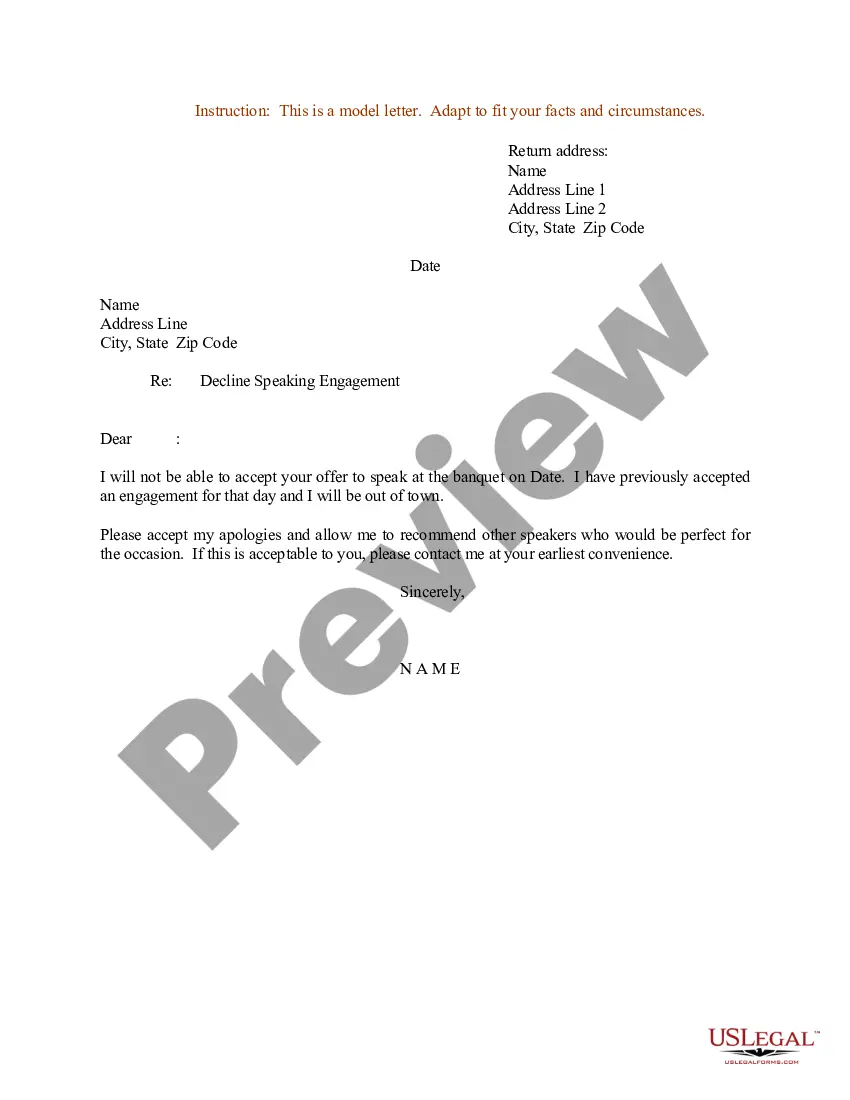
Letter Speaking Engagement With Client In Michigan
Description
Get your form ready online
Our built-in tools help you complete, sign, share, and store your documents in one place.
Make edits, fill in missing information, and update formatting in US Legal Forms—just like you would in MS Word.
Download a copy, print it, send it by email, or mail it via USPS—whatever works best for your next step.
Sign and collect signatures with our SignNow integration. Send to multiple recipients, set reminders, and more. Go Premium to unlock E-Sign.
If this form requires notarization, complete it online through a secure video call—no need to meet a notary in person or wait for an appointment.
We protect your documents and personal data by following strict security and privacy standards.

Make edits, fill in missing information, and update formatting in US Legal Forms—just like you would in MS Word.

Download a copy, print it, send it by email, or mail it via USPS—whatever works best for your next step.

Sign and collect signatures with our SignNow integration. Send to multiple recipients, set reminders, and more. Go Premium to unlock E-Sign.

If this form requires notarization, complete it online through a secure video call—no need to meet a notary in person or wait for an appointment.

We protect your documents and personal data by following strict security and privacy standards.
Looking for another form?







Form popularity
FAQ
MRPC 8.3(a) states: "(a) A lawyer having knowledge that another lawyer has committed a significant violation of the Rules of Professional Conduct that raises a substantial question as to that lawyer's honesty, trustworthiness, or fitness as a lawyer shall inform the Attorney Grievance Commission." Emphasis added.
Rule 1.0 - Scope and Applicability of Rules and Commentary (a) These are the Michigan Rules of Professional Conduct. The form of citation for this rule is MRPC 1.0.
Rule 1.7 - Conflict of Interest: General Rule (a) A lawyer shall not represent a client if the representation of that client will be directly adverse to another client, unless: (1) the lawyer reasonably believes the representation will not adversely affect the relationship with the other client; and (2) each client ...
In representing a client, a lawyer shall not communicate about the subject of the representation with a party whom the lawyer knows to be represented by another lawyer in the matter, unless the lawyer has the consent of the other lawyer or is authorized to do so by law or a court order.
Cond. 7.3. Rule 7.3 - Solicitation (a) A lawyer shall not solicit professional employment from a person with whom the lawyer has no family or prior professional relationship when a significant motive for the lawyer's doing so is the lawyer's pecuniary gain.
1 A lawyer is required to be truthful when dealing with others on a client's behalf, but generally has no affirmative duty to inform an opposing party of relevant facts. A misrepresentation can occur if the lawyer incorporates or affirms a statement of another person that the lawyer knows is false.
Michigan Court Rule 8.126 sets forth the process for foreign (out-of-state) attorneys to apply for temporary admission to practice in a Michigan court, administrative tribunal, or arbitration.
Meanwhile, MRPC 3.3 provides that a lawyer must not knowingly make a false statement of material fact or law to a tribunal or fail to disclose controlling authority or offer evidence known to be false.
The Michigan clean slate law provides for the following offenses to be automatically set aside once the corresponding period has elapsed: Misdemeanors with a sentence up to 92 days – Seven years. Up to four misdemeanors with a sentence of 93+ days – Seven years. Up to two eligible felonies – 10 years.
An engagement letter is a written agreement that describes the business relationship to be entered into by a client and a company. The letter details the scope of the agreement, its terms, and costs. The purpose of an engagement letter is to set expectations on both sides of the agreement.

