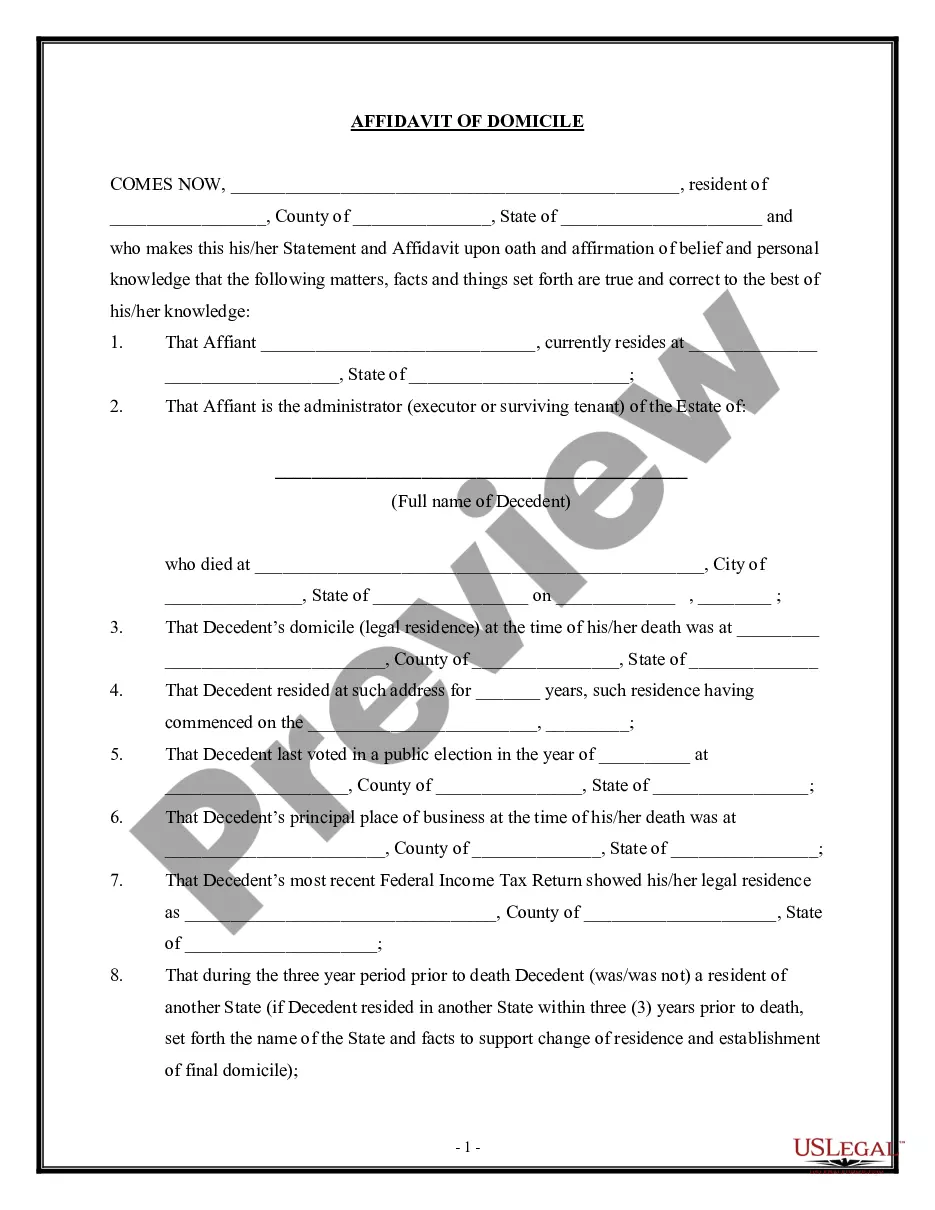
Domicile Definition In Law In Washington
Description
Get your form ready online
Our built-in tools help you complete, sign, share, and store your documents in one place.
Make edits, fill in missing information, and update formatting in US Legal Forms—just like you would in MS Word.
Download a copy, print it, send it by email, or mail it via USPS—whatever works best for your next step.
Sign and collect signatures with our SignNow integration. Send to multiple recipients, set reminders, and more. Go Premium to unlock E-Sign.
If this form requires notarization, complete it online through a secure video call—no need to meet a notary in person or wait for an appointment.
We protect your documents and personal data by following strict security and privacy standards.

Make edits, fill in missing information, and update formatting in US Legal Forms—just like you would in MS Word.

Download a copy, print it, send it by email, or mail it via USPS—whatever works best for your next step.

Sign and collect signatures with our SignNow integration. Send to multiple recipients, set reminders, and more. Go Premium to unlock E-Sign.

If this form requires notarization, complete it online through a secure video call—no need to meet a notary in person or wait for an appointment.

We protect your documents and personal data by following strict security and privacy standards.
Looking for another form?








Form popularity
FAQ
U.S. immigration laws generally require sponsors to have a U.S. domicile, meaning they live in the U.S. or plan to return permanently. If a sponsor is living abroad, they need to show strong ties to the U.S., like property, a job, or intent to return.
An individual who is physically present and resides in Washington for at least 183 days and does not commute back to their state of residence will generally be considered to “reside” in Washington and is a Washington resident for WFTC residency purposes.
Domicile • \DAH-muh-syle\ • noun. 1 : a dwelling place : place of residence : home 2 a : a person's fixed, permanent, and principal home for legal purposes b : the place where a corporation is actually or officially established.
Domicile: If Washington is your primary, permanent home, you are considered a resident. Domicile means you live in the state with no intention of making another state your primary residence. Physical presence: Spending significant time in Washington, even without official documents, may establish residency.
If you take any of the following actions, you can fit the Washington definition of residency. Register to vote in the state of Washington. Get a Washington State driver's license. Maintain a residence for personal use.
Its meaning in English law is not statutory, but has been developed by judges in cases decided over the last two centuries. The domicile of most individuals is their domicile of origin. The general rule is that an individual's domicile of origin is whatever domicile his or her father had when he or she was born.
Your domicile is the state of your permanent home, or the state you consider your home whenever you are. elsewhere. Your domicile is an important place. It is, for example, the place that usually has the power to tax.
Residence signifies the place where someone habitually dwells, their personal haven. Domicile, on the other hand, embodies the focal point of one's professional and financial affairs.
If you take any of the following actions, you can fit the Washington definition of residency. Register to vote in the state of Washington. Get a Washington State driver's license. Maintain a residence for personal use.
Domicile is not directly related to an individual's nationality, residence or ethnicity.

