Covenant And Agreement Difference In North Carolina
Description

Get your form ready online
Our built-in tools help you complete, sign, share, and store your documents in one place.
Make edits, fill in missing information, and update formatting in US Legal Forms—just like you would in MS Word.
Download a copy, print it, send it by email, or mail it via USPS—whatever works best for your next step.
Sign and collect signatures with our SignNow integration. Send to multiple recipients, set reminders, and more. Go Premium to unlock E-Sign.
If this form requires notarization, complete it online through a secure video call—no need to meet a notary in person or wait for an appointment.
We protect your documents and personal data by following strict security and privacy standards.

Make edits, fill in missing information, and update formatting in US Legal Forms—just like you would in MS Word.

Download a copy, print it, send it by email, or mail it via USPS—whatever works best for your next step.

Sign and collect signatures with our SignNow integration. Send to multiple recipients, set reminders, and more. Go Premium to unlock E-Sign.

If this form requires notarization, complete it online through a secure video call—no need to meet a notary in person or wait for an appointment.

We protect your documents and personal data by following strict security and privacy standards.
Looking for another form?









Form popularity
FAQ
Enforcing these covenants is the responsibility of the HOA's board of directors. They have the authority to take various actions, including issuing warnings, fines, or even pursuing legal action against homeowners who violate the covenant.
A contract is an agreement between parties while a covenant is a pledge. A contract is an agreement you can break while a covenant is a perpetual promise. You seal a covenant while you sign a contract. A contract is a mutually beneficial relationship while a covenant is something you fulfill.
A covenant not to compete is enforceable if it is: (1) in writing, (2) made part of a contract of employment; (3) based on valuable consideration; (4) reasonable both as to time and territory; and (5) not against public policy.
In most states, restrictive covenants are enforceable only if they serve a legitimate business purpose and are reasonable in duration, geographic scope and with respect to the substantive nature of the activity being restricted.
The covenant agreement is recorded at the county Register of Deeds and runs in perpetuity with the deed to the property, thus protecting the historic resource for future generations.
A real covenant is only enforceable if it was created intentionally, it relates to the property in question, and two kinds of privity are established. Additionally, a real covenant must be in writing. The party capable of enforcing the covenant depends on whether the burden or the benefit runs with the land.
A restrictive covenant runs with the land, affecting successive owners. It will not cease to be enforceable just because it was created a long time ago. However, the covenant may be unenforceable for another reason. For example, where the seller failed to observe the relevant registration formalities.
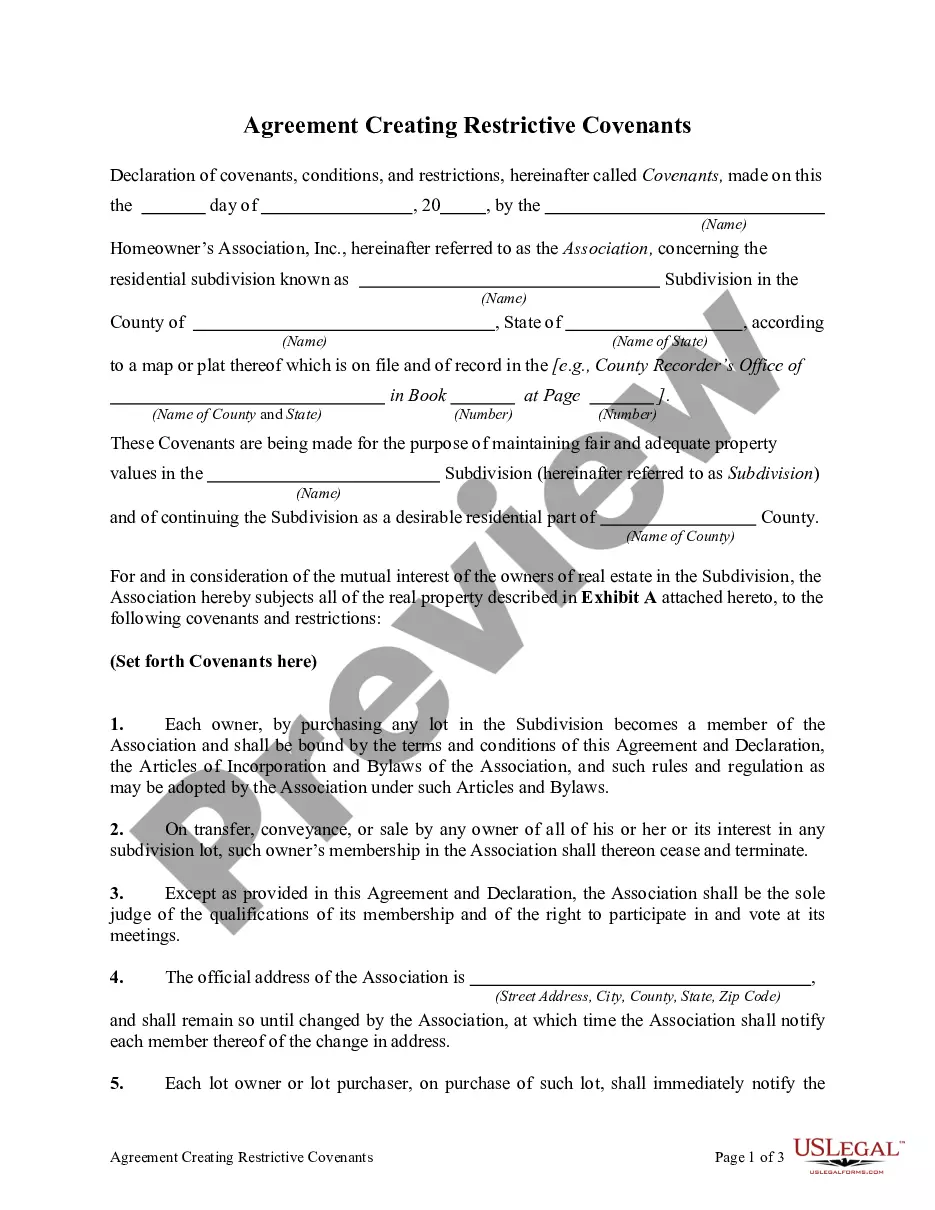
A covenant is a formal agreement or promise , usually included in a contract or deed , to do or not do a particular act. Covenants are particularly relevant in the fields of contract law and property law. An example of a contractual covenant is a non-compete agreement .
The primary remedy for breach of a Restrictive Covenant is a permanent injunction to restrain the breach. However, the courts have jurisdiction to award damages instead of an injunction.