Termination With Severance Meaning In Dallas
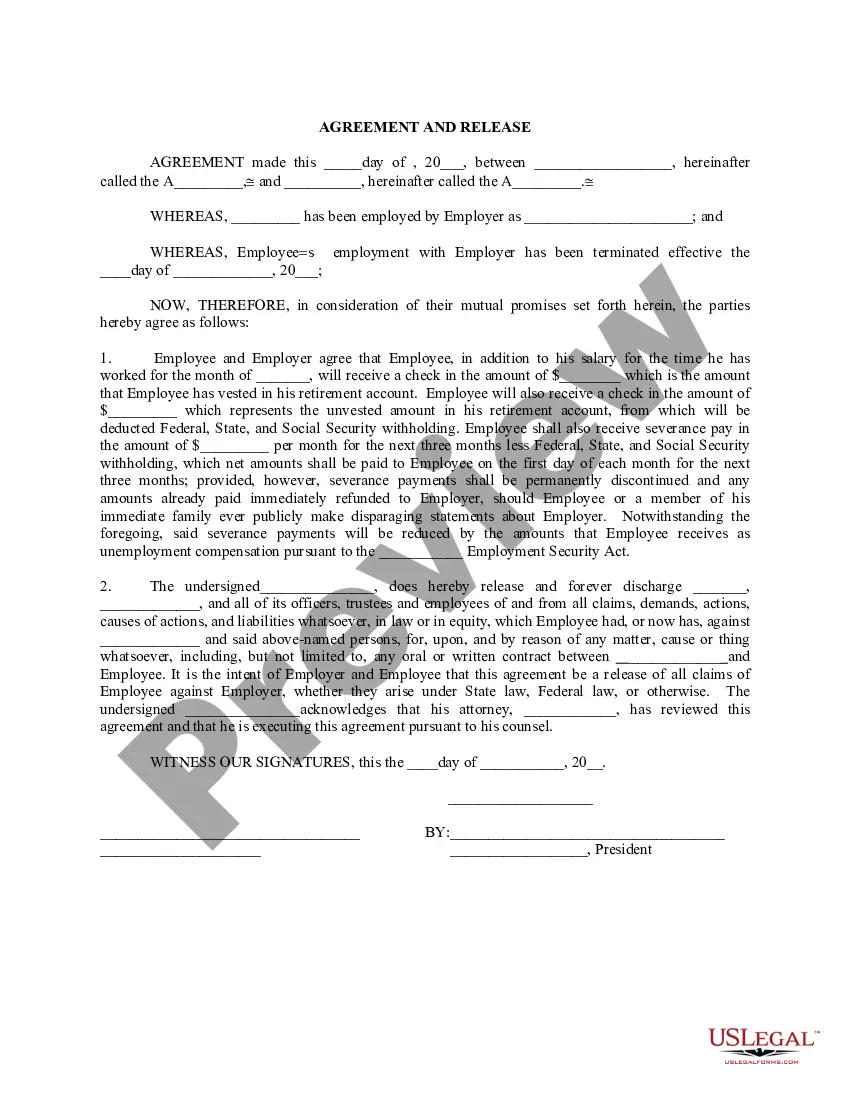
Description










Form popularity
FAQ
The majority of severance agreements are structured to provide financial support regardless of employment status after leaving the company. However, certain agreements may include provisions that allow an employer to stop severance payments if the employee secures comparable work.
Most termination clauses are an agreement between the employer and the employee that in the event the employer elects to dismiss the employee without cause, the employee will only receive what they are entitled to under the Employment Standards Code.
An employment termination payment (ETP) is a payment made in consequence of the termination of employment. It can include: amounts for unused rostered days off. amounts in lieu of notice. a gratuity or 'golden handshake'
A severance clause aims to ensure that a contract will survive the deletion of an unenforceable provision. For example, where a court later deems that a particular provision of a contract is no longer, or was never, enforceable, this deletion would not invalidate or deem unenforceable the entire contract.
In Brazil, employments are at will, meaning that any party may terminate the employment agreement without cause upon the mandatory prior notice and payment of the severance. It is not necessary to mention any reason for termination, except if it is a termination with cause.
Most termination clauses are an agreement between the employer and the employee that in the event the employer elects to dismiss the employee without cause, the employee will only receive what they are entitled to under the Employment Standards Code.
Most termination clauses are an agreement between the employer and the employee that in the event the employer elects to dismiss the employee without cause, the employee will only receive what they are entitled to under the Employment Standards Code.
You may be eligible for benefits if you were fired for reasons other than misconduct. Examples of misconduct that could make you ineligible include violation of company policy, violation of law, neglect or mismanagement of your position, or failure to perform your work adequately if you are capable of doing so.