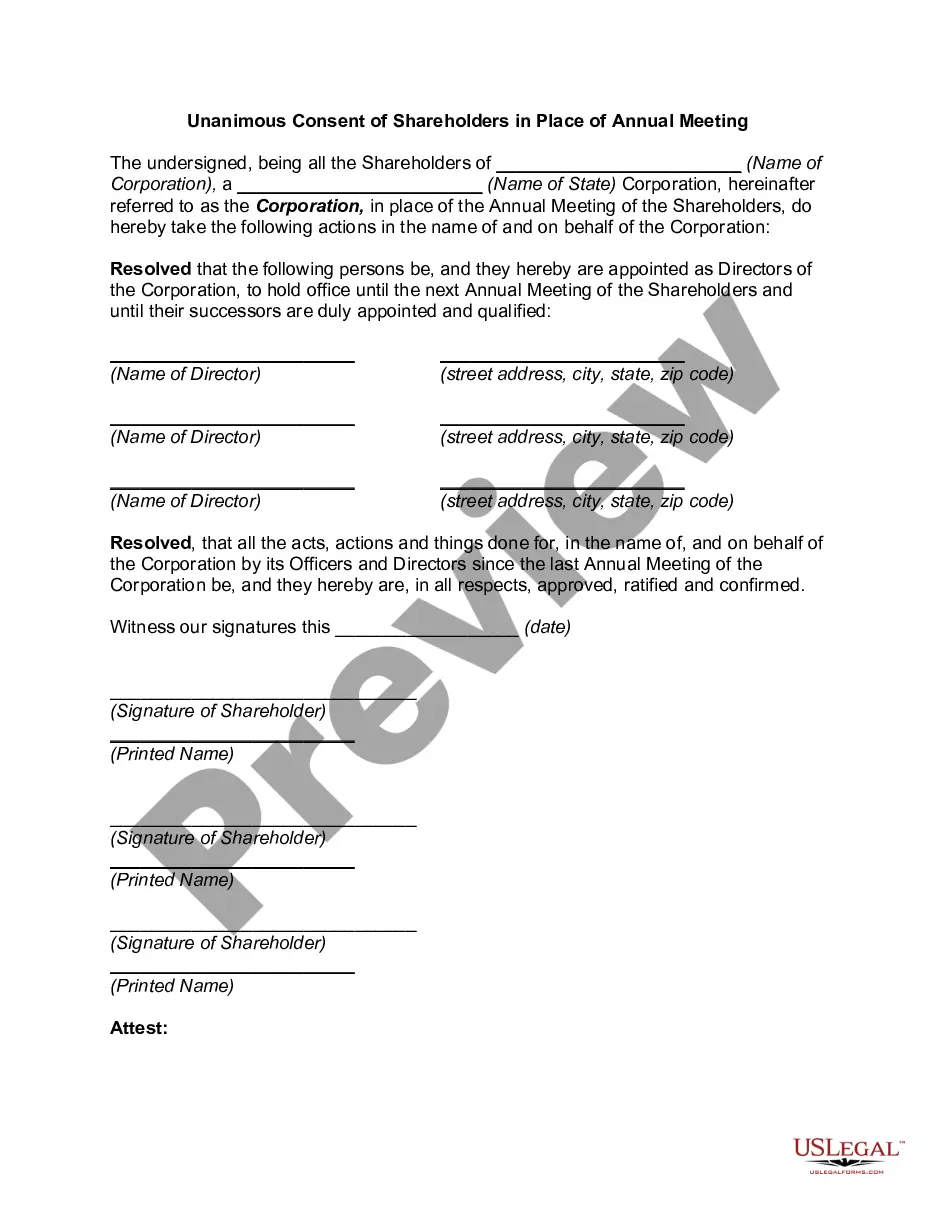
Annual Meeting Corporate With Example In Fulton
Description



Get your form ready online
Our built-in tools help you complete, sign, share, and store your documents in one place.
Make edits, fill in missing information, and update formatting in US Legal Forms—just like you would in MS Word.
Download a copy, print it, send it by email, or mail it via USPS—whatever works best for your next step.
Sign and collect signatures with our SignNow integration. Send to multiple recipients, set reminders, and more. Go Premium to unlock E-Sign.
If this form requires notarization, complete it online through a secure video call—no need to meet a notary in person or wait for an appointment.
We protect your documents and personal data by following strict security and privacy standards.

Make edits, fill in missing information, and update formatting in US Legal Forms—just like you would in MS Word.

Download a copy, print it, send it by email, or mail it via USPS—whatever works best for your next step.

Sign and collect signatures with our SignNow integration. Send to multiple recipients, set reminders, and more. Go Premium to unlock E-Sign.

If this form requires notarization, complete it online through a secure video call—no need to meet a notary in person or wait for an appointment.

We protect your documents and personal data by following strict security and privacy standards.
Looking for another form?










Form popularity
FAQ
An AGM requires 14 clear days' notice for a non-traded company. Traded companies require 21 clear days' notice, although public companies subject to the UK Corporate Governance Code must provide 20 working days' notice.
Disclosure of Information: Companies must provide shareholders with adequate information about the topics to be discussed, including financial status, current strategy, and governance matters. Insufficient disclosure may render the AGM invalid.
Annual shareholder meetings require a notice period of at least 21 days. The notice period can be shortened with the expressed consent of all shareholders. The notice should include all the basic meeting details and other important pieces of documentation, such as the meeting agenda.
AGMs must be held within six months of the end of the financial year, with no more than 15 months allowed between two AGMs. All companies are required to hold AGMs except for one-person companies (OPCs). The legal requirements for AGMs are primarily outlined in Section 96 of the Companies Act, 2013.
AGMs must be held within six months of the end of the financial year, with no more than 15 months allowed between two AGMs. All companies are required to hold AGMs except for one-person companies (OPCs). The legal requirements for AGMs are primarily outlined in Section 96 of the Companies Act, 2013.
An example of an AGM is the annual meeting of shareholders of a publicly traded company. At the AGM, shareholders are provided with financial statements, elect board members, and vote on important issues such as mergers and acquisitions.
Notice is hereby given to the shareholders of Old Mutual Limited (“Company”) recorded in the Company's securities register on Friday, 5 April 2024 ("shareholders"), that the 6th Annual General Meeting (“AGM”) of the Company will be held at SA time on Friday, , subject to any cancellation, postponement ...
Calling and purpose of an AGM An association's constitution must specify the manner of calling an AGM and the manner in which notice of the AGM is given. If the Model constitution applies, members must be given at least 14 days' notice of an AGM or 21 days' notice if a special resolution is to be proposed.
The notice should: Specify the purpose of the meeting. List the agenda items clearly. Provide instructions on how to attend the meeting (including virtual attendance, if applicable). Explain the voting process, including how votes will be counted and how shareholders can vote if they cannot attend in person.