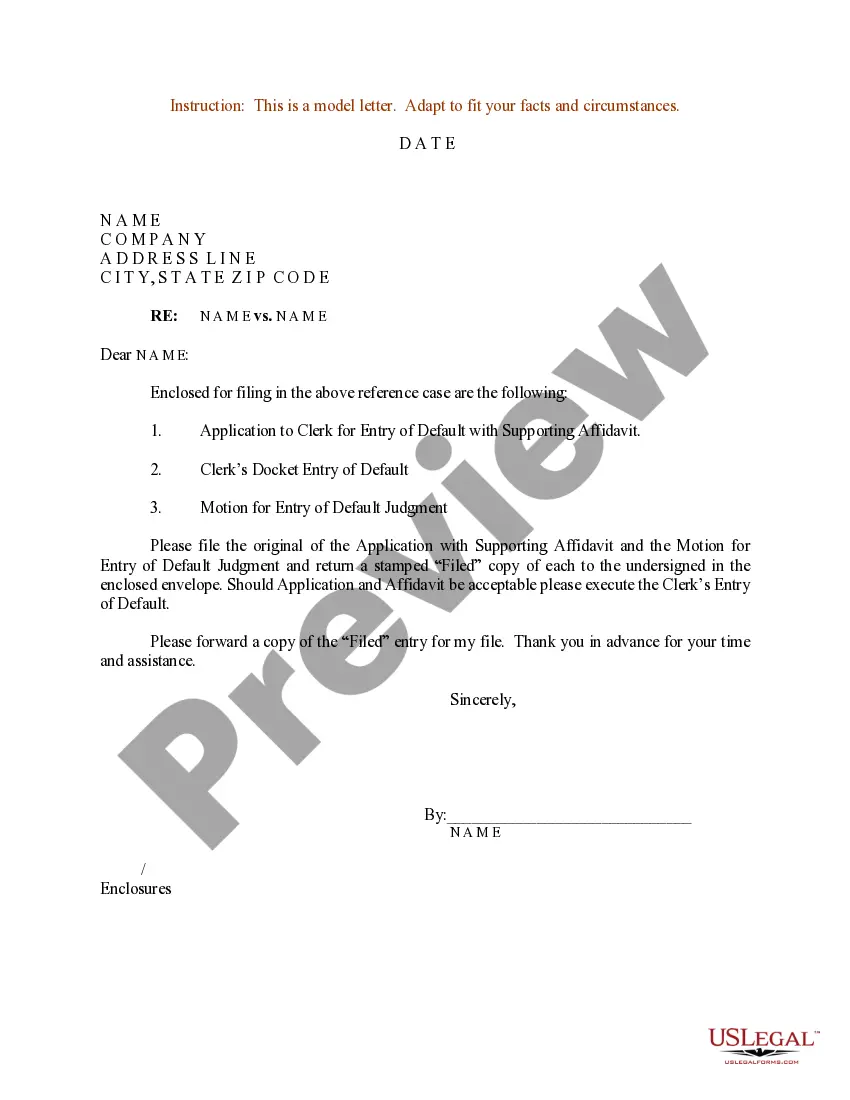
Letter Requesting Motion To Vacate Order Of Default Without Notice In Minnesota
Description

Get your form ready online
Our built-in tools help you complete, sign, share, and store your documents in one place.
Make edits, fill in missing information, and update formatting in US Legal Forms—just like you would in MS Word.
Download a copy, print it, send it by email, or mail it via USPS—whatever works best for your next step.
Sign and collect signatures with our SignNow integration. Send to multiple recipients, set reminders, and more. Go Premium to unlock E-Sign.
If this form requires notarization, complete it online through a secure video call—no need to meet a notary in person or wait for an appointment.
We protect your documents and personal data by following strict security and privacy standards.

Make edits, fill in missing information, and update formatting in US Legal Forms—just like you would in MS Word.

Download a copy, print it, send it by email, or mail it via USPS—whatever works best for your next step.

Sign and collect signatures with our SignNow integration. Send to multiple recipients, set reminders, and more. Go Premium to unlock E-Sign.

If this form requires notarization, complete it online through a secure video call—no need to meet a notary in person or wait for an appointment.

We protect your documents and personal data by following strict security and privacy standards.
Looking for another form?






Form popularity
FAQ
Instructions for filing a. Motion. in the Minnesota Court of Appeals. Step 1: Fill out the Motion form. Step 2: Fill out the Affidavit in Support of Motion form. Step 3: Serve your Motion and Affidavit on the opposing parties. Step 4: Proof of Service. Step 5: File the Motion, Affidavit, and Certificate of Service by Mail.
A default judgment may be vacated by the judge upon a proper showing by the defendant that: (1) the defendant did not receive a summons before the trial within sufficient time to permit a defense and did not receive notice of the order for default judgment within sufficient time to permit application for relief within ...
There are only three ways in which a judgment can be made to go away: paying the debt, vacating the judgment or discharging the debt through bankruptcy.
Rule 60. Clerical mistakes in judgments, orders, or other parts of the record and errors therein arising from oversight or omission may be corrected by the court at any time upon its own initiative or on the motion of any party and after such notice, if any, as the court orders.
If you don't file an Answer or you miss a court date, the party suing you will ask the court for a default judgment against you. You can ask the court to vacate (undo) the default judgment. If the judgment is vacated and the case is put back on the court's calendar and the case will continue.
Is a Default Judgment a Final Judgment? A default judgment is a final judgment because it is a decision on the merits (as it was properly heard). Therefore, if a party disagrees, they must file an appeal or a motion to reconsider. The defaulting party may obtain a reverse judgment if they appeal the decision.
If you do not think the default judgment was appropriately entered against you, you must file a motion with the court asking the judge to “set aside” (void or nullify) the judgment. If the judge grants your motion, the case starts back up again.
Yes, a default judgment may negatively affect your credit score, and will be a lien on all of your real estate. Buying and selling real estate will be negatively affected by the entry of a default judgment.
