Erisa Law For Insurance In Utah
Description

Get your form ready online
Our built-in tools help you complete, sign, share, and store your documents in one place.
Make edits, fill in missing information, and update formatting in US Legal Forms—just like you would in MS Word.
Download a copy, print it, send it by email, or mail it via USPS—whatever works best for your next step.
Sign and collect signatures with our SignNow integration. Send to multiple recipients, set reminders, and more. Go Premium to unlock E-Sign.
If this form requires notarization, complete it online through a secure video call—no need to meet a notary in person or wait for an appointment.
We protect your documents and personal data by following strict security and privacy standards.
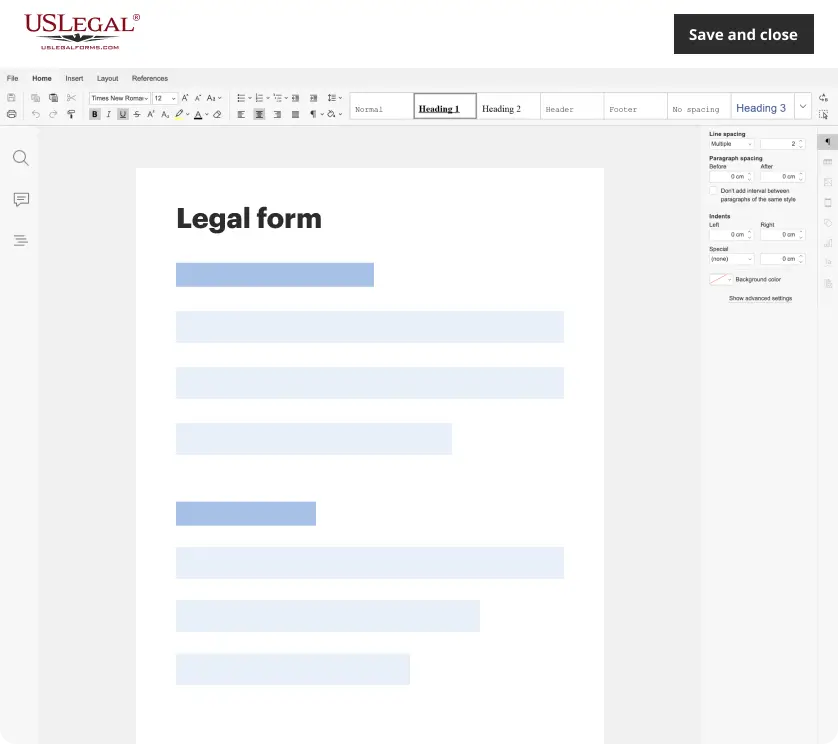
Make edits, fill in missing information, and update formatting in US Legal Forms—just like you would in MS Word.
Download a copy, print it, send it by email, or mail it via USPS—whatever works best for your next step.
Sign and collect signatures with our SignNow integration. Send to multiple recipients, set reminders, and more. Go Premium to unlock E-Sign.

If this form requires notarization, complete it online through a secure video call—no need to meet a notary in person or wait for an appointment.
We protect your documents and personal data by following strict security and privacy standards.
Looking for another form?
Form popularity
FAQ
Contact your regional EBSA office to file a complaint or an appeal after exhausting your insurance appeals process. You can also find ERISA information through the U.S. Department of Labor online at .dol/ebsa.
ERISA requires plans to provide participants with plan information including important information about plan features and funding; sets minimum standards for participation, vesting, benefit accrual and funding; provides fiduciary responsibilities for those who manage and control plan assets; requires plans to ...
ERISA bonding requirements A plan official must be bonded for at least 10% of the amount of funds handled, subject to a minimum bond amount of $1,000 per plan. In most instances, the maximum bond amount that can be required under ERISA with respect to any one plan official is $500,000 per plan.
Common ERISA violations include denying benefits improperly, breaching fiduciary duties, and interfering with employee rights under the plan.
Civil and criminal sanctions are enforced when employers fail to adhere to ERISA standards for private-sector employee benefit plans. Violations include denying benefits improperly, breaching fiduciary duties, or interfering with employee rights under the plan.
The Employee Retirement Income Security Act of 1974 (ERISA) is a federal law that sets minimum standards for most voluntarily established retirement and health plans in private industry to provide protection for individuals in these plans.
In most instances, the maximum bond amount that can be required under ERISA with respect to any one plan official is $500,000 per plan. However, the maximum required bond amount is $1 million for officials of plans holding employer securities.
Under ERISA, each fund is subject to additional requirements and obligations once more than 25 percent of the fund's assets under management (AUM) are subject to ERISA (the 25 percent threshold).
The rule is triggered if you raise enough dollars through retirement accounts. Generally speaking, it is wise to stay below 25% of retirement plan assets unless you qualify for an exception. For "fund of funds", the fund acts as an ERISA investor.
IS AN ERISA FiDELiTY BOND THE SAME THiNG AS FiDUCiARY LiABiLiTY iNSURANCE? No. The fidelity bond required under ERISA specifically insures a plan against losses due to fraud or dishonesty (e.g., theft) by persons who handle plan funds or property.