E Commerce Agreement For Dummies In Maryland
Description


Get your form ready online
Our built-in tools help you complete, sign, share, and store your documents in one place.
Make edits, fill in missing information, and update formatting in US Legal Forms—just like you would in MS Word.
Download a copy, print it, send it by email, or mail it via USPS—whatever works best for your next step.
Sign and collect signatures with our SignNow integration. Send to multiple recipients, set reminders, and more. Go Premium to unlock E-Sign.
If this form requires notarization, complete it online through a secure video call—no need to meet a notary in person or wait for an appointment.
We protect your documents and personal data by following strict security and privacy standards.

Make edits, fill in missing information, and update formatting in US Legal Forms—just like you would in MS Word.

Download a copy, print it, send it by email, or mail it via USPS—whatever works best for your next step.

Sign and collect signatures with our SignNow integration. Send to multiple recipients, set reminders, and more. Go Premium to unlock E-Sign.

If this form requires notarization, complete it online through a secure video call—no need to meet a notary in person or wait for an appointment.

We protect your documents and personal data by following strict security and privacy standards.
Looking for another form?









Form popularity
FAQ
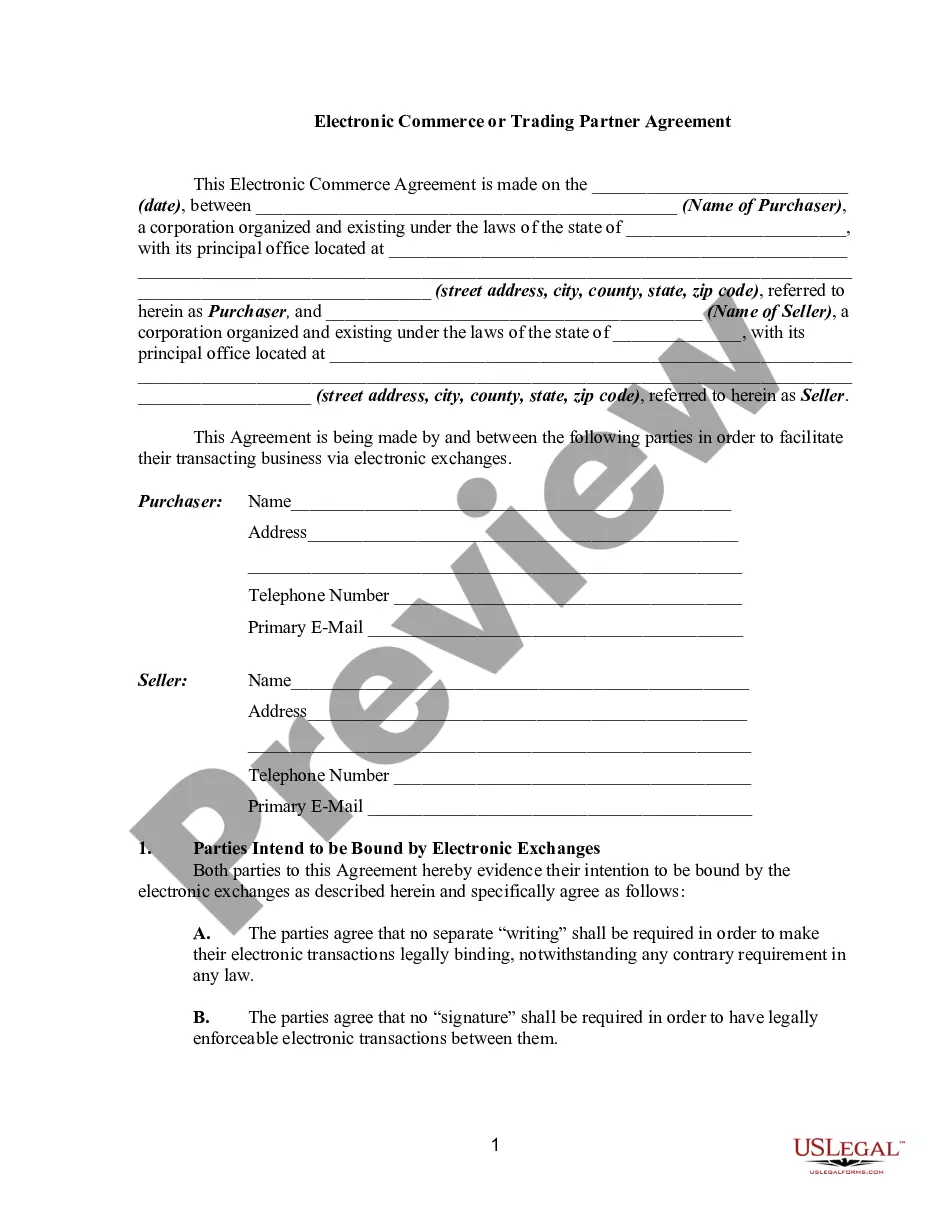
A user agreement is any contract between a website user and the site's owner or operator. These e-commerce contracts can be end-user license agreements (EULAs), terms of service/terms and conditions, or privacy policies. They outline the rights and obligations of both parties.
You do not need to have a formal business entity to start and run an online business. Still, forming an LLC provides you with some significant benefits, which we will discuss more in detail below. Also, forming an LLC for your online business creates credibility and consumer trust, which can benefit your sales.
Start an Online eCommerce Business Choose your niche. Do your research. Choose your product and target market. Validate your product. Decide how you'll get your product. Write your business plan. Pick your business name and legal structure. Apply for your EIN, permits, and licenses.
Step 1: Research and validate your business idea. What problem or challenge are you seeking to solve? ... Step 2: Source products. Step 3: Choose an online selling channel. Step 4: List and optimize products. Step 5: Market and promote your ecommerce shop.
The ecommerce industry is regulated by digital customer data privacy laws such as CCPA, Data Broker Registrations and GDPR among others. You must comply with the privacy laws applicable to your business in order to avoid potential legal penalties and reputational damages.
The UETA and E-SIGN Act have now legitimized the ability of parties to form contracts electronically both at the federal and state levels.
The Federal Trade Commission Act (FTCA) prohibits certain unfair or deceptive acts or practices in or affecting commerce. Other state and federal regulations govern the shipment of goods and the issuance of, or notices concerning, refunds.
A user agreement is any contract between a website user and the site's owner or operator. These e-commerce contracts can be end-user license agreements (EULAs), terms of service/terms and conditions, or privacy policies. They outline the rights and obligations of both parties.
The Electronic Signatures in Global and National Commerce Act (E-Sign Act), 1 signed into law on June 30, 2000, provides a general rule of validity for electronic records and signatures for transactions in or affecting interstate or foreign commerce.
In the United States, federal eCommerce law includes the 1996 Telecommunications Act, the 1998 Digital Mil- lennium Copyright Act, the 2000 Electronic Signatures In Global and National Commerce, and the 2003 Con- trolling the Assault of Non-Solicited ography and Marketing Act.