Board Meeting And Resolution In Virginia
Description




Get your form ready online
Our built-in tools help you complete, sign, share, and store your documents in one place.
Make edits, fill in missing information, and update formatting in US Legal Forms—just like you would in MS Word.
Download a copy, print it, send it by email, or mail it via USPS—whatever works best for your next step.
Sign and collect signatures with our SignNow integration. Send to multiple recipients, set reminders, and more. Go Premium to unlock E-Sign.
If this form requires notarization, complete it online through a secure video call—no need to meet a notary in person or wait for an appointment.
We protect your documents and personal data by following strict security and privacy standards.

Make edits, fill in missing information, and update formatting in US Legal Forms—just like you would in MS Word.

Download a copy, print it, send it by email, or mail it via USPS—whatever works best for your next step.

Sign and collect signatures with our SignNow integration. Send to multiple recipients, set reminders, and more. Go Premium to unlock E-Sign.

If this form requires notarization, complete it online through a secure video call—no need to meet a notary in person or wait for an appointment.

We protect your documents and personal data by following strict security and privacy standards.
Looking for another form?







Form popularity
FAQ
There are two ways for directors to approve matters: the first is at a board meeting and the other is by way of written resolution. Either method should result in a written document evidencing such decision and this note set outs the key considerations / content for such documents.
All public records and meetings shall be presumed open, unless an exemption is properly invoked. The provisions of this chapter shall be liberally construed to promote an increased awareness by all persons of governmental activities and afford every opportunity to citizens to witness the operations of government.
Once a board resolution has been written, the board will need to approve it orally at a board meeting and preserve it in writing after the meeting. The following steps will take you through the process: The board chair reads the resolution (or asks another board director to do so)
Under Virginia FOIA, a "meeting" is any gathering of three or more members of a public body (or a quorum, if a quorum is less than three) to discuss or transact business of the public body. The law applies to all discussions, deliberations, and formal action.
A shareholders' resolution can either be passed during a formal meeting of the shareholders or in writing (without holding an actual meeting). Regardless of the method, the resolutions must be passed in ance with certain statutory, and possibly contractual, requirements.
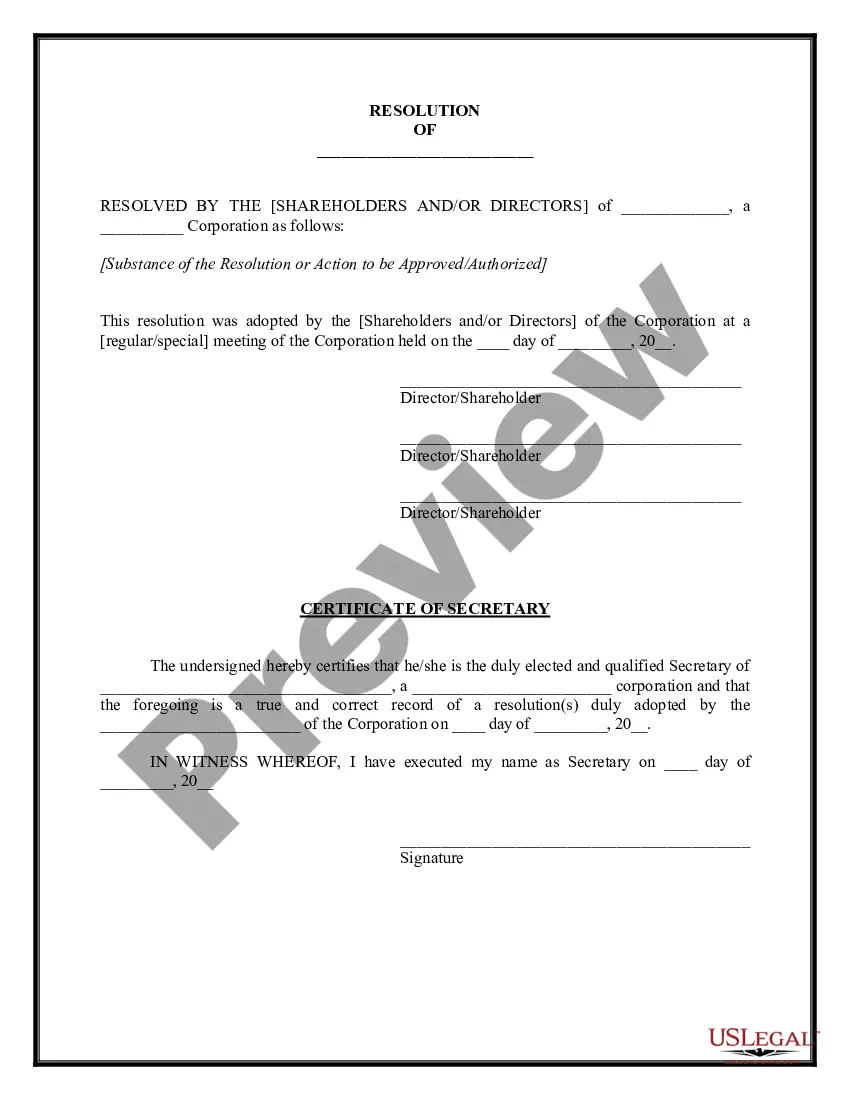
A resolution is a legally binding agreement or decision made by company members or directors. The outcome of a resolution is determined by the votes cast for and against the decision. If the required majority is reached, the resolution is 'passed'.
The notice handed over to the members prior to the meeting has to specifically mention on its agenda of the passing of a special resolution. In order for a special resolution to be passed at a General Meeting, a supermajority is required in favor of it.
A form of written resolutions of the directors of a company, for use where those directors wish to pass resolutions without holding a board meeting.
Resolutions begin with "Whereas" statements, which provides the basic facts and reasons for the resolution, and conclude with "Resolved" statements which, identifies the specific proposal for the requestor's course of action.
To write a board resolution, include: Title: Use the title to state that the document is a resolution clearly. Date: This should be the date the resolution is being proposed. Resolution Number: Give the resolution a unique identifier ing to your record-keeping system.

