Appointment For Director In Private Limited Company In California
Description

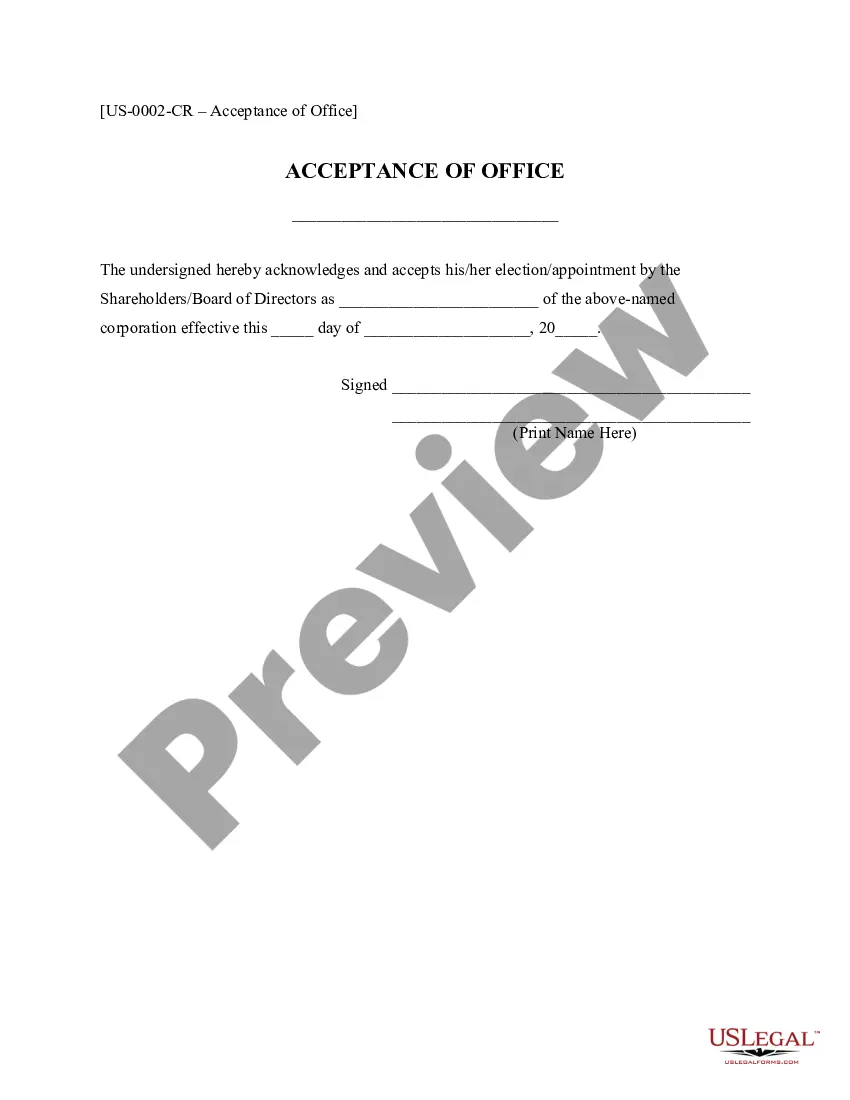

Get your form ready online
Our built-in tools help you complete, sign, share, and store your documents in one place.
Make edits, fill in missing information, and update formatting in US Legal Forms—just like you would in MS Word.
Download a copy, print it, send it by email, or mail it via USPS—whatever works best for your next step.
Sign and collect signatures with our SignNow integration. Send to multiple recipients, set reminders, and more. Go Premium to unlock E-Sign.
If this form requires notarization, complete it online through a secure video call—no need to meet a notary in person or wait for an appointment.
We protect your documents and personal data by following strict security and privacy standards.

Make edits, fill in missing information, and update formatting in US Legal Forms—just like you would in MS Word.

Download a copy, print it, send it by email, or mail it via USPS—whatever works best for your next step.

Sign and collect signatures with our SignNow integration. Send to multiple recipients, set reminders, and more. Go Premium to unlock E-Sign.

If this form requires notarization, complete it online through a secure video call—no need to meet a notary in person or wait for an appointment.

We protect your documents and personal data by following strict security and privacy standards.
Looking for another form?



Form popularity
FAQ
A company can seek approval from Central Government through 'MR-2' webform for approval of appointment of managing director or whole-time director or manager in certain special circumstances as mentioned in Schedule V of the Companies Act, 2013.
Appointment process of independent directors shall be independent of the company management; while selecting independent directors the Board shall ensure that there is appropriate balance of skills, experience and knowledge in the Board so as to enable the Board to discharge its functions and duties effectively.
(2) No company shall appoint or re-appoint any person as its managing director, whole-time director or manager for a term exceeding five years at a time: Provided that no re-appointment shall be made earlier than one year before the expiry of his term.
Section 149(1) of the Companies Act, 2013 requires that every company shall have a minimum number of 3 directors in the case of a public company, two directors in the case of a private company, and one director in the case of a One Person Company. A company can appoint maximum 15 fifteen directors.
The company may pass a resolution to appoint a director in an Annual General Meeting (AGM). If the company decides to appoint a director in the middle of the year, it may appoint a director by passing a resolution in an Extraordinary General Meeting (EGM).
The appointment can be made at the Annual General Meeting or an Extra-Ordinary General Meeting. All pertinent information for the procedure should be included in the notice for such a meeting, including the agenda for the appointment of the Director along with the consent letters and other necessary documents.
A company must file the following forms with the ROC to add a new director: MGT-14 – Resolution passed in the general meeting regarding the appointment of the director. DIR-2 – Consent received by the proposed director to hold the position of a director in the company. DIR-12 – Particulars of appointment of the director.
The company may pass a resolution to appoint a director in an Annual General Meeting (AGM). If the company decides to appoint a director in the middle of the year, it may appoint a director by passing a resolution in an Extraordinary General Meeting (EGM).
Directors are appointed by the shareholders or guarantors (members) who own the company. In many cases, particularly small companies, members appoint themselves as directors, thus taking full responsibility for running their own companies.
