360 Review Cost In King
Description

Get your form ready online
Our built-in tools help you complete, sign, share, and store your documents in one place.
Make edits, fill in missing information, and update formatting in US Legal Forms—just like you would in MS Word.
Download a copy, print it, send it by email, or mail it via USPS—whatever works best for your next step.
Sign and collect signatures with our SignNow integration. Send to multiple recipients, set reminders, and more. Go Premium to unlock E-Sign.
If this form requires notarization, complete it online through a secure video call—no need to meet a notary in person or wait for an appointment.
We protect your documents and personal data by following strict security and privacy standards.

Make edits, fill in missing information, and update formatting in US Legal Forms—just like you would in MS Word.

Download a copy, print it, send it by email, or mail it via USPS—whatever works best for your next step.

Sign and collect signatures with our SignNow integration. Send to multiple recipients, set reminders, and more. Go Premium to unlock E-Sign.

If this form requires notarization, complete it online through a secure video call—no need to meet a notary in person or wait for an appointment.

We protect your documents and personal data by following strict security and privacy standards.
Looking for another form?








Form popularity
FAQ
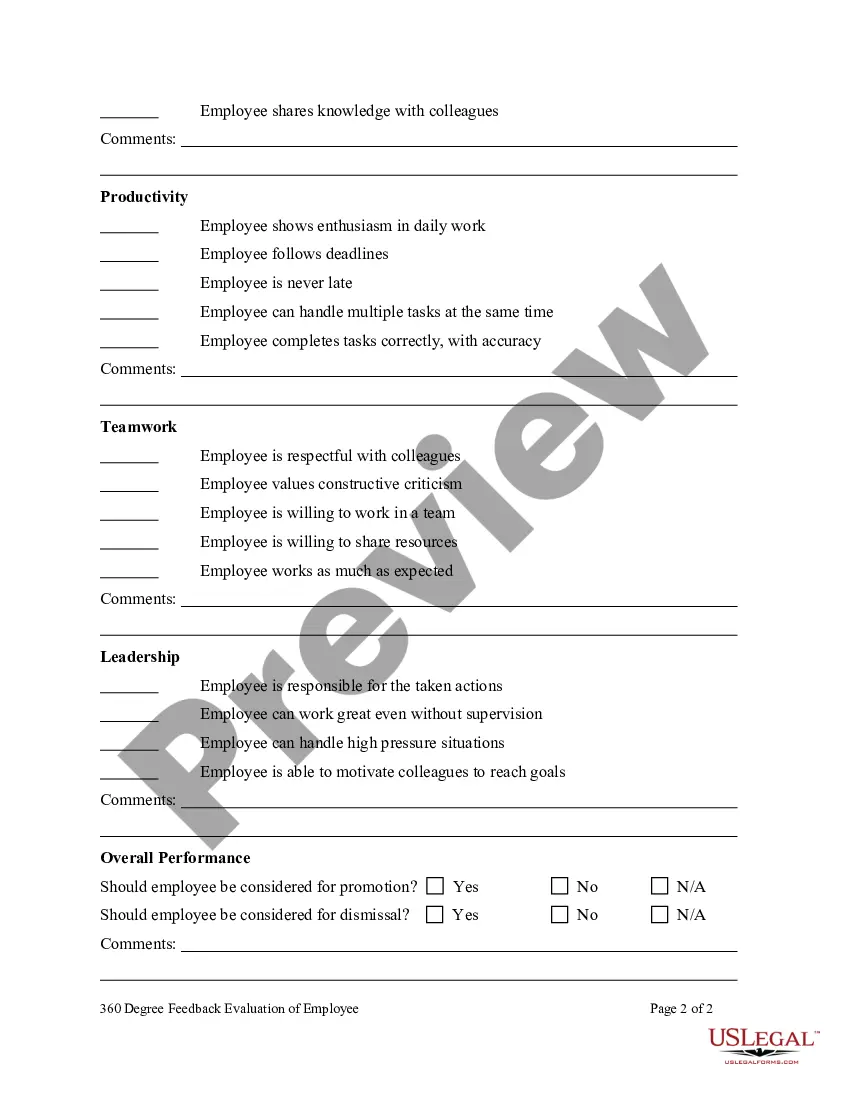
Positive 360 feedback examples The approach you have to resolving conflicts is commendable. Your active listening and tactful communication have helped to transform conflicts into opportunities for growth and team bonding.
How to conduct 360 reviews Establish criteria for rating each employee. Invest time into developing useful, relevant questions that provide valuable insight. Choose who will assess each employee. Send surveys. Send the survey to the employee. Schedule the 360 evaluation. Review ratings with employee. Follow up on progress.
A 360 review typically consists of managers receiving and analyzing employee feedback to look for notable patterns of behavior and positive/negative feedback and then creating a report. This can provide employees with constructive criticism without overwhelming them.
During the feedback process: Make it a two-way conversation and encourage questions. Remember that there are positives and negatives to each piece of feedback. Be objective, genuine, and non-judgmental. Use behavioral examples and refer to job context – and be specific.
7 steps for designing an effective 360 degree feedback review program Set clear goals. Train raters. Focus on natural strengths. Involve managers and leaders. Create buy-in and trust in the 360 development program. Know what to ask and how to ask it. Personalise the 360 degree feedback program to your organisation.
What are the 4 Components of 360-degree Performance Appraisal? Self-Assessment. Self-assessment is where the employee evaluates their performance. Peer Feedback. Incorporating peer feedback involves gathering input from colleagues who interact with the employee regularly. Manager Feedback. Subordinate Feedback.
360° reviews provide an opportunity for individuals to strengthen relationships with the people they work with. Seeing the positive feedback others share about them can create a sense of camaraderie while receiving insight about areas for improvement can help them become better team members.
10 Examples of 360-degree feedback Positive environment. “The positive environment you created in our workspace made an astounding positive impact. Appreciating the help. Good management. Clarity of instructions. Miscommunication issues. Increased workload. Handholding. Areas of improvement.
360 reviews are effective, but they require cooperation from multiple stakeholders, which can be time-intensive. Some sources may hesitate to respond to 360 reviews if they don't feel they know the subject well enough to share feedback. Others may feel they don't need to participate because “Someone else will do it.”
Some companies use peer-based review systems as an alternative to the 360-degree review. In this system, feedback is gathered from an employee's peers rather than from managers alone. This approach is believed to provide a more comprehensive and accurate view of an employee's performance.
