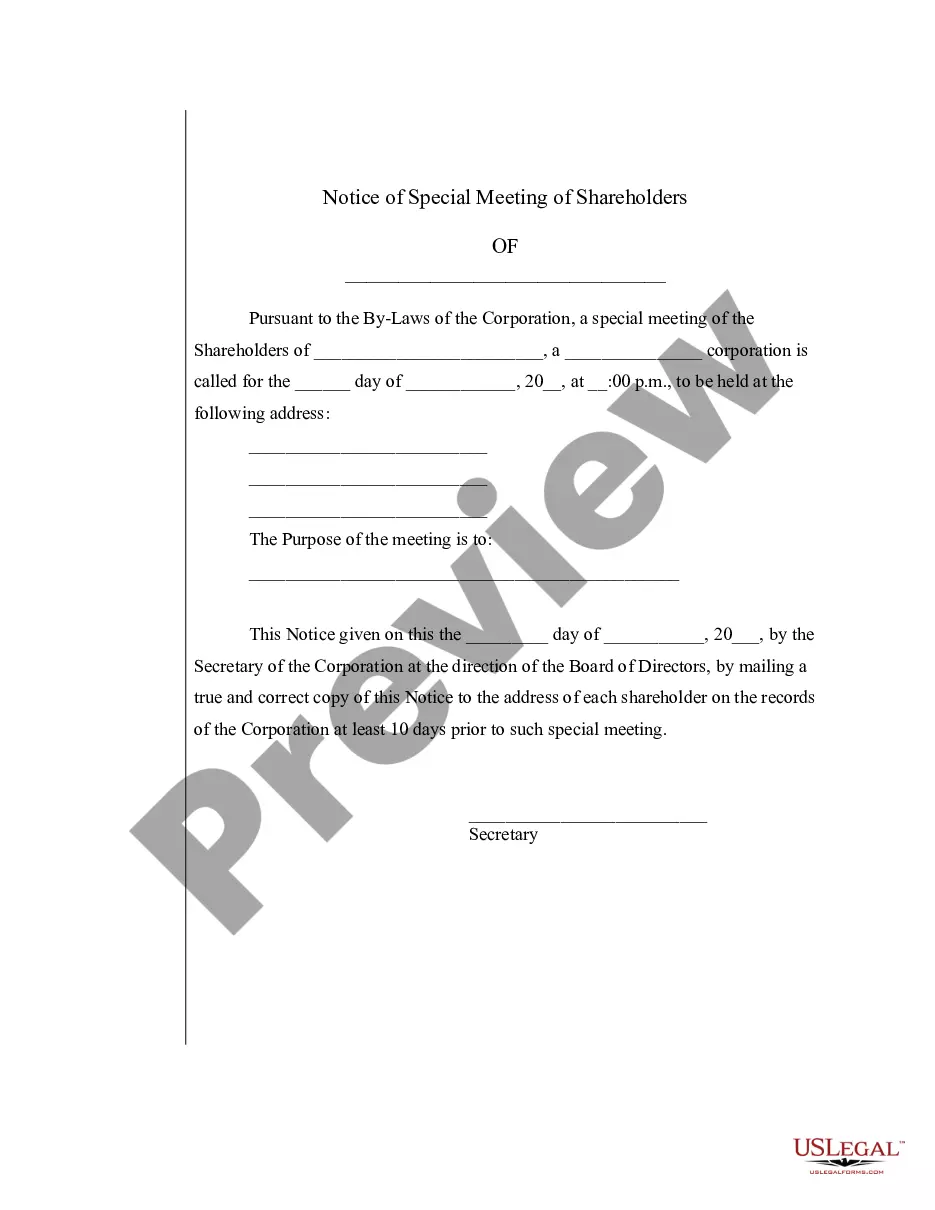
Special Meeting Sample With Client In North Carolina
Description



Get your form ready online
Our built-in tools help you complete, sign, share, and store your documents in one place.
Make edits, fill in missing information, and update formatting in US Legal Forms—just like you would in MS Word.
Download a copy, print it, send it by email, or mail it via USPS—whatever works best for your next step.
Sign and collect signatures with our SignNow integration. Send to multiple recipients, set reminders, and more. Go Premium to unlock E-Sign.
If this form requires notarization, complete it online through a secure video call—no need to meet a notary in person or wait for an appointment.
We protect your documents and personal data by following strict security and privacy standards.

Make edits, fill in missing information, and update formatting in US Legal Forms—just like you would in MS Word.

Download a copy, print it, send it by email, or mail it via USPS—whatever works best for your next step.

Sign and collect signatures with our SignNow integration. Send to multiple recipients, set reminders, and more. Go Premium to unlock E-Sign.

If this form requires notarization, complete it online through a secure video call—no need to meet a notary in person or wait for an appointment.

We protect your documents and personal data by following strict security and privacy standards.
Looking for another form?






Form popularity
FAQ
In addition to specifying the date, time and location of the meeting, special meeting notices should make note of all agenda items. Unless the bylaws indicate something different, board members should only be discussing the business that was stated in the notice for the special meeting.
Here are five steps to write a notice of meeting letter: Create a header. Start by creating a header for the notice of meeting letter. Write meeting information. Below the header, write a brief paragraph that includes the meeting's information. List the agenda. Conclude the letter. Revise the letter.
Prescribed Management Rule 53 deals with special general meetings (SGMs). ing to this rule trustees may convene a SGM whenever they feel it is necessary. The trustees must call a SGM if requested in writing to do so by either owners entitled to 25% of the total of the participation quotas of all sections.
A special meeting may be called any time by the Presiding Officer or by a majority of the members of the Commission or Committee.
1. A Shareholder Requests a Director to Call a Meeting. Shareholders can request the company directors to call a meeting. However, these shareholders must hold at least 5% of the votes to make this request.
Shareholders must be given clear advance notice of the meeting's date, time, place, and agenda, typically within a state-specified timeframe. A corporation's bylaws or certificate of incorporation may allow the board, executives, or qualifying shareholders to call a special meeting.
A special meeting is a gathering of people that is called for a specific purpose or reason. It is different from a regular meeting because it is not scheduled in advance and is only held when necessary.
Like many other states, North Carolina enacted a stand your ground law in 2011. Under N.C.G.S. 14.51. 3, individuals have the right to defend themselves using deadly in their homes, motor vehicles, and workplaces.
North Carolina has two Sunshine Laws to promote transparency in government: the Open Meetings Law and the Public Records Law. These laws give the public the right to attend meetings and to access documents deemed a public record.
It is different from a regular meeting, which is held on a regular schedule. For example, a company may call a special meeting to discuss a major decision, such as a merger or acquisition. A school board may call a special meeting to address a specific issue, such as a budget shortfall.

